SAP Innovation
Exploring Joule Studio with JEV for Autonomous Enterprise AI Agents
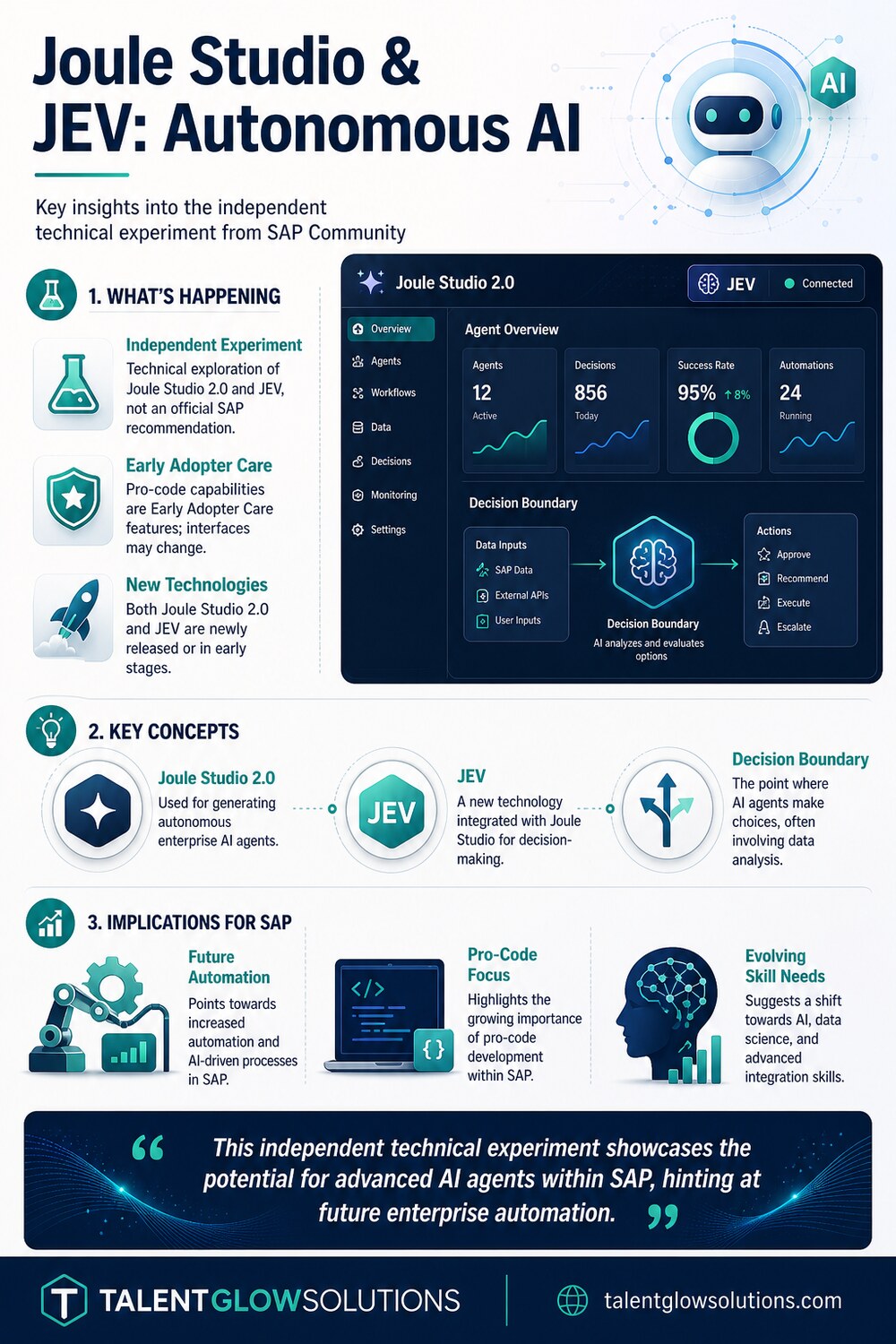
On September 25, 2026, the SAP Community's Technology blogs published an article detailing an independent technical experiment: "Joule Studio with JEV at the Decision Boundary for Autonomous Enterprise AI Agents." This article provides an early look into how these new technologies might shape the future of enterprise automation within the SAP ecosystem. It's crucial to note this is an independent exploration, not an official SAP endorsement, and features discussed are part of Early Adopter Care, meaning they are subject to change before general availability.
What is Joule Studio with JEV?
Joule Studio 2.0 is the version of Joule Studio used in this experiment, focusing on the generation of autonomous enterprise AI agents. These agents are designed to perform tasks independently, leveraging artificial intelligence to make decisions. The integration of JEV, a newly released technology, is central to these agents' decision-making capabilities, particularly at what is termed the 'decision boundary'.
The concept of a decision boundary refers to the point where an AI agent evaluates various inputs and makes a choice or takes an action. In the context of enterprise applications, this could involve automating complex processes like invoice verification or payment release. The experiment specifically highlights the use of mocked invoice and vendor data to demonstrate how an AI agent could release a block, making an invoice eligible for payment.
How Autonomous AI Agents Work in This Experiment
The experiment outlines a pro-code approach, utilizing capabilities described as Early Adopter Care features. This means developers use code to configure and deploy these AI agents, giving them precise control over their behavior and decision logic. The focus is on demonstrating the potential for sophisticated automation.
For instance, an autonomous AI agent could be trained to analyze incoming invoices. It would assess various parameters, such as vendor details, payment terms, and historical data, to decide whether to release a payment block. This process does not execute the payment itself but makes the invoice ready for the next stage in the procure-to-pay cycle.
Key Technical Considerations and Limitations
As an independent technical experiment, the demonstration emphasizes that commands, interfaces, and availability of Joule Studio 2.0 and JEV may change. This is typical for technologies in Early Adopter Care, which are still under development and refinement. Users interested in these capabilities should anticipate potential shifts in functionality and implementation methods.
Another important aspect is the use of mocked data. All invoice and vendor data used in the demonstration is artificial, ensuring no real-world financial information is processed. This is a standard practice in early-stage technical experiments to focus on functionality without legal or privacy complications. It also means the results are illustrative rather than reflective of live system performance.
Understanding the Decision Boundary
The decision boundary is a critical concept in this experiment, representing the point where the AI agent's logic determines an outcome. This could involve complex algorithms that weigh various factors to arrive at a 'yes' or 'no' decision, such as approving an action or flagging an anomaly. For example, an agent might decide to release an invoice block if all predefined conditions are met.
This boundary is where the intelligence of the AI agent truly comes into play, moving beyond simple rule-based automation. It implies a level of adaptability and learning, allowing the system to handle variations and make more nuanced judgments over time. Understanding how to define and manage these boundaries will be crucial for effective AI agent deployment.
Implications for SAP Professionals and Learners
This news about Joule Studio with JEV at the Decision Boundary for Autonomous Enterprise AI Agents signals a future where SAP systems are even more integrated with advanced AI. For SAP learners and professionals, this means an increasing demand for skills in AI, machine learning, and pro-code development within the SAP ecosystem. Understanding how to work with and develop these autonomous agents will become a valuable asset.
SAP professionals specializing in modules like FICO, MM, and SD, where processes like invoice verification and procurement are central, will find these developments particularly relevant. The ability to integrate and manage AI agents that automate such tasks could significantly enhance efficiency and accuracy. Embracing these emerging technologies will be key to staying competitive.
| Feature | Description | Impact on SAP Professionals |
|---|---|---|
| Joule Studio 2.0 | Platform for generating autonomous enterprise AI agents. | Requires understanding of AI agent development and configuration. |
| JEV Technology | New technology aiding AI agent decision-making. | Implies learning new integration methods and AI logic. |
| Decision Boundary | Point where AI agents make critical choices. | Focus on designing and refining AI decision-making processes. |
| Pro-Code Capabilities | Emphasizes coding for AI agent development. | Strong coding skills (e.g., ABAP, Python) become increasingly vital for customization. |
| Early Adopter Care | Features are in development and subject to change. | Need to stay updated with SAP's evolving AI roadmap and documentation. |
How to Prepare for the Future of SAP AI
Staying current with SAP's technological advancements, especially in AI and automation, is essential for a successful career. Engaging with resources like the SAP Community, attending webinars, and exploring official SAP documentation can provide valuable insights. Hands-on experience with new tools as they become available will be crucial.
For those looking to build a foundation in SAP and prepare for these future trends, comprehensive training is vital. TalentGlowSolutions offers mentor-led, project-based training on a live S/4HANA system across seven core SAP modules: FICO, MM, SD, PP, EWM, BASIS, and ABAP. This training approach helps learners develop practical skills relevant to both current and emerging SAP technologies.
What Does This Mean for Enterprise Automation?
This experiment suggests a significant shift towards more sophisticated enterprise automation. Autonomous AI agents, powered by Joule Studio and JEV, could handle routine yet complex tasks, freeing up human resources for more strategic initiatives. This could lead to substantial improvements in operational efficiency, data accuracy, and compliance within large organizations.
The potential for these agents to operate at the 'decision boundary' means they can go beyond simple task execution, making informed judgments based on vast amounts of data. This capability could revolutionize how businesses manage everything from supply chain logistics to financial operations, making them more agile and responsive to market changes. The future of SAP is clearly moving towards a more intelligent, automated enterprise.
Sources
Frequently asked questions
What is the significance of Joule Studio with JEV?
The independent experiment with Joule Studio 2.0 and JEV demonstrates the potential for autonomous enterprise AI agents within SAP, focusing on automated decision-making for complex tasks like invoice processing.
Is this an official SAP product release?
No, the SAP Community article explicitly states this is an independent technical experiment, not an official SAP recommendation. The features discussed are part of Early Adopter Care and may change before general availability.
What kind of data was used in the demonstration?
All invoice and vendor data used in this demonstration was mocked. This means it was artificial data, not real-world financial information, used purely for experimental purposes.
How does this impact SAP careers?
This development highlights the growing importance of AI, machine learning, and pro-code development skills for SAP professionals. Those with expertise in these areas, especially within core SAP modules, will be well-positioned for future roles in enterprise automation.
What is the 'decision boundary' in this context?
The 'decision boundary' refers to the point where an autonomous AI agent evaluates various inputs and makes an informed choice or takes a specific action, such as releasing an invoice block or approving a process step.
Ready to launch your career?
Prepare for the evolving SAP landscape with our mentor-led, project-based training, offering 100% placement assistance (we do not guarantee a job).
Explore Programs Talk to us