Career Guidance
SAP EWM vs. MM Training: Picking Your Path in Warehouse Management
Deciding on an SAP module can feel like navigating a complex maze, especially when both SAP EWM and MM seem relevant to warehouse and logistics operations. Many aspiring professionals find themselves at a crossroads, unsure whether to pursue SAP EWM or MM training. This article aims to clarify the distinctions, helping you make an informed choice that aligns with your career aspirations in the SAP ecosystem.
What is SAP MM and What Does it Cover?
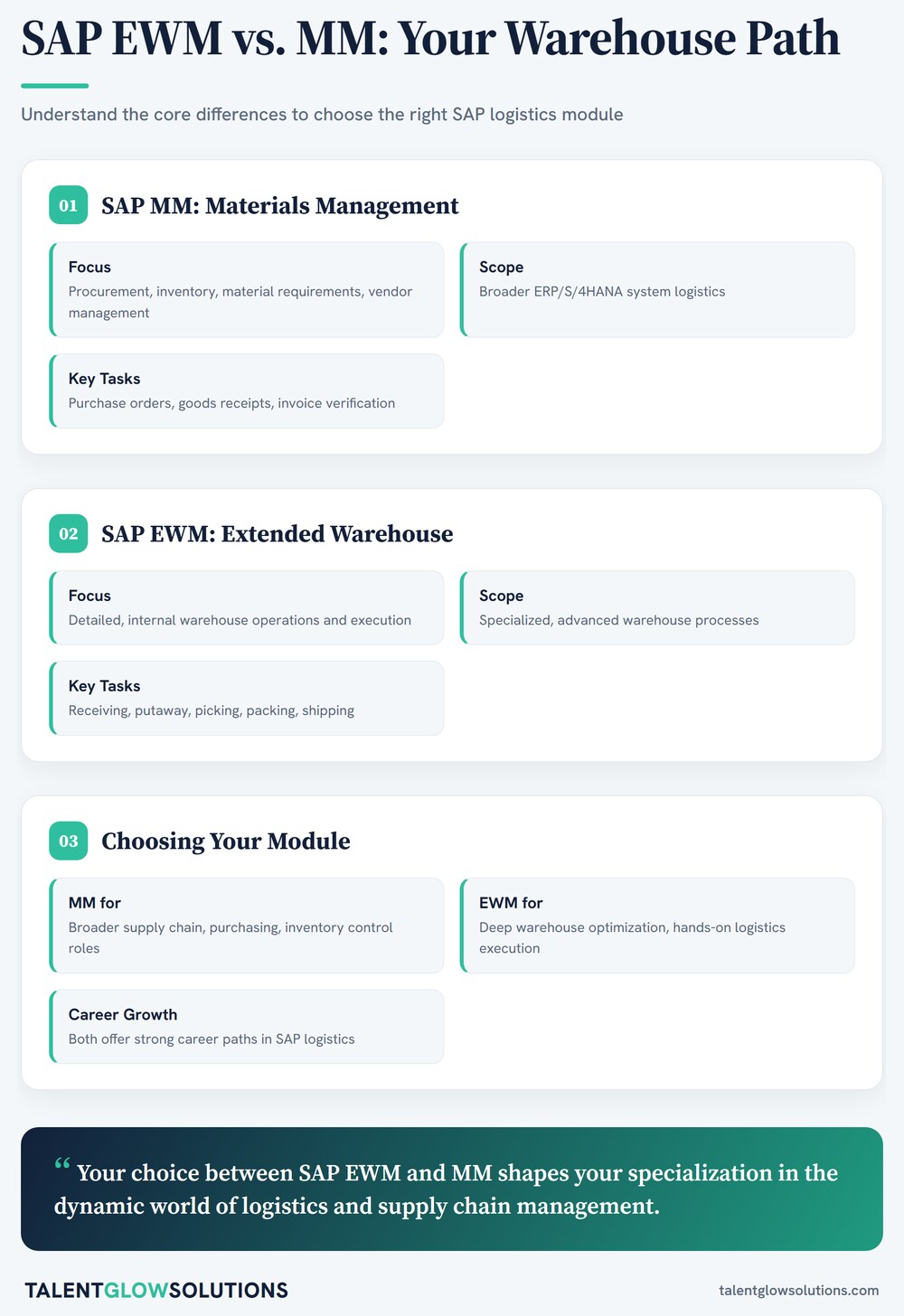
SAP MM (Materials Management) is a core module within the broader SAP ERP or S/4HANA system. It primarily focuses on the entire lifecycle of materials within an organization, from procurement to inventory management. This module ensures that materials are always available without excess or shortage.
Its functionalities span several key areas. These include managing material master data, handling vendor selection and purchase orders, overseeing goods receipts and invoice verification, and conducting inventory management tasks. Essentially, MM supports all phases of material planning and execution outside the detailed warehouse floor.
What is SAP EWM and What Does it Cover?
SAP EWM (Extended Warehouse Management) is a specialized module designed for highly detailed warehouse operations and execution. Unlike MM, EWM dives deep into the internal workings of a warehouse, managing the entire lifecycle of goods once they are inside the warehouse facility. It handles intricate processes that standard MM might not cover.
EWM's capabilities include advanced inbound and outbound processing, detailed putaway and picking strategies, internal warehouse movements, physical inventory, and value-added services. It provides granular control over warehouse resources and tasks, optimizing efficiency and accuracy within large, complex warehouse environments.
How Do SAP EWM and MM Differ in Scope?
The primary difference lies in their scope and level of detail. SAP MM operates at a higher, more strategic level, focusing on the overall flow of materials across the supply chain. It manages the business processes related to purchasing and inventory control from a broader enterprise perspective.
SAP EWM, conversely, operates at a very granular, operational level within the four walls of a warehouse. It handles the physical movement and storage of goods, optimizing every step of warehouse execution. Think of MM as managing what to procure and how much inventory to hold, while EWM manages how those materials are handled inside the warehouse.
Here's a comparison table to highlight the key distinctions:
| Feature | SAP MM (Materials Management) | SAP EWM (Extended Warehouse Management) |
|---|---|---|
| Primary Focus | Procurement, Inventory Management, Vendor Management | Detailed Warehouse Operations, Execution, Optimization |
| Level of Detail | Broader, strategic supply chain processes | Granular, operational within the warehouse |
| Key Processes | Purchase Requisition, Purchase Order, Goods Receipt, Invoice Verification | Inbound Processing, Putaway, Picking, Packing, Outbound Processing |
| Integration | Core ERP/S/4HANA module, integrates with Finance, Production | Integrates with S/4HANA, often deployed as a separate system |
| Typical Role | Procurement Analyst, Inventory Manager, Supply Chain Consultant | EWM Consultant, Warehouse Solution Architect, Logistics Specialist |
Which Module is Right for Your Career Goals?
Choosing between SAP EWM and MM training depends heavily on your career interests and desired specialization. If you are drawn to the broader aspects of supply chain management, including purchasing, vendor relations, and overall inventory control, then SAP MM is likely a better fit. MM professionals often work in roles that involve strategic sourcing, material planning, and ensuring the smooth flow of goods into and out of the enterprise at a high level.
If your passion lies in optimizing the physical flow of goods, managing complex warehouse layouts, and implementing advanced logistics strategies on the ground, then SAP EWM training would be more suitable. EWM roles often involve configuring and managing automated warehouses, optimizing picking routes, and ensuring high efficiency in storage and retrieval operations. Consider if you prefer the strategic 'why' of materials or the operational 'how' of physical goods.
What Kind of Training is Available for SAP EWM or MM?
For those looking to enter the SAP ecosystem, comprehensive training is crucial. Programs typically cover the core functionalities of the chosen module, offering both theoretical knowledge and practical application. Mentor-led training on a live S/4HANA system is highly beneficial, allowing learners to gain hands-on experience with real-world scenarios. This type of training helps bridge the gap between academic understanding and industry demands, preparing you for immediate contributions in a professional setting.
Training often includes project-based learning, where participants work through case studies that simulate actual business processes. This practical approach solidifies understanding and builds confidence in navigating the SAP environment. Such training can also include support for job searching, offering guidance and insights into the hiring process. TalentGlowSolutions, for instance, offers training in both SAP EWM and MM, providing mentor-led, project-based instruction on a live S/4HANA system to prepare learners for the industry.
What are the Career Prospects for SAP EWM and MM?
Both SAP EWM and MM consultants are in high demand across various industries. Companies that rely on efficient supply chains, manufacturing, retail, and logistics all seek professionals skilled in these SAP modules. Your choice will influence the specific types of roles you pursue, but both paths offer robust career growth opportunities.
SAP MM roles might include Procurement Consultant, Inventory Manager, or Material Management Analyst. These positions focus on optimizing purchasing processes and maintaining inventory levels. SAP EWM roles, on the other hand, often lead to positions like EWM Consultant, Warehouse Solution Architect, or Logistics Execution Specialist, focusing on the intricacies of warehouse automation and efficiency. The demand for SAP professionals continues to grow as more companies adopt and optimize their S/4HANA systems.
How to Get Started with SAP EWM or MM Training?
- Assess Your Interests: Reflect on whether you are more interested in the broader procurement and inventory strategy (MM) or the detailed, physical operations within a warehouse (EWM).
- Research Training Providers: Look for institutes that offer mentor-led, project-based training on a live S/4HANA system. Verify their curriculum covers the latest industry practices.
- Understand Certification: While training completion certificates are valuable, be aware that SAP's own certification is a separate exam set and priced by SAP. Training providers typically prepare you for this exam and help with the setup.
- Inquire About Support: Ask about any provided support for job searching. While no institution can guarantee a job, guidance and mentorship during your career transition can be incredibly helpful. TalentGlowSolutions offers 100% placement assistance, though we do not guarantee a job, focusing instead on mentorship and skill development.
- Connect with Professionals: Network with current SAP EWM and MM professionals on platforms like LinkedIn to gain insights into their daily work and career paths. This can provide valuable real-world perspective.
By carefully considering these factors, you can confidently choose the SAP module that best aligns with your professional ambitions and embark on a rewarding career in SAP logistics.
Sources
Frequently asked questions
Is SAP EWM a part of SAP MM?
No, SAP EWM is not a part of SAP MM. While both modules deal with logistics, SAP MM focuses on broader materials management and procurement, whereas SAP EWM is a specialized, standalone module for advanced, detailed warehouse operations.
Can I learn both SAP EWM and MM?
Yes, it is possible to learn both SAP EWM and MM. Many professionals find that having expertise in both modules provides a comprehensive understanding of the entire supply chain, from procurement to detailed warehouse execution, opening up more diverse career opportunities.
Which module is easier to learn, EWM or MM?
Generally, SAP MM is considered to have a slightly less complex learning curve initially due to its broader, more foundational nature in ERP. SAP EWM, with its focus on highly detailed and advanced warehouse processes, can be more intricate, but both require dedicated study and practice.
What kind of companies use SAP EWM and MM?
Companies across various industries use SAP EWM and MM, especially those with complex supply chains and large inventory needs. This includes manufacturing, retail, automotive, pharmaceutical, and logistics service providers who need efficient procurement, inventory, and warehouse management.
Ready to launch your career?
Our mentor-led training on a live S/4HANA system can provide the foundational knowledge and practical skills you need to excel in either SAP EWM or MM.
Explore Programs Talk to us