Career Paths
SAP Training for Commerce & Finance Graduates: Beyond Engineering
Many commerce and finance graduates believe that a career in SAP is exclusively for engineering or IT professionals. This is a common misconception. In reality, your background in commerce, accounting, or finance provides a strong foundation for excelling in specific SAP modules, particularly SAP FICO.
SAP FICO (Financial Accounting and Controlling) directly aligns with the core knowledge you've gained from your B.Com or M.Com degree. Understanding financial statements, debit and credit principles, and the intricacies of the vendor/customer invoice cycle are not just beneficial; they are essential prerequisites that give you a significant advantage in this field.
Why is SAP FICO ideal for commerce and finance graduates?
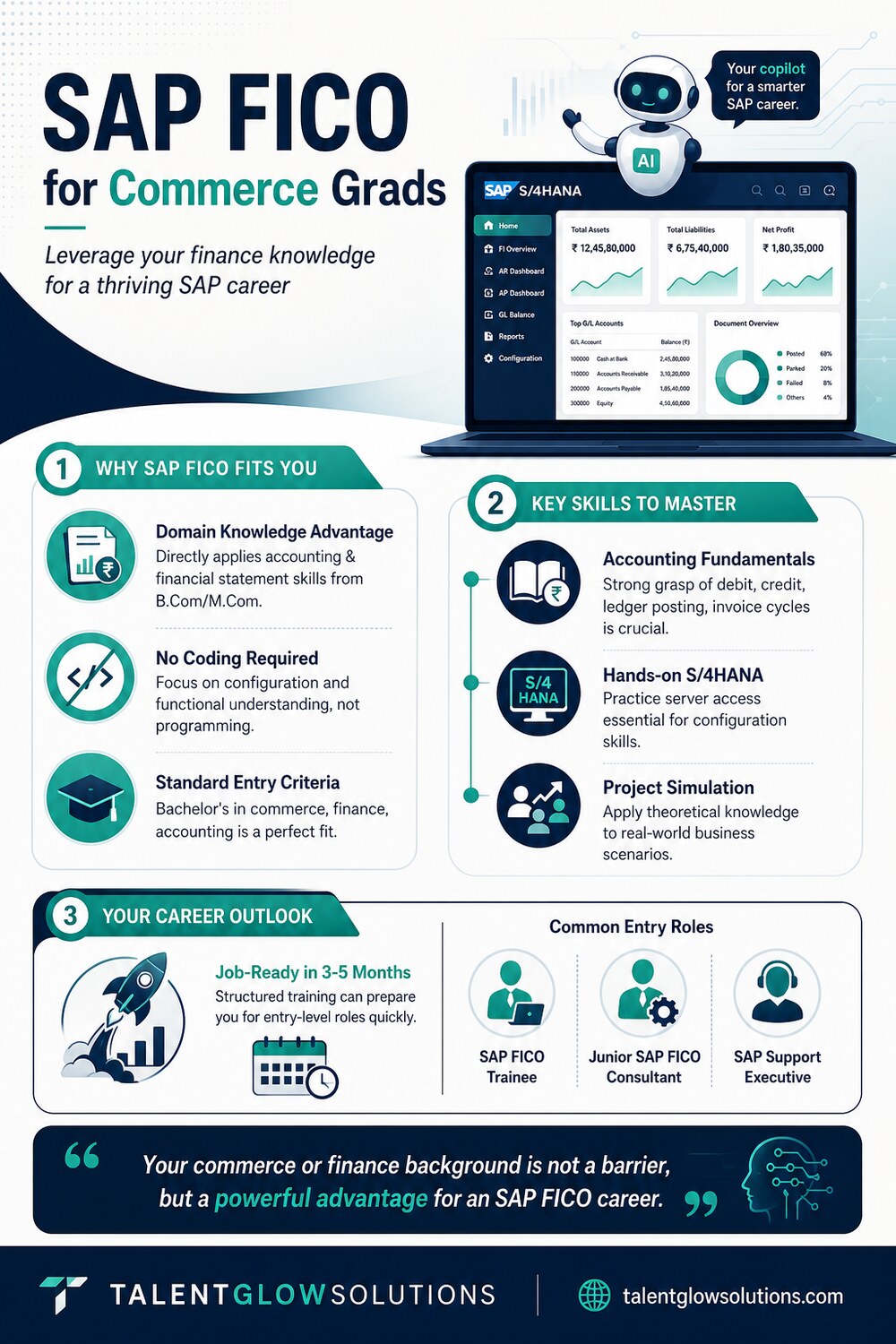
SAP FICO is an excellent fit for individuals with a commerce or finance background because it leverages existing domain knowledge. Unlike some other SAP modules or IT roles, SAP FICO is a functional module, meaning its primary focus is on business processes and configuration, not coding. This makes it highly accessible for those without a programming or engineering degree.
Your academic understanding of accounting and financial management directly translates to how SAP FICO structures financial data and processes. This existing knowledge base significantly shortens the learning curve for understanding the business logic within the SAP system. For example, concepts like general ledger posting or accounts payable are already familiar territory, allowing you to focus on how SAP executes these functions.
What are the eligibility criteria for SAP FICO training?
To pursue SAP FICO training, a bachelor's degree in commerce, finance, accounting, or business administration is typically a standard entry criterion. This academic foundation ensures you possess the fundamental business and financial understanding necessary to grasp SAP FICO concepts effectively. The curriculum is built upon these core principles, making your prior education directly relevant.
While a strong academic record is beneficial, the most crucial aspect is a clear understanding of accounting fundamentals. This includes concepts such as debit and credit, ledger posting, and the entire vendor/customer invoice cycle. Without these basics, even the most comprehensive SAP FICO training will be challenging to fully absorb (entri.app).
Does SAP FICO require coding skills?
No, SAP FICO does not require coding skills. This is a significant advantage for commerce and finance graduates who may not have an IT or programming background. The role of an SAP FICO consultant primarily involves configuring the system to meet specific business requirements, managing financial processes, and supporting end-users.
While some advanced customization might involve collaboration with an ABAP programmer, your core responsibilities will revolve around understanding business processes and translating them into SAP configurations. This means your focus will be on functional knowledge and system setup, not writing lines of code (mythinktree.com).
What kind of training is most effective for SAP FICO?
Effective SAP FICO S/4HANA training should be structured and hands-on. It's crucial to gain access to a practice server, as configuring the system is a skill learned by doing, not just by theoretical study. This practical experience allows you to apply what you learn in a simulated real-world environment, reinforcing concepts and building confidence.
Training programs that include project simulation are particularly valuable. These simulations mimic actual business scenarios, allowing you to practice end-to-end financial processes within SAP. Mentor-led guidance on a live S/4HANA system, such as that offered by TalentGlowSolutions, ensures you receive expert support as you navigate complex configurations and troubleshoot issues.
How long does it take to become job-ready in SAP FICO?
Most commerce graduates can become job-ready in SAP FICO within 3 to 5 months of structured training. This timeline is achievable when the training includes comprehensive hands-on system access and project simulation. The rapid progress is largely due to your existing financial domain knowledge, which provides a significant head start.
The intensity and quality of the training program play a critical role in this timeline. A well-designed curriculum that focuses on practical application and real-world scenarios will accelerate your learning process, preparing you for entry-level roles efficiently (spanbix.com).
What are common entry-level SAP FICO roles?
For freshers entering the SAP FICO field, several common entry-level roles are available. These positions allow you to gain valuable experience and further develop your skills within an organizational setting. Understanding these roles helps you target your job search effectively.
Entry-level SAP FICO roles often include: * SAP FICO Trainee: A position focused on learning the ropes under supervision. * SAP Support Executive: Providing first-level support to end-users on SAP FICO issues. * Junior SAP FICO Consultant: Assisting senior consultants with configuration, testing, and documentation. * SAP End User: Operating the SAP FICO module for daily financial tasks within a company.
These roles are crucial stepping stones for building a successful career as a full-fledged SAP FICO consultant (bestonlinecareer.com).
SAP FICO vs. Other SAP Modules for Commerce Graduates
While SAP FICO is a prime choice, it's helpful to understand how it compares to other functional SAP modules that might also appeal to commerce graduates. Each module serves a different business function, and your specific interests might guide your choice.
| Feature | SAP FICO (Financial Accounting & Controlling) | SAP MM (Materials Management) | SAP SD (Sales & Distribution) |
|---|---|---|---|
| Primary Focus | Managing financial transactions, general ledger, accounts payable/receivable. | Procuring goods and services, inventory management, vendor relationships. | Managing sales orders, deliveries, billing, customer interactions. |
| Domain Link | Direct link to B.Com/M.Com accounting, finance, auditing. | Supply chain, purchasing, logistics, inventory control. | Sales, marketing, customer service, order fulfillment. |
| Coding Required? | No coding required for functional roles. | No coding required for functional roles. | No coding required for functional roles. |
| Key Skills | Accounting fundamentals, financial reporting, cost accounting. | Procurement processes, inventory control, vendor master data. | Sales process, pricing, customer master data, logistics. |
| Career Path | FICO Consultant, Finance Analyst, SAP End User. | MM Consultant, Procurement Specialist, Inventory Manager. | SD Consultant, Sales Coordinator, Customer Service Lead. |
This comparison highlights that while FICO is a natural fit, other functional modules like MM and SD also have strong ties to business operations that commerce graduates often study. TalentGlowSolutions offers mentor-led training in a range of SAP modules, including FICO, MM, SD, PP, EWM, BASIS, and ABAP, allowing you to choose the best fit for your career aspirations.
How does SAP FICO training prepare you for the real world?
SAP FICO training prepares you for real-world application by focusing on practical scenarios and system configuration. The goal is to equip you with the skills to implement and manage financial processes within an SAP environment. This involves understanding how to set up company codes, chart of accounts, and manage various financial transactions.
Beyond technical configuration, training often includes understanding business requirements and translating them into SAP solutions. This problem-solving aspect is crucial for any consultant role. By the end of a comprehensive program, you should be able to navigate the S/4HANA system, perform critical financial tasks, and contribute effectively to a business's finance department.
What are the benefits of pursuing SAP FICO with a commerce background?
Pursuing SAP FICO with a commerce background offers several distinct benefits. Firstly, your existing conceptual understanding of finance and accounting principles gives you a significant edge in comprehending how SAP processes these operations. You won't be starting from scratch on the business logic, only on the system's execution of it.
Secondly, this path opens doors to specialized roles that blend IT and finance, which are increasingly in demand across industries. You become a bridge between the finance department and IT, a highly valued position. Your ability to speak both business and system language makes you an invaluable asset to any organization using SAP (elearningsolutions.co.in).
What about SAP certification fees?
SAP certification fees are set by SAP directly and can vary based on the country and specific certification. These fees are separate from any training course fees. TalentGlowSolutions focuses on providing comprehensive training to prepare you for the SAP certification exam, and our mentors can guide you through the process of registering and attempting it.
For current SAP certification exam costs, it is best to check the official SAP certification website or consult with your training provider. They can provide the most up-to-date information regarding fees and registration procedures. Training institutes like TalentGlowSolutions do not set or collect these fees.
Conclusion: Your Path to SAP FICO Success
For commerce and finance graduates, the path to a successful SAP career, particularly in SAP FICO, is clear and well-defined. Your domain expertise is not just relevant; it's a powerful asset that positions you for rapid learning and career growth. By focusing on practical, hands-on training, you can quickly transition into a specialized and rewarding role within the SAP ecosystem.
Embrace the opportunity to merge your financial acumen with cutting-edge enterprise software. The demand for skilled SAP FICO professionals remains strong, and your unique background makes you a highly competitive candidate in this field. Start building your expertise today and unlock new career possibilities.
Sources
- SAP Career Path for Commerce Graduates
- What SAP Course is Best For B.Com Graduates?
- Non IT Students Learn SAP
- SAP Courses for Non-IT Students 2026
- SAP FICO Course Eligibility, Syllabus, Career Scope & Salary
- SAP FICO Consulting Career Path: Step-by-Step Guidelines
- SAP FICO Certification
- SAP FICO Course Eligibility
- SAP FICO Jobs in USA
Frequently asked questions
Is SAP FICO only for IT professionals?
No, SAP FICO is primarily a functional module, making it ideal for commerce and finance graduates. It focuses on business processes and configuration, not coding, directly leveraging your accounting and financial knowledge.
What kind of accounting knowledge is needed for SAP FICO?
A strong understanding of accounting fundamentals like debit and credit, ledger posting, and the vendor/customer invoice cycle is crucial. This foundational knowledge helps you grasp how SAP processes financial transactions.
Can I get a job in SAP FICO without an engineering degree?
Absolutely. A bachelor's degree in commerce, finance, accounting, or business administration is a standard entry criterion for SAP FICO training. Your domain knowledge is a significant advantage for entry-level roles like Junior SAP FICO Consultant or SAP Support Executive.
How important is hands-on practice in SAP FICO training?
Hands-on practice on a live S/4HANA system is extremely important. Configuration skills are learned by doing, not just by theory. Effective training includes practical exercises and project simulations to solidify your understanding.
What is the typical duration to become job-ready in SAP FICO?
With structured training that includes hands-on system access and project simulation, most commerce graduates can become job-ready in SAP FICO within 3 to 5 months due to their relevant existing knowledge.
Ready to launch your career?
Ready to transform your finance expertise into an in-demand SAP FICO career? Explore TalentGlowSolutions's mentor-led, project-based training with dedicated placement assistance.
Explore Programs Talk to us