Career Guidance
Navigating the AI Shift: Will AI Replace Entry-Level Tech Jobs in 2026?
The tech landscape is constantly evolving, and the rise of Artificial Intelligence (AI) is undoubtedly one of the most significant disruptors of our time. Many aspiring tech professionals are asking: will AI replace entry-level tech jobs in 2026? This is a valid concern, as the data indicates a clear shift in hiring trends. Understanding these changes and proactively adapting your skillset is key to staying competitive and launch a successful career in tech.
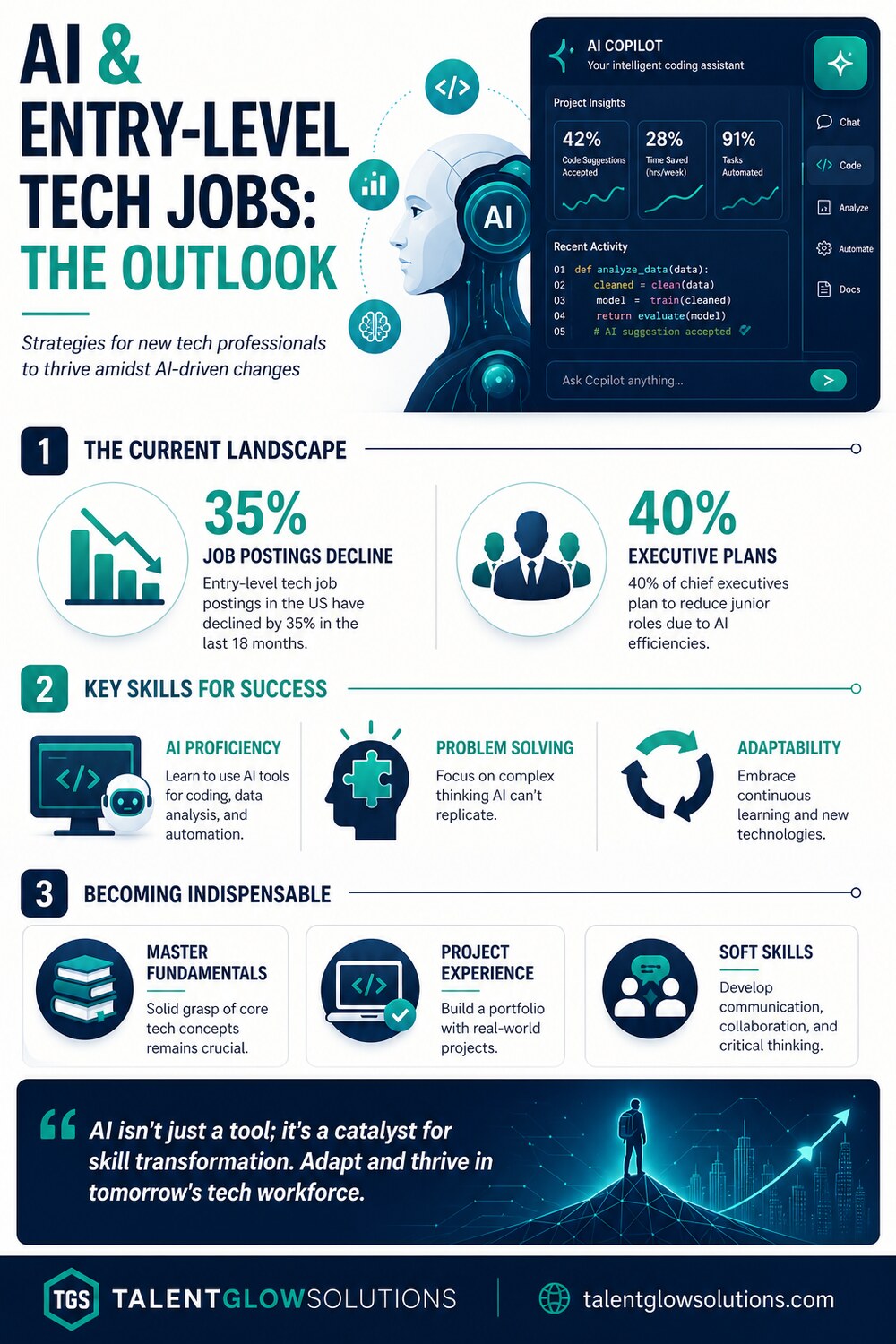
Over the past 18 months, entry-level tech job postings in the US have seen a significant decline of 35%. This trend is largely attributed to the increasing capabilities of AI, which can automate tasks traditionally performed by junior staff. It's not just a temporary blip; this represents a fundamental change in how companies operate and what skills they value.
The Executive View on Junior Roles
Business leaders are actively planning for an AI-driven future. 40% of chief executives plan to reduce junior roles in the next year or two. This decision stems from the efficiencies and cost savings AI can bring to various business functions. Companies are looking to leverage AI to streamline operations, which often means fewer hands are needed for repetitive or foundational tasks.
This doesn't mean entry-level jobs will disappear entirely, but their nature is changing. New professionals must be equipped to work alongside AI, not compete with it. The focus is shifting from performing basic tasks to managing and leveraging AI tools effectively.
Why AI is Impacting Entry-Level Roles
AI's impact on junior positions is multifaceted. It excels at tasks that are rule-based, data-intensive, and repetitive. These often form the core responsibilities of entry-level roles.
Consider these examples:
- Data Entry & Cleaning: AI algorithms can process and clean large datasets much faster and with fewer errors than humans.
- Basic Coding: Tools like GitHub Copilot can generate code snippets, complete functions, and even debug, accelerating development cycles.
- Customer Support: AI-powered chatbots handle routine inquiries, freeing up human agents for complex issues.
- Quality Assurance: AI can automate testing processes, identifying bugs and vulnerabilities more efficiently.
This automation allows senior professionals to focus on higher-value activities, but it also raises the bar for new entrants.
Adapting Your Skillset: The AI Proficiency Imperative
To thrive in this new environment, AI proficiency is no longer optional; it's essential. This means not just knowing about AI, but knowing how to use AI tools in your specific tech domain.
Here's how AI proficiency translates across different tech fields:
- Full-stack Development: Utilize AI code assistants (e.g., GitHub Copilot, Tabnine) for faster development, bug detection, and boilerplate generation. Learn to integrate AI APIs into applications.
- Data & AI: Master AI/ML libraries (e.g., scikit-learn, TensorFlow, PyTorch) for data analysis, model building, and predictive analytics. Understand prompt engineering for large language models (LLMs) to extract insights.
- Cloud/DevOps: Leverage AI-powered monitoring tools (e.g., Datadog, Dynatrace) for anomaly detection and predictive maintenance. Automate infrastructure management tasks using AI scripts.
- Cybersecurity: Employ AI-driven threat detection systems and security orchestration, automation, and response (SOAR) platforms to identify and mitigate cyber threats more effectively.
- SAP & ServiceNow: Use AI features within these platforms for process automation, intelligent recommendations, and enhanced user experiences.
The Enduring Value of Core Fundamentals
While AI proficiency is critical, it doesn't negate the need for strong foundational tech skills. AI tools are powerful, but they are tools nonetheless. A deep understanding of underlying principles allows you to use AI intelligently, troubleshoot issues, and build innovative solutions.
| Skill Category | Importance with AI |
|---|---|
| Core Programming | Essential for understanding AI-generated code and custom development. |
| Data Structures | Crucial for efficient data handling and algorithm design, even with AI assistance. |
| Networking | Fundamental for understanding how systems communicate, especially in cloud environments. |
| Operating Systems | Key for managing software and hardware interactions, vital for system optimization. |
These foundational skills provide the context and critical thinking necessary to validate and enhance AI's output.
Cultivating Soft Skills: Your Human Edge
In a world increasingly automated by AI, human-centric skills become even more valuable. These are the areas where AI currently falls short and where humans excel.
- Critical Thinking & Problem Solving: AI can execute, but humans define the problem and evaluate the solution's real-world impact.
- Creativity & Innovation: Developing new ideas, strategies, and approaches is still a uniquely human domain.
- Communication & Collaboration: Effectively explaining complex technical concepts to non-technical stakeholders and working in diverse teams is paramount.
- Adaptability & Lifelong Learning: The pace of technological change demands a commitment to continuous learning and embracing new tools and methodologies.
These skills are what make you indispensable, even as AI handles more technical tasks.
Gaining Practical Experience Through Projects
Employers are increasingly looking for candidates who can demonstrate practical skills and a proven ability to deliver. Project-based learning is a powerful way to build this experience. Instead of just theoretical knowledge, you'll apply concepts to real-world scenarios.
Here's how to maximize project experience:
- Identify a problem: Find a real-world problem you can solve using tech. This could be a personal tool, a contribution to an open-source project, or a simulated business challenge.
- Choose your tech stack: Select technologies relevant to your career goals and incorporate AI tools where appropriate.
- Plan your project: Break down the project into smaller, manageable tasks. Define clear objectives and deliverables.
- Build and document: Develop the project, ensuring your code is clean and well-documented. Use version control (e.g., Git) and write clear READMEs.
- Showcase your work: Host your project on platforms like GitHub, create a portfolio website, and be ready to discuss your contributions and learnings in interviews.
This hands-on approach shows employers you can apply your knowledge and contribute immediately.
The Role of Mentorship in a Changing Market
Navigating a rapidly changing job market, especially with the impact of AI, can be challenging. Mentorship and structured training can provide a significant advantage. Learning from experienced professionals offers insights into current industry demands and practical application of skills.
Programs that emphasize mentor-led, project-based training help bridge the gap between academic knowledge and industry requirements. This approach ensures you're not just learning theory but gaining the practical experience and guidance needed to stand out. Such training focuses on building a portfolio of real-world projects, which is critical for demonstrating your capabilities to potential employers.
Conclusion: Thriving in an AI-Augmented Future
While the question of "will AI replace entry-level tech jobs in 2026" highlights genuine concerns, the future isn't about replacement; it's about transformation. The tech job market is evolving, demanding a new blend of skills. By focusing on AI proficiency, reinforcing core fundamentals, developing strong soft skills, and gaining practical project experience, you can position yourself for success. Embrace continuous learning and view AI as a powerful co-pilot, not a competitor. The tech world still needs talented individuals who can innovate, solve complex problems, and drive progress.
Sources
Frequently asked questions
Are entry-level tech jobs disappearing due to AI?
Entry-level tech job postings in the US have declined by 35% in the last 18 months, with 40% of chief executives planning to reduce junior roles. While not disappearing entirely, the nature of these jobs is changing, requiring new skills and adaptation.
What skills should I focus on to stay competitive in tech?
Focus on AI proficiency (learning to use AI tools), strong foundational tech skills, critical thinking, problem-solving, communication, and adaptability. These skills will help you work effectively alongside AI and tackle complex challenges.
How can I gain practical experience if entry-level roles are harder to find?
Engage in project-based learning by building personal projects, contributing to open-source initiatives, or participating in bootcamps that emphasize real-world project development. This builds a portfolio that demonstrates your practical abilities to employers.
Will AI eventually replace all human tech jobs?
AI is designed to augment human capabilities, automating repetitive tasks and enhancing efficiency. While it will transform many roles, uniquely human skills like creativity, critical thinking, complex problem-solving, and interpersonal communication will remain indispensable.
Ready to launch your career?
Our mentor-led, project-based training provides the support and practical experience you need to adapt to the evolving tech landscape and build a compelling portfolio.
Explore Programs Talk to us