SAP News
How IVF8 Separates Customs from Accounting in SAP S/4HANA Cloud 2608
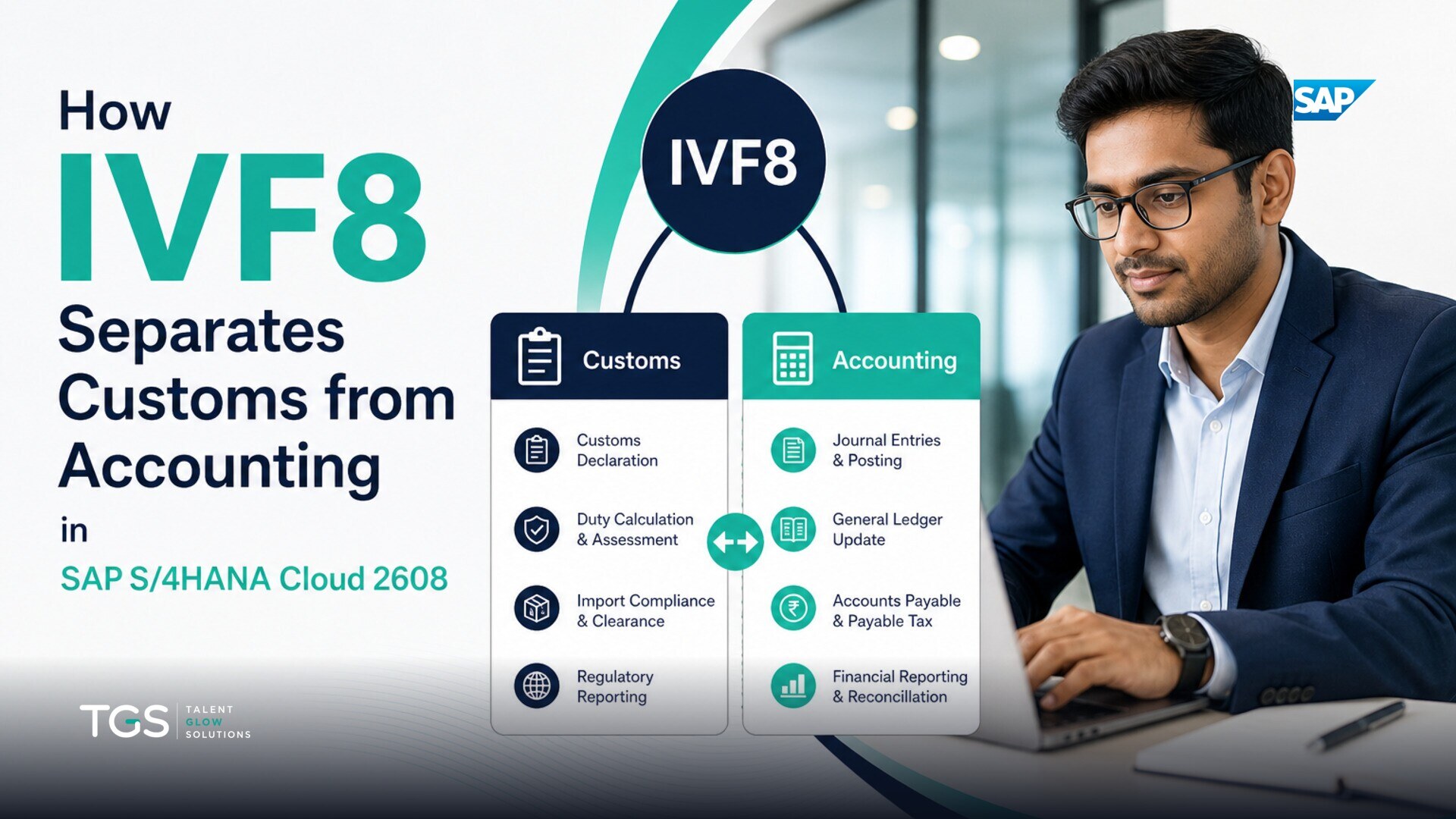
A significant update for SAP S/4HANA Cloud Public Edition users, particularly those in sales and distribution, has emerged. An SAP Community blog, published on November 24, 2026, highlights the new billing type IVF8 for intercompany pro forma invoices. This development is crucial for businesses managing international trade, as it formally separates customs documentation from intercompany accounting processes within SAP S/4HANA Cloud 2608. Previously, handling intercompany flows for both customs and accounting presented complexities, often requiring workarounds. Now, a dedicated solution is available to streamline these operations. This article will explore the practical implications of separating customs from accounting: Intercompany Pro Forma Invoices (IVF8) in SAP S/4HANA Cloud 2608.
What is the purpose of IVF8 in SAP S/4HANA Cloud 2608?
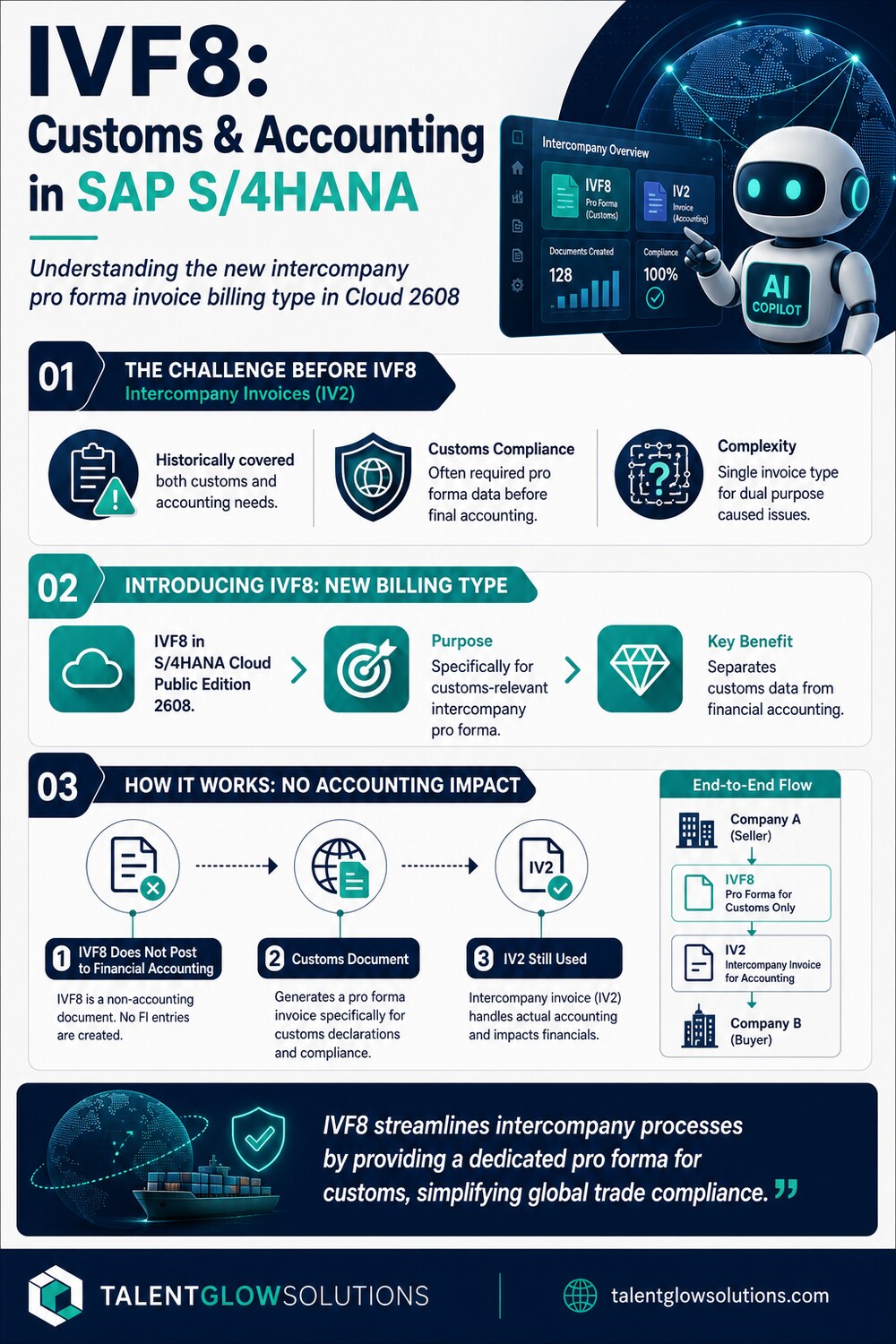
The primary purpose of the new IVF8 billing type in SAP S/4HANA Cloud Public Edition 2608 is to generate intercompany pro forma invoices specifically for customs purposes. This means that a separate document can be created to fulfill customs declaration requirements without impacting the financial accounting entries. This separation is vital for companies operating across borders, enabling them to comply with customs regulations more efficiently.
Before IVF8, intercompany invoices often served a dual role, leading to potential discrepancies or additional steps to satisfy both customs and financial reporting. The introduction of IVF8 resolves this by providing a clear distinction. It allows for the creation of a pro forma document that is legally sufficient for customs authorities but does not post any values to the general ledger.
How does IVF8 differ from traditional intercompany invoices like IV2?
IVF8 differs from IV2 because it is designed purely as a customs pro forma document, whereas IV2 is the standard intercompany invoice that posts to financial accounting. The key distinction lies in their accounting impact. IVF8 creates a document that is not relevant for financial accounting, meaning it does not generate any accounting entries or impact your company's financial statements.
In contrast, the IV2 intercompany invoice is crucial for internal financial reconciliation between different company codes within the same organizational group. It ensures that goods or services exchanged internally are properly accounted for, with corresponding debits and credits posted to the relevant accounts. This distinction allows for parallel processing: customs documentation with IVF8 and financial settlement with IV2.
What are the benefits of separating customs from accounting with IVF8?
Separating customs from accounting with IVF8 offers several key benefits for businesses engaged in international trade. It enhances compliance, improves operational efficiency, and reduces the risk of errors in financial reporting. By providing a dedicated document for customs, companies can ensure that all required information is present and accurate for regulatory bodies.
Benefits include: * Improved Compliance: Ensures accurate and timely customs declarations, reducing potential fines or delays at borders. * Streamlined Processes: Eliminates the need for workarounds or complex configurations to satisfy both customs and financial requirements with a single document. * Reduced Errors: Prevents customs-specific data from inadvertently affecting financial accounting records. * Clearer Audit Trails: Provides distinct documentation for customs and financial audits, simplifying verification processes. * Faster Shipments: Expedites customs clearance by having the correct pro forma invoice readily available.
How is IVF8 implemented in SAP S/4HANA Cloud Public Edition 2608?
Implementing IVF8 in SAP S/4HANA Cloud Public Edition 2608 involves configuring the new billing type within the SAP Sales and Distribution (SD) module. This typically includes defining new document types and potentially adjusting existing output determination procedures. The goal is to ensure that IVF8 is triggered appropriately for intercompany sales orders requiring customs pro forma documentation.
Configuration steps generally involve: 1. Defining Billing Type IVF8: Ensure the standard IVF8 billing type is active and configured correctly in your system. 2. Output Determination: Set up output types to generate the IVF8 document automatically or manually based on specific criteria. 3. Process Flow Integration: Integrate IVF8 into your existing intercompany sales process, typically after the outbound delivery and before the final IV2 invoice. 4. User Training: Train users on when and how to generate and utilize the IVF8 pro forma invoice.
What does this mean for SAP SD professionals and learners?
For SAP SD professionals and learners, the introduction of IVF8 signifies an important evolution in intercompany billing processes within SAP S/4HANA Cloud. It highlights SAP's ongoing commitment to enhancing global trade functionality and simplifying complex business scenarios. Understanding IVF8 is crucial for anyone working with or learning SAP SD, especially those involved in international logistics and finance.
This update reinforces the need for continuous learning and adaptation within the SAP ecosystem. Professionals should familiarize themselves with the new billing type's functionality, configuration, and its impact on existing intercompany processes. For those starting their SAP journey, this is a relevant topic to master, demonstrating a practical application of SAP SD in real-world international business. At TalentGlowSolutions, our mentor-led SAP SD training on a live S/4HANA system covers such real-world scenarios, preparing learners for these exact changes in the field.
Comparison: Before and After IVF8 Introduction
The introduction of IVF8 marks a clear improvement in how intercompany processes are handled for customs and accounting purposes. The following table highlights the key differences.
| Feature | Before IVF8 (Typical) | After IVF8 (SAP S/4HANA Cloud 2608) |
|---|---|---|
| Customs Document | Often relied on IV2 or manual pro forma generation. | Dedicated IVF8 billing type for customs pro forma. |
| Accounting Impact | IV2 had direct financial accounting impact. | IVF8 has no direct financial accounting impact. |
| Process Flow | Combined or complex steps for customs and accounting. | Clear separation of customs (IVF8) and accounting (IV2). |
| Compliance Ease | Required careful management to meet both needs. | Streamlined compliance with a dedicated customs document. |
| Error Potential | Higher risk of discrepancies between customs and finance. | Reduced risk due to clear functional separation. |
What are the future implications of such updates for SAP careers?
Updates like the introduction of IVF8 demonstrate that the SAP landscape is constantly evolving, which has significant implications for SAP careers. Professionals need to stay current with new functionalities and best practices to remain competitive. Specializing in modules like SAP SD, which is directly impacted by such changes, can open up opportunities in areas like international trade compliance and global supply chain management.
The demand for SAP professionals who understand the latest S/4HANA functionalities continues to grow. Keeping up-to-date with SAP Community blogs and official SAP announcements is key. For those looking to enter the SAP field, comprehensive training that includes practical, project-based experience on live S/4HANA systems is invaluable. It ensures you are familiar with the tools and processes that businesses are actively adopting.
These ongoing developments mean that a strong foundation in core SAP modules, combined with an understanding of new features, is critical. TalentGlowSolutions offers mentor-led training in SAP modules like FICO, MM, SD, PP, EWM, BASIS, and ABAP, providing the in-depth knowledge and hands-on experience needed to thrive in this dynamic environment. We also provide placement assistance, offering support and mentorship to help our learners navigate their career paths, though we do not guarantee a job.
Sources
Frequently asked questions
What is a pro forma invoice in SAP?
A pro forma invoice in SAP is a preliminary invoice used for various purposes, often for customs declarations or to inform a customer of the value of goods or services before the final invoice is issued. It typically does not post to financial accounting.
Which SAP module is most relevant to intercompany billing?
The SAP Sales and Distribution (SD) module is most relevant to intercompany billing, as it handles sales order processing, delivery, and invoicing, including intercompany scenarios like those addressed by IV2 and the new IVF8.
How does SAP S/4HANA Cloud differ from on-premise versions?
SAP S/4HANA Cloud is a software-as-a-service (SaaS) solution managed by SAP, offering regular updates like the one for IVF8 in version 2608. On-premise versions are installed and managed by the customer, allowing for greater customization but requiring more internal IT resources.
Does IVF8 replace IV2 for intercompany accounting?
No, IVF8 does not replace IV2 for intercompany accounting. IVF8 is specifically for customs-related pro forma invoices and has no accounting impact. IV2 remains the standard intercompany invoice type for financial accounting postings and reconciliation.
What skills are needed to work with SAP SD intercompany processes?
To work with SAP SD intercompany processes, you need a strong understanding of sales order management, delivery processing, billing, pricing, and output determination. Knowledge of international trade regulations and financial accounting basics is also beneficial.
Ready to launch your career?
For those looking to master SAP SD and other core modules, our mentor-led training provides the essential support and mentorship to build a successful SAP career.
Explore Programs Talk to us