Career Guide
Top SAP EWM Interview Questions for Freshers: Master Your First Interview

Embarking on a career in SAP Extended Warehouse Management (EWM) can be a rewarding path, especially for freshers. The first hurdle is often the interview, where demonstrating a solid grasp of fundamental concepts is key. This guide will walk you through common SAP EWM interview questions for freshers, directly addressing the core knowledge expected in the field.
Preparing for these questions will not only boost your confidence but also highlight your understanding of EWM's role in modern logistics. Let's dive into the essential topics that frequently come up in entry-level SAP EWM discussions.
What is the main difference between SAP WM and SAP EWM?
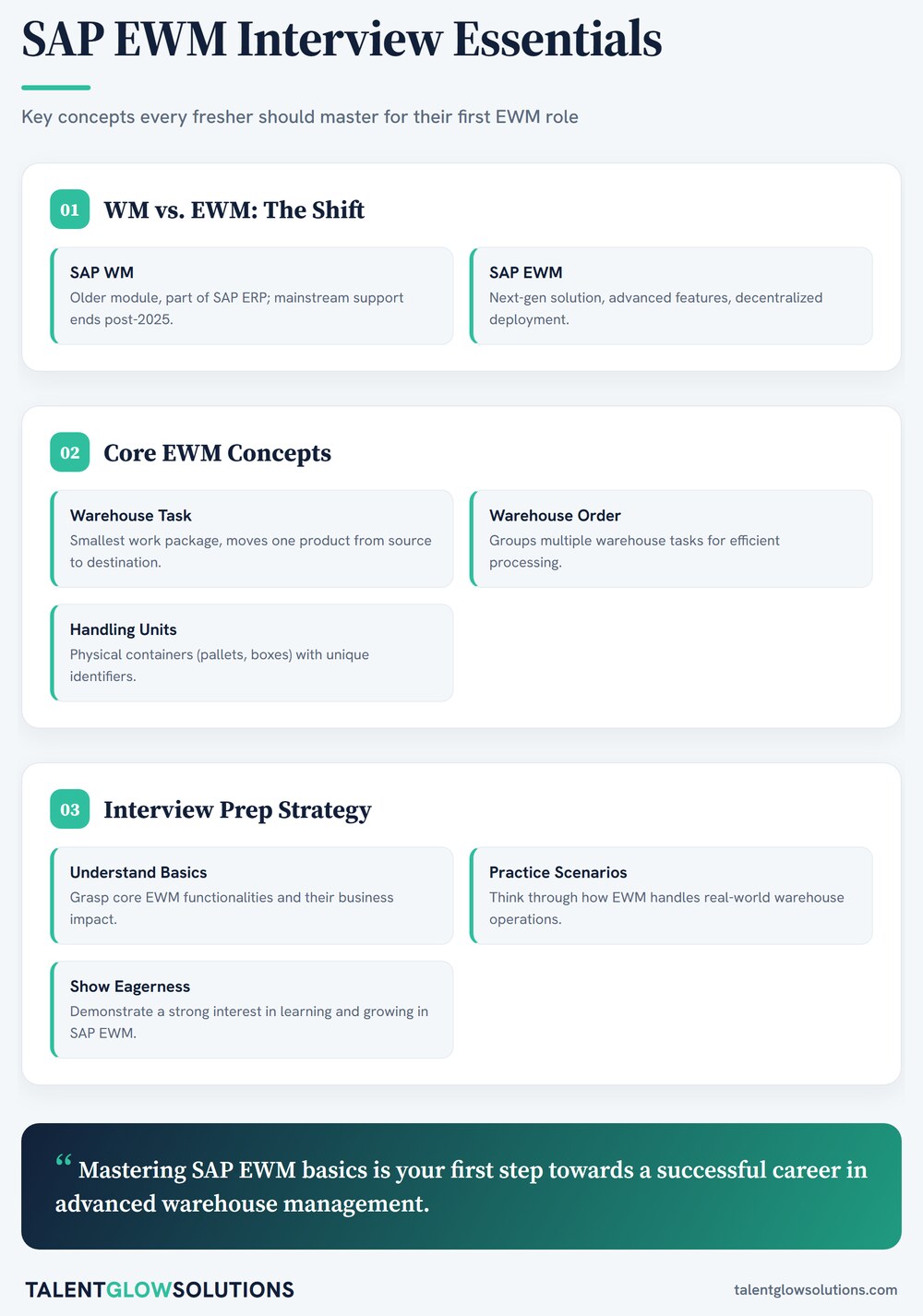
The main difference is their scope and technological foundation: SAP Warehouse Management (WM) is an older module, integrated within SAP ERP, while SAP Extended Warehouse Management (EWM) is the next-generation, standalone solution. SAP WM's mainstream support is scheduled to end after 2025, making EWM the strategic choice for advanced warehouse operations.
EWM offers significantly more advanced features compared to WM. This includes enhanced functionality like detailed storage bin management, advanced slotting and rearrangement, and more flexible process control. EWM can also be deployed decentralized, providing greater flexibility and scalability for complex warehouse environments.
Why is SAP EWM considered superior to SAP WM for modern warehouses?
SAP EWM is considered superior due to its advanced capabilities and strategic focus on complex, high-volume warehouse operations. It provides a more granular level of control and optimization that WM simply cannot match. This makes EWM better suited for the demands of modern supply chains.
Key advantages of EWM include sophisticated resource management, labor management, yard management, and a robust material flow system. These features allow businesses to optimize warehouse processes, improve efficiency, and reduce operational costs more effectively than with the older WM module. The shift to EWM reflects an industry move towards more integrated and intelligent logistics solutions.
Can you explain the concept of a Warehouse Task in SAP EWM?
A Warehouse Task (WT) is the smallest unit of work in SAP EWM, representing a single movement of a product within the warehouse. It defines the source storage bin and the destination storage bin for a specific quantity of a product. Think of it as a detailed instruction for moving items.
Each Warehouse Task is generated automatically or manually to execute a specific step in a warehouse process, such as putaway, picking, or internal movements. It ensures that every product movement is tracked and managed precisely, contributing to overall warehouse efficiency and accuracy.
What is a Warehouse Order, and how does it relate to Warehouse Tasks?
A Warehouse Order (WO) is a document that groups together multiple Warehouse Tasks (WTs) to optimize and streamline their execution. It serves as a container for WTs, allowing warehouse workers to process several related movements as a single unit of work. This improves efficiency by minimizing travel times and maximizing resource utilization.
For example, instead of processing each pick task individually, an EWM system can group several pick tasks for the same area into one Warehouse Order. This enables a picker to collect multiple items from various bins in a single trip, significantly reducing the time and effort required. This relationship is crucial for efficient warehouse operations.
| Feature | Warehouse Task (WT) | Warehouse Order (WO) |
|---|---|---|
| Definition | Smallest unit of work, single product movement | Groups multiple WTs for optimized execution |
| Purpose | Defines source and destination for one product | Optimizes worker routes and resource use |
| Scope | One specific material movement | Collection of related movements |
| Generation | Automatic or manual for individual moves | System-generated based on WO creation rules |
| Execution | Carried out by a single worker or resource | Assigned to a worker who executes all contained WTs |
What are Handling Units (HUs) in SAP EWM, and why are they important?
Handling Units (HUs) in SAP EWM represent physical containers, such as pallets, boxes, or crates, that contain one or more products and are uniquely identified. They are crucial because they allow for the management of entire logistical units rather than individual products, simplifying complex movements and tracking. Each Handling Unit has a unique number, often a barcode, that enables easy scanning and tracking throughout the warehouse.
Managing materials in Handling Units streamlines processes like goods receipt, putaway, picking, and shipping. Instead of scanning each individual item, workers can scan a single HU to move or track all its contents. This significantly improves efficiency, reduces errors, and provides better visibility into the physical flow of goods within the warehouse. (igmguru.com, checked on igmguru.com in August 2024).
How does EWM support advanced slotting and rearrangement?
SAP EWM supports advanced slotting and rearrangement by providing sophisticated algorithms to determine the optimal storage locations for products based on various factors. These factors include product characteristics, movement frequency, dimensions, weight, and specific storage requirements. This ensures efficient use of warehouse space and faster access to high-demand items.
The system can automatically suggest or execute rearrangement tasks to move products to more optimal locations over time, adapting to changing demand patterns. This dynamic optimization helps to reduce travel distances for putaway and picking, improving overall warehouse productivity and throughput. It's a key feature that distinguishes EWM from simpler WM systems.
What types of deployment options are available for SAP EWM?
SAP EWM offers flexible deployment options, including embedded on S/4HANA or as a decentralized system. The embedded option means EWM runs directly within the S/4HANA system, offering tight integration with other logistics modules. This is often preferred for simpler warehouse landscapes or when a single system landscape is desired.
The decentralized deployment option allows EWM to run on a separate system, often a dedicated server. This provides greater scalability, performance, and flexibility, especially for large, complex warehouses with high transaction volumes or specific performance requirements. It also allows for continuous operations even if the central ERP system is temporarily unavailable.
How does TalentGlowSolutions prepare freshers for SAP EWM careers?
TalentGlowSolutions provides mentor-led, project-based training on a live S/4HANA system for SAP EWM, equipping freshers with practical skills and confidence. Our curriculum covers essential modules like FICO, MM, SD, PP, EWM, BASIS, and ABAP, ensuring a comprehensive understanding of the SAP ecosystem.
Our training focuses on real-world scenarios, preparing you not just for interview questions but for actual job responsibilities. We also offer placement assistance, including resume building, interview preparation, and networking support. While we provide 100% placement assistance, we do not guarantee a job, focusing instead on empowering you with the skills and support needed to succeed.
What is meant by granular storage bin management in EWM?
Granular storage bin management in SAP EWM refers to the system's ability to manage stock at a very detailed level, down to individual storage bins and even specific sections within a bin. This contrasts with older systems that might only track stock at a broader storage type or warehouse level. This precision ensures accurate inventory records and efficient space utilization.
This level of detail allows for precise control over where products are stored, optimizing space, reducing search times, and improving inventory accuracy. It supports complex storage strategies like fixed bin, random storage, and mixed storage, enabling warehouses to adapt to diverse product requirements and operational needs.
What are the key benefits of implementing SAP EWM for a business?
Implementing SAP EWM brings several key benefits, including improved operational efficiency, enhanced inventory accuracy, and better resource utilization. By optimizing warehouse processes, businesses can significantly reduce labor costs and cycle times. EWM's advanced features lead to more precise inventory counts, minimizing discrepancies and stockouts.
Furthermore, EWM provides real-time visibility into warehouse operations, enabling better decision-making and responsiveness to changes in demand. The result is a more agile and cost-effective supply chain, capable of handling modern logistical challenges with greater ease and control.
Sources
Frequently asked questions
Is SAP EWM difficult to learn for freshers?
Learning SAP EWM as a fresher requires dedication, but with structured training and a strong foundation in logistics concepts, it is achievable. Focus on understanding the core processes and system functionalities, and practical, project-based learning can significantly ease the learning curve.
What kind of career opportunities are there in SAP EWM for freshers?
Freshers in SAP EWM can pursue roles such as EWM Junior Consultant, Support Analyst, or Data Analyst. As you gain experience, opportunities expand to EWM Functional Consultant, Solution Architect, or Project Manager. The demand for EWM professionals is growing as more companies adopt the advanced solution.
Do I need prior SAP experience to learn EWM?
While prior SAP experience can be beneficial, it's not strictly necessary for freshers to start learning EWM. Many training programs, like those at TalentGlowSolutions, are designed to build foundational knowledge from the ground up. A basic understanding of warehouse operations and logistics is helpful.
What is the typical salary range for an SAP EWM fresher in India?
Salary ranges for SAP EWM freshers in India can vary widely based on factors such as location, company, and specific skill set. It's best to research current market trends on job portals or consult with career counselors for up-to-date information. TalentGlowSolutions focuses on providing the skills and mentorship to help you secure competitive offers.
How long does it take to become proficient in SAP EWM?
Becoming proficient in SAP EWM typically takes several months to a year of dedicated learning and practical application. Initial training courses can provide a strong foundation in a few weeks or months, but true proficiency comes with hands-on project experience and continuous learning in a professional environment.
Ready to launch your career?
Our mentor-led SAP EWM training, with placement assistance, helps you build a strong foundation for a successful career.
Explore Programs Talk to us