Career Guide
Ace Your SAP Interview: Discussing Self-Study Projects Without Corporate Experience

Landing your first SAP job without prior corporate experience can feel challenging, especially when asked about practical project work. However, your self-study SAP projects are a powerful asset if you know how to present them effectively. The key is to frame your experience in a way that resonates with recruiters, demonstrating not just technical knowledge but also an understanding of business processes and problem-solving. This guide will show you how to talk about a self-study SAP project in an interview with no corporate experience, turning your learning into a compelling narrative.
How Can I Frame My Self-Study SAP Project for an Interview?
To frame your self-study SAP project effectively, focus on the business context and the value you created. Recruiters want to see that you understand how SAP functions impact real-world operations, not just that you can navigate the system. Think about the 'why' behind your configurations and processes.
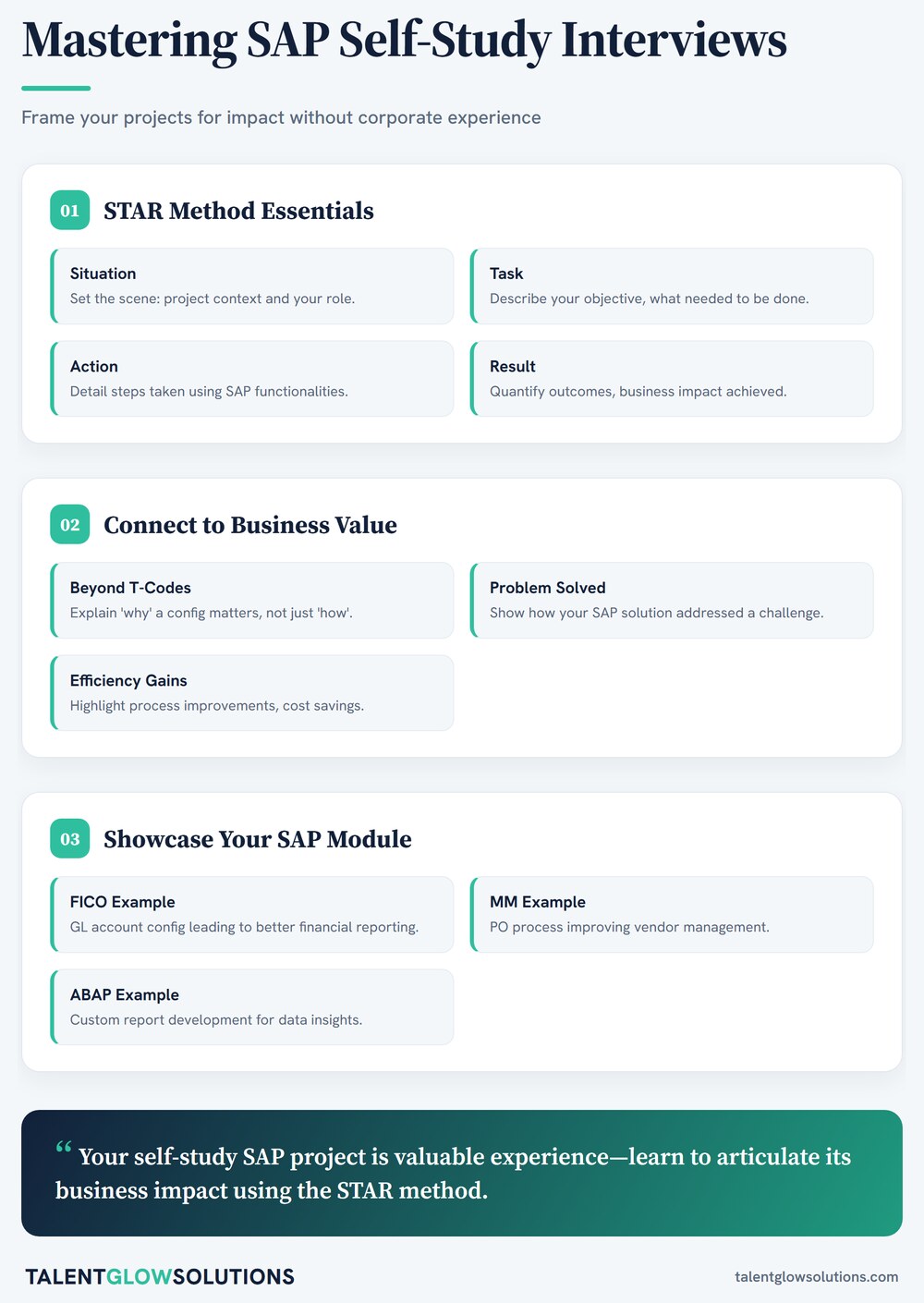
- Connect to Business Impact: Instead of merely listing T-codes or configurations, explain why you performed certain steps and what business problem they solved. For instance, configuring a new General Ledger account in FICO isn't just a technical task; it enables better financial reporting and compliance.
- Highlight Problem-Solving: Describe challenges you encountered during your project and how you overcame them. This demonstrates critical thinking and resourcefulness, qualities highly valued in any role.
- Showcase Autonomy: Emphasize that you initiated and completed the project independently. This speaks volumes about your drive and ability to learn and execute without constant supervision.
What is the STAR Method and How Do I Use It?
The STAR method is a structured way to answer behavioral interview questions by providing concrete examples of your experience. It helps you tell a clear, concise, and compelling story about your self-study project. Recruiters often look for this format to understand your thought process and actions.
- Situation: Describe the background or context of your project. What was the scenario you set up or the problem you aimed to solve? Keep it brief but informative.
- Task: Explain your specific role and objective within that situation. What were you trying to achieve or implement with your SAP module?
- Action: Detail the steps you took to complete the task. This is where you can mention specific SAP functionalities, configurations, or processes you used, always linking them to the 'why'.
- Result: Conclude with the outcome of your actions. What did you accomplish? How did your project demonstrate business value or improve a simulated process? Quantify results if possible.
| STAR Component | What to Include (Example: SAP MM) |
|---|---|
| Situation | "In my self-study, I simulated a procurement process for a manufacturing company needing raw materials." |
| Task | "My goal was to configure the full Procure-to-Pay cycle, from requisition to invoice verification and payment posting." |
| Action | "I created vendor master data, defined material types, configured purchasing organizations, and processed a Purchase Order (PO), Goods Receipt (GR), and Invoice Verification (IR) within the SAP S/4HANA system." |
| Result | "This allowed me to understand how integrated MM processes ensure accurate inventory and financial postings, reducing manual errors by simulating automated workflows." |
How Do I Connect SAP Concepts to Business Impact?
Connecting SAP concepts to business impact is crucial for demonstrating your understanding beyond mere technical skills. An employer wants to know how your SAP knowledge can benefit their organization. Avoid simply listing T-codes or configuration steps.
- FICO (Financial Accounting and Controlling): Instead of saying, "I configured GL accounts," say, "I configured General Ledger accounts and cost centers to enable detailed financial reporting and cost analysis, providing management with better insights into departmental spending and profitability."
- MM (Materials Management): Rather than, "I created Purchase Orders," explain, "I configured and executed the Purchase Order process, which streamlines procurement, ensures timely material availability, and helps negotiate better vendor terms, impacting supply chain efficiency and cost savings."
- SD (Sales and Distribution): Don't just state, "I processed sales orders." Instead, articulate, "I set up the entire Order-to-Cash cycle, from sales order creation to billing and delivery, which enhances customer satisfaction through efficient order fulfillment and accurate revenue recognition."
- PP (Production Planning): Beyond "I ran a production order," elaborate, "I simulated a production planning scenario, demonstrating how SAP PP optimizes manufacturing processes, reduces waste, and ensures production schedules align with demand, leading to improved operational efficiency."
- EWM (Extended Warehouse Management): Instead of, "I managed warehouse bins," describe, "I configured warehouse structures and putaway strategies, which optimizes inventory placement, speeds up picking processes, and enhances overall warehouse throughput and accuracy."
- BASIS (System Administration): More than, "I installed SAP," explain, "I performed system installation and user management, which ensures the SAP landscape is stable, secure, and accessible, supporting business continuity and data integrity."
- ABAP (Advanced Business Application Programming): Not just, "I wrote a report," but, "I developed a custom ABAP report to extract specific sales data, providing real-time insights that were not available in standard reports, thereby supporting faster business decisions."
What If My Project Was Just Following a Tutorial?
Even if your self-study project involved following a tutorial or guided exercise, you can still present it as valuable experience. The key is to articulate what you learned and achieved from it, and how you applied critical thinking. Acknowledge the guidance but emphasize your active role.
- Personalize the Experience: Describe any variations you made, challenges you faced, or additional research you conducted beyond the tutorial. This shows initiative.
- Focus on Understanding: Explain the underlying SAP logic and business implications of the steps you followed. What did you understand about the module's functionality and its purpose?
- Demonstrate Application: Highlight how this tutorial helped you grasp core concepts that you could apply to new scenarios. For example, if you configured a basic FICO process, explain how that foundational knowledge would help you tackle more complex financial scenarios.
Recruiters are aware that freshers often start with guided learning. Your ability to articulate your takeaways, problem-solving during the process, and the business relevance of what you configured is far more important than whether the project was entirely self-conceived. Show that you actively engaged with the material, rather than passively copying steps. This approach helps you effectively discuss a self-study SAP project in an interview with no corporate experience.
How Can I Show Enthusiasm and Readiness?
Demonstrating enthusiasm and readiness for an SAP career is vital, especially when you lack corporate experience. Your passion for learning and commitment to the field can make a strong impression. Employers seek individuals who are eager to contribute and grow.
- Research the Company: Show you've done your homework by mentioning how your self-study project or skills align with their specific business or industry. This indicates genuine interest.
- Ask Insightful Questions: Prepare questions about the company's SAP landscape, upcoming projects, or team structure. This shows engagement and a forward-thinking mindset.
- Highlight Continuous Learning: Mention any additional courses, certifications (like preparing for an SAP certification exam), or community involvement you've pursued. This reinforces your dedication to professional development.
Many training programs, like those focused on SAP FICO, MM, SD, PP, EWM, BASIS, and ABAP, offer mentor-led, project-based learning on live S/4HANA systems. This kind of hands-on experience, even without a corporate tag, is highly valuable and prepares you to articulate practical skills effectively. Such programs also provide 100% placement assistance, offering support and mentorship to help you navigate the job market, though it's important to remember that we do not guarantee a job.
What are Common Mistakes to Avoid?
When discussing your self-study SAP project, avoid these common pitfalls to ensure your interview goes smoothly. Focusing on a structured, business-oriented approach will set you apart from other candidates.
- Too Technical, Not Enough Business: Don't get lost in a sea of T-codes and configuration screens without explaining their business relevance. Always bridge the gap between technical action and business outcome.
- Lack of Structure: Rambling without a clear narrative makes it hard for the interviewer to follow. The STAR method provides the necessary framework for a coherent story.
- Underestimating Your Experience: Don't apologize for not having corporate experience. Your self-study projects are valid experience that demonstrates initiative, learning capability, and practical application of SAP skills.
- Generic Answers: Avoid vague statements. Be specific about what you did, how you did it, and what the results were. Generic answers don't showcase your unique abilities.
- Not Asking Questions: Failing to ask questions at the end of the interview can signal a lack of interest. Always have a few thoughtful questions ready.
By avoiding these mistakes and focusing on a well-structured, business-centric explanation of your self-study projects, you can significantly improve your chances of success in SAP job interviews. Your proactive learning and ability to articulate its value are your strongest assets.
Sources
Frequently asked questions
How can I make my self-study SAP project sound professional?
Frame your project using the STAR method (Situation, Task, Action, Result) and always connect your SAP configurations and processes to their real-world business impact and problem-solving. Focus on the 'why' behind your actions.
Should I mention T-codes in my interview answers?
While you can mention T-codes to demonstrate technical familiarity, always immediately follow up by explaining the business context and impact of the action performed using that T-code. Don't just list them.
What if my self-study project wasn't complex?
The complexity is less important than your ability to explain what you learned, the challenges you overcame, and how it relates to business processes. Emphasize your problem-solving skills and the foundational knowledge gained.
How do I show passion for SAP without corporate experience?
Show your passion by discussing additional learning, researching the company's SAP usage, asking insightful questions, and expressing enthusiasm for continuous learning and contributing to their team.
Ready to launch your career?
Our mentor-led, project-based SAP training provides the hands-on experience and mentorship needed to confidently discuss your skills in any interview.
Explore Programs Talk to us