Career Shift
SAP EWM Training: The Direct Path for Logistics & Warehouse Professionals
If you've spent time on the warehouse floor, managing inventory, or coordinating logistics, you've likely encountered the complexities of efficient material flow. From the moment goods arrive at the dock to their final shipment, every step requires precision. This hands-on experience is not just valuable; it's a direct advantage if you're considering SAP EWM training for people from a logistics or warehouse operations background.
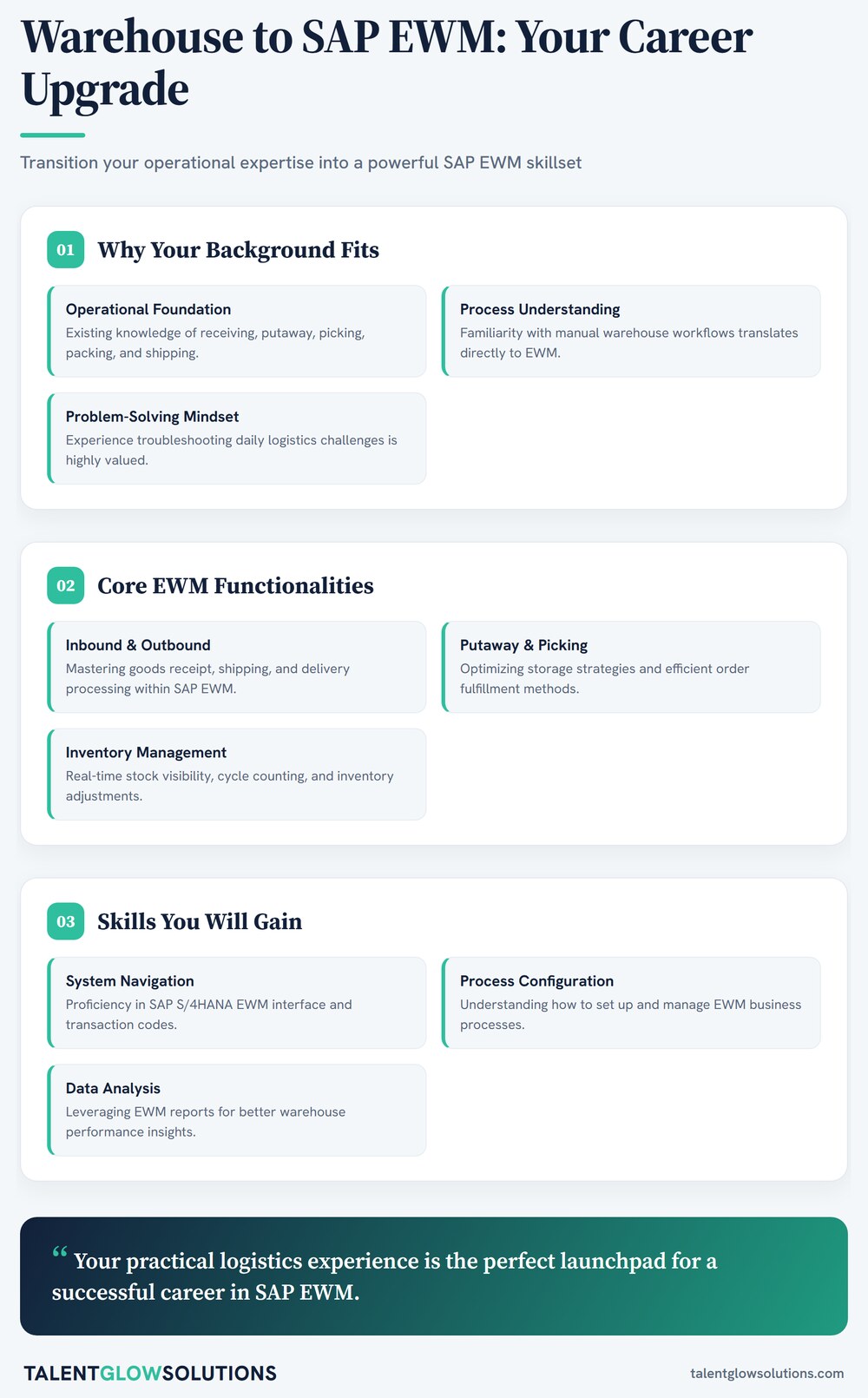
Your practical knowledge of receiving, putaway, picking, packing, and shipping provides a foundational understanding that makes learning SAP EWM intuitive. Instead of starting from scratch, you'll be learning how a powerful software system automates and optimizes the very processes you already perform manually or manage daily. This article explores why your background is an ideal fit for an SAP EWM career.
Why is a Logistics Background Ideal for SAP EWM?
A logistics or warehouse operations background is ideal for SAP EWM because it provides a prerequisite foundational understanding of the real-world processes that the software manages. You already grasp the 'why' behind each system function. This includes a deep understanding of receiving, putaway, picking, packing, and shipping, which are core to EWM functionalities.
Your daily experience in a warehouse setting means you've seen the challenges and intricacies firsthand. When you learn about inbound processing in SAP EWM, you immediately connect it to actual receiving dock operations. This practical context significantly accelerates your learning curve and helps you grasp complex EWM concepts faster, as noted in the EWM Syllabus on scribd.com.
What Core Warehouse Processes Does SAP EWM Cover?
SAP EWM provides in-depth, practical instruction on core functionalities such as inbound and outbound processes, putaway, picking, and inventory management. It's designed to streamline and optimize every movement of goods within a warehouse. This means automating tasks, optimizing storage, and ensuring accurate stock levels.
Think of the journey of an item in a warehouse: it arrives (inbound), needs a place to go (putaway), is retrieved for an order (picking), prepared for shipment (packing), and finally leaves (outbound). SAP EWM offers robust tools for each of these stages, ensuring efficiency and visibility. Your existing knowledge of these stages makes the system's logic much easier to follow.
How Does SAP EWM Handle Inbound and Outbound Processes?
SAP EWM significantly enhances inbound and outbound processes by providing comprehensive tools for managing goods receipt, quality inspection, and efficient putaway strategies. For outbound, it covers order fulfillment, wave management, picking, packing, and shipping. These functionalities ensure smooth operations from dock to door.
For example, in inbound processing, EWM can guide operators to the optimal storage bin based on predefined rules like product characteristics or storage capacity. For outbound, it can consolidate multiple orders into a single picking wave, minimizing travel time and maximizing efficiency. This level of automation directly impacts warehouse productivity.
What is Putaway and Picking Optimization in SAP EWM?
Putaway and picking optimization in SAP EWM focuses on maximizing space utilization and minimizing travel time for warehouse staff. EWM uses advanced algorithms to suggest the best storage locations for incoming goods and the most efficient routes for picking items for outgoing orders. This directly translates to significant operational cost savings.
- Putaway Strategies: EWM can implement various strategies like fixed bin, general storage, or activity-based putaway. It considers factors like product dimensions, weight, and material handling equipment. This ensures items are stored logically and accessibly.
- Picking Strategies: The system can guide pickers through optimized routes (e.g., shortest path, zone picking) and suggest picking methods (e.g., FIFO, LIFO). This reduces the time spent locating and retrieving items, speeding up order fulfillment.
What About Inventory Management in SAP EWM?
Inventory management in SAP EWM offers real-time visibility and precise control over all stock within the warehouse. This includes tracking quantities, locations, and movements of goods, as well as managing physical inventory counts and adjustments. Accurate inventory data is crucial for efficient operations and customer satisfaction.
EWM supports various inventory management techniques, such as cycle counting, physical inventory, and inventory adjustments. It allows businesses to maintain high levels of inventory accuracy, reduce stockouts, and minimize carrying costs. Your understanding of stock rotation and counting methods will make these EWM features easy to grasp.
How Does Live System Training Benefit Logistics Professionals?
Training on a live S/4HANA system offers invaluable practical experience for logistics professionals transitioning to SAP EWM. It allows learners to apply theoretical knowledge in a real-world environment, simulating actual warehouse operations. This hands-on approach builds confidence and system proficiency.
This type of training, often mentor-led, means you're not just reading about EWM; you're actively performing tasks like goods receipt, putaway, and picking within the SAP environment. This direct interaction helps solidify understanding and prepares you for real-world scenarios. It bridges the gap between your operational experience and the technical execution within SAP.
What Does Placement Assistance Entail for SAP EWM Careers?
Placement assistance for SAP EWM careers typically involves support services to help learners prepare for job applications and interviews, but we do not guarantee a job. This support can include resume building workshops, interview preparation, and guidance on navigating the job market. The goal is to equip learners with the tools needed to effectively pursue career opportunities.
TalentGlowSolutions provides 100% placement assistance, focusing on preparing individuals for their job search. This means offering mentorship and guidance throughout the process, leveraging the skills gained during the training. It's about empowering you to present your new SAP EWM expertise effectively to potential employers.
Comparing Manual vs. SAP EWM Processes
Transitioning from manual warehouse operations to SAP EWM involves understanding how the system automates and optimizes tasks you're already familiar with. This table highlights key differences and benefits.
| Feature | Manual Warehouse Operations | SAP EWM-Managed Operations |
|---|---|---|
| Inventory Tracking | Often paper-based, manual counts, prone to errors | Real-time digital tracking, high accuracy, reduced discrepancies |
| Putaway Logic | Based on operator discretion or simple rules | System-guided, optimized for space and efficiency, rule-based |
| Picking Efficiency | Route planning can be inefficient, manual item location | Optimized picking routes, wave picking, system-directed tasks |
| Reporting & Analytics | Limited, time-consuming to compile, retrospective | Instant access to comprehensive reports, predictive analytics |
| Error Reduction | Higher potential for human error in data entry and processes | Automated checks, barcode scanning, significantly lower error rates |
| Scalability | Difficult to scale with increasing volume or complexity | Highly scalable, adaptable to growing business needs and volumes |
What Training Content is Covered in SAP EWM?
SAP EWM training provides in-depth, practical instruction on core functionalities, ensuring a comprehensive understanding of the system. This typically includes detailed modules on inbound processing, outbound processing, internal warehouse movements, and inventory management. Learners gain hands-on experience with the system.
According to the EWM Syllabus (scribd.com), key areas covered include:
- Master Data: Setting up product master data, storage bins, and resource management.
- Inbound Process: Managing goods receipt, quality inspection, and putaway strategies.
- Outbound Process: Handling delivery processing, wave management, picking, packing, and shipping.
- Internal Warehouse Processes: Stock transfers, physical inventory, and value-added services.
- Integration: Understanding EWM integration with other SAP modules like MM and SD.
This structured approach ensures that individuals from a logistics background can map their existing knowledge directly to SAP EWM's functionalities.
Sources
Frequently asked questions
Do I need prior SAP experience for SAP EWM training?
No, prior SAP experience is not strictly required. A foundational understanding of warehouse operations and logistics concepts, including receiving, putaway, picking, packing, and shipping, is a prerequisite for effective SAP EWM training. Your practical experience in logistics is a strong starting point.
What kind of jobs can I get after SAP EWM training?
After completing SAP EWM training, you can pursue roles such as SAP EWM Consultant, Warehouse Analyst, Logistics Coordinator with EWM skills, or Supply Chain Management Specialist. Your operational background combined with EWM expertise makes you a strong candidate for these positions.
Is SAP EWM difficult to learn for someone without an IT background?
While SAP EWM is a powerful enterprise software, your non-IT logistics and warehouse operations background is actually an asset. The training focuses on how the system manages real-world processes you already understand. Mentor-led training on a live S/4HANA system helps bridge any technical gaps, making it accessible.
How long does SAP EWM training typically take?
The duration of SAP EWM training can vary depending on the program structure and the depth of content. Comprehensive courses, especially those that are mentor-led and include hands-on practice on a live system, are designed to ensure thorough understanding and practical proficiency over a dedicated period.
What is the difference between SAP WM and SAP EWM?
SAP EWM (Extended Warehouse Management) is a more advanced and robust warehouse management solution compared to its predecessor, SAP WM (Warehouse Management). EWM offers enhanced functionalities for complex warehouse processes, including sophisticated putaway and picking strategies, labor management, and yard management, designed for modern supply chain demands.
Ready to launch your career?
Elevate your logistics career by mastering SAP EWM with our mentor-led, project-based training and dedicated placement assistance.
Explore Programs Talk to us