Career Advice
Explaining a Career Gap in Tech Interviews: Strategies & Examples

Landing a tech job can be competitive, and sometimes, a career gap can feel like a hurdle. Whether it's due to a layoff, a personal career break, or a deliberate switch into a new field, knowing how to explain a career gap in a tech interview is crucial. The key is to transform a perceived weakness into a narrative of strength, resilience, and intentional growth, showing interviewers you're ready and capable for the role.
This article provides actionable strategies and example answers to help you confidently address your career gap. By focusing on transparency, productivity, and your readiness for the future, you can turn your break into a compelling part of your professional story.
How Should You Address a Layoff in an Interview?
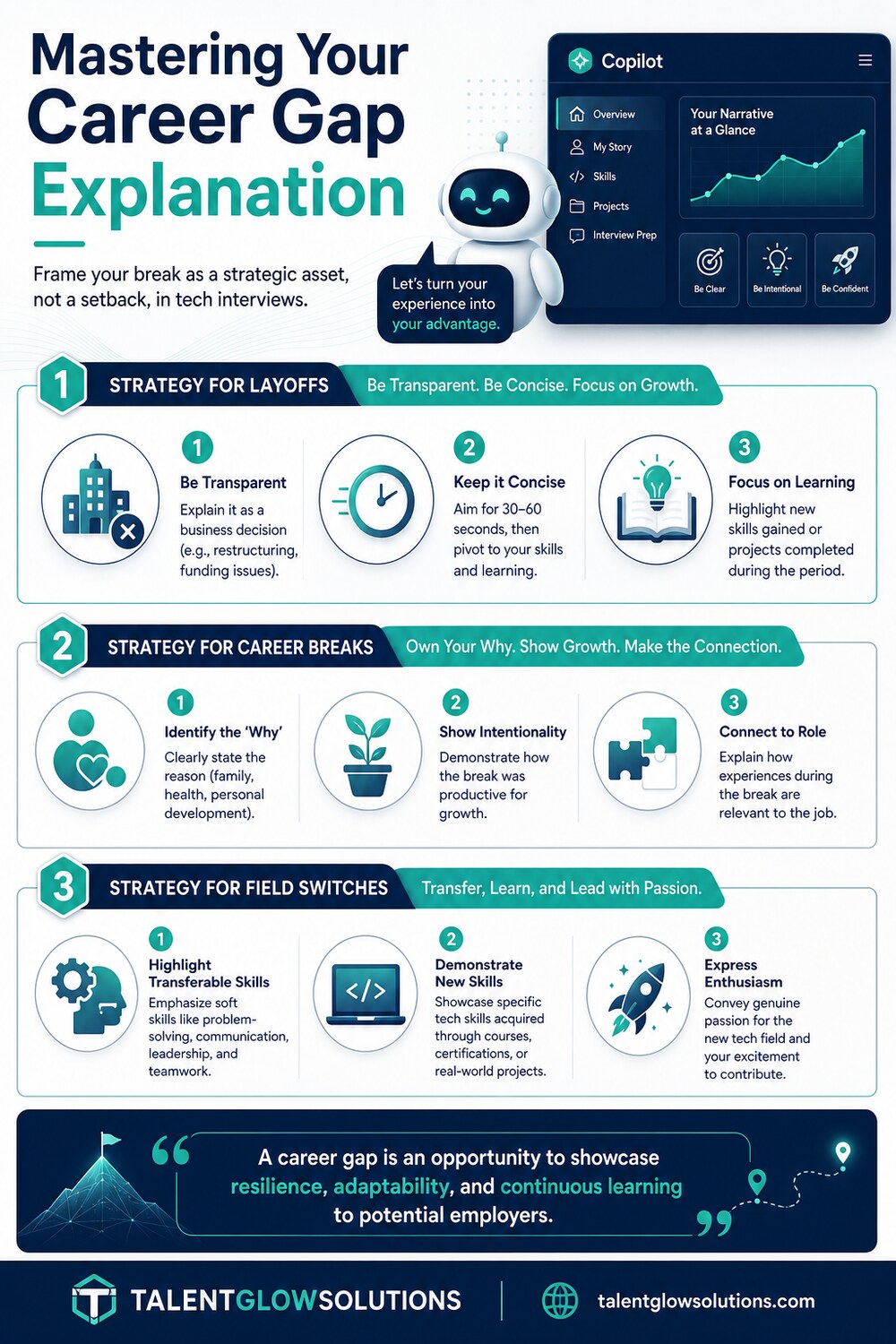
When discussing a layoff in a technical interview, be transparent by explaining it as a business decision and keep the explanation concise, around 30-60 seconds, before shifting focus to your strengths. Many companies undergo restructuring or face funding issues, and your layoff was likely not a reflection of your performance. Frame the event factually and without bitterness.
Focus on the positive outcomes or lessons learned from the experience. This could include using the time to upskill, network, or reflect on your career goals. This approach demonstrates maturity and a proactive mindset, which are highly valued in tech roles.
- Example Answer for a Layoff: "My last role ended due to a company-wide restructuring that impacted over 80,000 tech employees across the industry, a purely business decision. While unexpected, I used that time to deepen my skills in [specific tech skill, e.g., cloud architecture] through [course/project] and am now eager to apply that enhanced knowledge here."
How Can You Explain a Personal Career Break?
Explaining a personal career break effectively means showing that the time was used productively, even if it wasn't directly work-related. Whether for family care, health, travel, or personal development, the goal is to demonstrate intentionality and growth. Interviewers want to see that you remained engaged and are now ready to re-enter the workforce with renewed focus.
Highlight any skills you developed or refined during this period, such as problem-solving, time management, or learning new technologies. Connect these new capabilities back to the job requirements to show your continued relevance. This approach helps to bridge the gap between your personal time and professional readiness.
- Example Answer for a Personal Break: "I took [X months/years] to [care for a family member/focus on my health/travel], which provided me with invaluable experience in [e.g., complex problem-solving, project management for personal projects]. During this time, I also dedicated myself to mastering [new tech skill] through [online courses/personal projects], and I'm now excited to bring that refreshed perspective and technical proficiency to this team."
What if You're Switching Fields into Tech?
If you're making a deliberate switch into the tech field, your career gap becomes a story of transformation and ambition. Emphasize the transferable skills from your previous career that are valuable in tech, such as analytical thinking, communication, or project coordination. Then, clearly articulate the steps you took to gain specific tech skills.
This is where showcasing your dedication to learning is vital. Mention specific training programs, certifications, or personal projects you completed to build your tech foundation. TalentGlowSolutions, for instance, offers mentor-led, project-based training in areas like Full-stack, Data & AI, Cloud/DevOps, Cyber, SAP, and ServiceNow, which can provide the practical experience employers seek. This demonstrates genuine interest and preparedness.
- Example Answer for a Field Switch: "After [X years] in [previous field], I realized my passion lay in [specific tech area]. I dedicated the past [X months/years] to an intensive learning journey, completing [mention relevant courses, e.g., a Full-stack development bootcamp, Data & AI certifications]. My background in [previous field's skill, e.g., detailed problem-solving] combined with my new technical expertise makes me a unique and adaptable candidate for this role."
How to Frame Your Gap as Intentional Groundwork
Framing your career gap as intentional groundwork requires a shift in perspective: instead of viewing it as a blank space, see it as a period of active preparation. This could involve formal education, self-study, volunteer work, or even personal projects that honed relevant skills. The goal is to show that your time off was purposeful and led to professional growth.
Demonstrate how the skills or experiences gained during your gap directly align with the requirements of the job you're interviewing for. This proactive connection helps the interviewer see you as a strategic thinker who uses every opportunity for development. Your narrative should convey a clear path from your past to your desired future role.
| Aspect of Gap | How to Frame It | Example Benefit for Tech Role |
|---|---|---|
| Upskilling/Reskilling | Deliberate learning to acquire new tech skills | Stronger command of specific programming languages or tools |
| Personal Project | Applied knowledge to build practical solutions | Demonstrated initiative, problem-solving, and practical coding skills |
| Volunteering | Developed soft skills and contributed to a cause | Enhanced teamwork, communication, and leadership abilities |
| Travel/Cultural Immersion | Gained new perspectives, adaptability, resilience | Improved cross-cultural communication and creative problem-solving |
What Should You Avoid When Discussing a Career Gap?
When discussing your career gap, it's crucial to maintain professionalism and a positive outlook. Avoid blaming past employers or colleagues, as this can reflect poorly on your character. Similarly, do not provide excessive detail about personal circumstances that are not relevant to your professional readiness.
Steer clear of sounding apologetic or defensive. Instead, present your explanation with confidence and focus on what you've gained. Also, do not lie or heavily embellish details; honesty is always the best policy, and interviewers appreciate sincerity. Keep your responses concise, focused, and forward-looking.
How Can You Prepare for Career Gap Questions?
Preparation is key to confidently answering questions about your career gap. Start by reflecting on the reasons for your gap and identify the positive outcomes or lessons learned. Practice your answers aloud until they feel natural and articulate, ensuring they are concise and impactful. This rehearsal builds confidence and clarity.
Anticipate follow-up questions and be ready to elaborate on specific projects or skills you developed. Consider how your experiences, even non-traditional ones, have prepared you for the tech role. This thorough preparation ensures you can present your career gap as a testament to your adaptability and continuous learning.
- Identify the Core Reason: Clearly define why the gap occurred (layoff, personal, education).
- Pinpoint Positive Outcomes: List specific skills learned, projects completed, or personal growth achieved.
- Draft Concise Answers: Write out your responses, aiming for 30-60 seconds per explanation.
- Practice Aloud: Rehearse your answers to ensure a confident and natural delivery.
- Connect to the Role: Explicitly link your gap experiences to the job requirements and your readiness.
- Prepare for Follow-ups: Think about potential follow-up questions and how you'd address them.
By following these steps, you can turn a potentially awkward question into an opportunity to highlight your strengths and commitment to a tech career. Remember, your narrative shapes the perception of your professional journey.
Conclusion
Navigating questions about a career gap in a tech interview can be challenging, but with the right strategy, it becomes an opportunity to showcase your resilience, adaptability, and continuous commitment to growth. By being transparent, concise, and focusing on the positive outcomes, you can effectively explain your time away from work. Frame your gap as a period of intentional groundwork, highlighting new skills, projects, or personal development that makes you a stronger candidate today. With preparation and a positive outlook, your career gap can become a compelling part of your professional story.
Sources
Frequently asked questions
Is a career gap a red flag in tech hiring?
Not necessarily. While some employers might initially view it with caution, a well-explained career gap that highlights personal growth, skill development, or strategic redirection can be seen as a positive. Many companies value candidates who demonstrate resilience and a commitment to continuous learning.
How long is too long for a career gap?
There's no universally 'too long' career gap. What matters most is how you explain the gap and what you did during that time. A longer gap that involved significant upskilling, personal projects, or managing a challenging personal situation can be just as valid as a shorter one, provided you articulate its value.
Should I mention personal reasons for my career gap?
You can mention personal reasons concisely if they led to a career break, but keep the focus on how you managed the situation and what you learned or achieved during that time. Avoid oversharing intimate details; instead, pivot to how you remained engaged or prepared for your return to work.
How do I explain a career gap if I didn't do anything productive?
Even if your gap wasn't filled with formal learning, you likely gained valuable soft skills. Perhaps you managed household responsibilities, navigated complex personal situations, or spent time on self-reflection. Frame these experiences in terms of problem-solving, time management, or personal growth, and express your renewed enthusiasm for a tech career. Consider what you can do now to fill that gap, such as taking a course or working on a personal project.
What if my career gap was due to burnout?
If your gap was due to burnout, you can explain that you took time to prioritize your well-being and return refreshed. Emphasize what you learned about maintaining work-life balance and how you plan to approach your next role with renewed energy and focus. This shows self-awareness and maturity.
Ready to launch your career?
For personalized guidance and project-based training that helps bridge career gaps, explore TalentGlowSolutions's mentor-led programs.
Explore Programs Talk to us