Career Advice
SAP Fresher Interview Red Flags: What Employers Really Look For

Landing your first SAP role as a fresher can feel daunting, but understanding what employers look for—and what they actively avoid—can give you a significant edge. Many candidates focus solely on technical terms, but experienced interviewers are looking for much more than just memorized definitions. They want to see genuine understanding and practical application of SAP concepts. This article will help you identify common SAP fresher interview red flags employers watch for and equip you with strategies to present yourself as a confident, capable candidate.
What are the biggest SAP fresher interview red flags employers watch for?
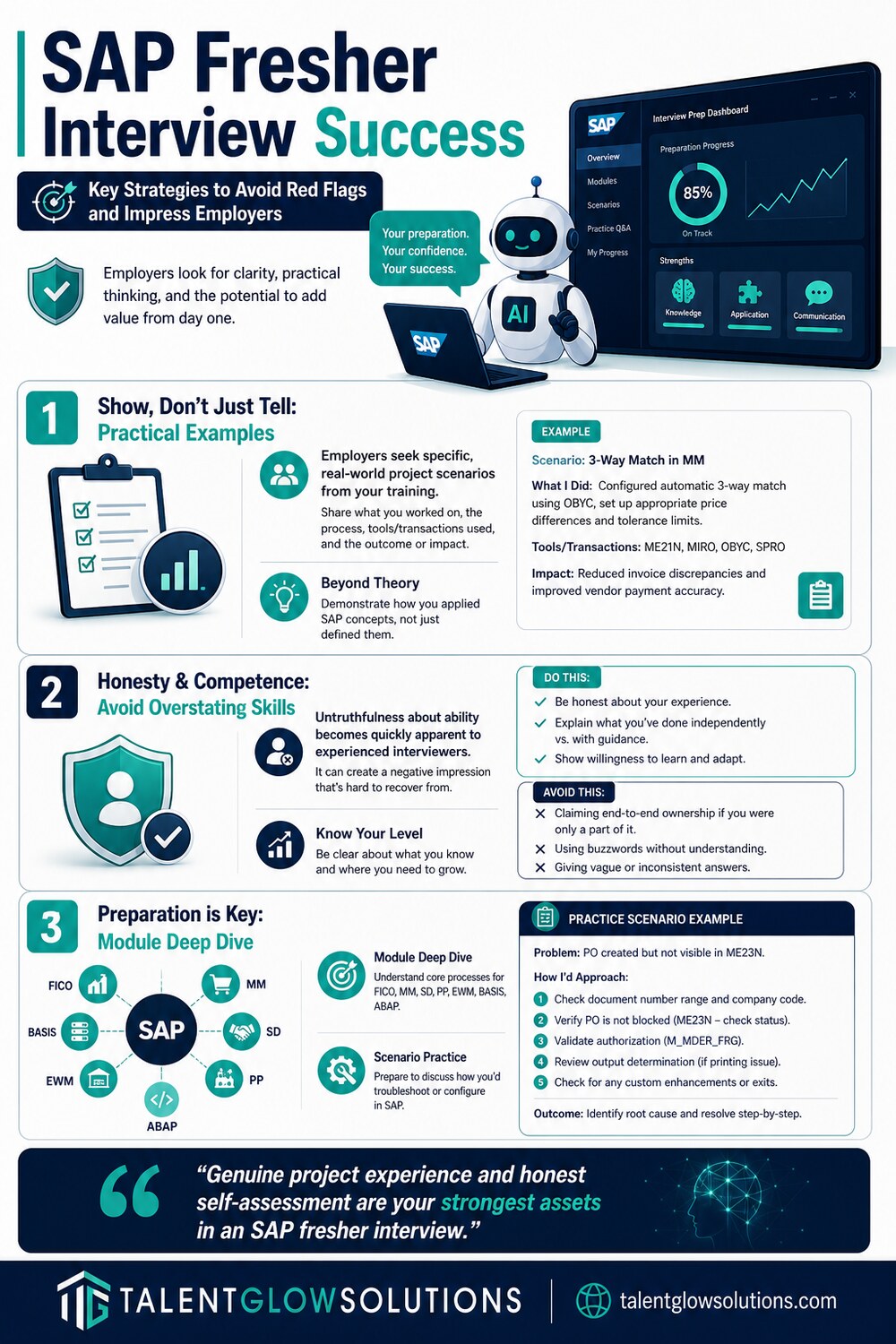
The biggest red flag employers watch for is a candidate's inability to provide specific, real-world examples from their training or projects. It's not enough to just define an SAP term; you must demonstrate how you practically applied it. This shows a true grasp of the functionality beyond theoretical knowledge.
Employers are keen to see how you've actually used SAP in a simulated or project environment. For instance, instead of saying "I know SAP FICO," explain a scenario where you configured a new GL account or processed a vendor invoice in a project. This practical demonstration is crucial for freshers.
Why is overstating abilities a major red flag?
Overstating your abilities or being untruthful about your competency level is a significant red flag that quickly becomes apparent during an interview. Interviewers are skilled at probing candidates' knowledge, and any exaggerations will be exposed, damaging your credibility. An employer considers it a red flag if freshers cannot provide specific, real-world examples from their training or projects, demonstrating practical application of SAP concepts.
It's always better to be honest about your skill level and express a willingness to learn. For example, if asked about a complex SAP module you've only briefly touched upon, acknowledge your foundational understanding and express eagerness to develop deeper expertise. This honesty is valued more than false claims.
How can I demonstrate genuine SAP project experience?
To demonstrate genuine SAP project experience, focus on describing the problems you solved and the specific SAP functionalities you used. Instead of broad statements, detail your role, the challenges encountered, and the steps you took to achieve a solution using SAP.
Consider structuring your answers using the STAR method (Situation, Task, Action, Result). This helps you provide a clear, concise, and impactful narrative of your project involvement. For example, if you worked on an SAP MM project, describe a scenario where you configured a new purchasing group or optimized a material master record. This level of detail shows depth.
- Situation: Briefly set the scene of your project.
- Task: Explain your specific responsibility within that situation.
- Action: Detail the steps you took using SAP functionalities.
- Result: Describe the outcome of your actions and what you learned.
What technical areas should SAP freshers truly understand?
SAP freshers should truly understand the core processes within the modules they have studied. This means knowing the end-to-end flow of transactions and how different components interact. Memorizing transaction codes is less important than understanding the business process they facilitate.
For example, in SAP FICO, understand the entire procure-to-pay or order-to-cash cycle. In SAP MM, grasp how material master data, purchasing, and inventory management integrate. This holistic view demonstrates a strong foundation.
| SAP Module | Core Process Understanding Needed |
|---|---|
| FICO | Procure-to-pay, Order-to-cash, General Ledger, Accounts Payable/Receivable |
| MM | Material Master, Purchasing, Inventory Management, Vendor Management |
| SD | Sales Order Processing, Delivery, Billing, Pricing |
| PP | Production Planning, Master Data, Shop Floor Control |
| EWM | Warehouse Inbound/Outbound, Storage Bin Management, Picking/Packing |
| BASIS | System Administration, User Management, Transport Management |
| ABAP | Custom Report Development, Enhancements, Debugging, Data Dictionary |
How can I prepare for scenario-based SAP interview questions?
To prepare for scenario-based SAP interview questions, practice articulating how you would approach a business problem using SAP. These questions test your problem-solving skills and your ability to apply theoretical knowledge to practical situations. An employer considers it a red flag if freshers cannot provide specific, real-world examples from their training or projects, demonstrating practical application of SAP concepts.
Think about common business challenges related to your chosen SAP modules and formulate potential solutions. For instance, if asked how to handle a stock discrepancy in SAP EWM, walk through the steps of investigation, potential system checks, and corrective actions within the system.
- Identify the core business problem: What is the root cause from an SAP perspective?
- Recall relevant SAP functionalities: Which transactions or configurations apply?
- Outline a step-by-step solution: Describe the process you'd follow in SAP.
- Explain potential impacts: How would your solution affect other modules or users?
- Mention troubleshooting: What if the initial solution doesn't work?
What role does continuous learning play for an SAP fresher?
Continuous learning plays a critical role for an SAP fresher, signaling to employers that you are adaptable and committed to long-term growth. The SAP landscape is constantly evolving, with new functionalities and updates being released regularly. Demonstrating a proactive approach to learning is highly valued.
Mention any self-study, online courses, or community involvement you participate in. This shows initiative and a genuine passion for the field. Employers want to hire individuals who will stay current and contribute to their team's knowledge base. According to Gaurav Consulting, interview tips for SAP beginners include being honest about your competency level.
How can TalentGlowSolutions help freshers avoid red flags?
TalentGlowSolutions offers mentor-led, project-based, placement-focused training that directly addresses these red flags. Our programs provide hands-on experience in modules like FICO, MM, SD, PP, EWM, BASIS, and ABAP, ensuring you can provide those crucial real-world examples employers seek.
Our approach emphasizes practical application over rote memorization, helping you build genuine competency and confidence. While we provide 100% placement assistance, we do not guarantee a job. Our focus is on equipping you with the skills and project experience to navigate interviews successfully and launch your SAP career, including preparation for SAP's own certification exams.
Sources
Frequently asked questions
What kind of SAP project examples should a fresher prepare?
Freshers should prepare specific examples detailing a problem, the SAP functionality used to solve it, and the outcome. Focus on configurations, data management, or process flows you handled in modules like FICO, MM, or SD during your training projects.
Is it okay to say 'I don't know' in an SAP interview?
Yes, it is always better to honestly state if you don't know something than to guess or mislead. Follow up by explaining what you *do* know or how you would find the answer, demonstrating your problem-solving approach and willingness to learn.
How can I show my passion for SAP during an interview?
Show your passion by discussing your motivations for pursuing an SAP career, mentioning any self-study or online resources you follow, and expressing enthusiasm for continuous learning and contributing to an SAP team. This demonstrates genuine interest beyond just getting a job.
Should I memorize SAP transaction codes for an interview?
While knowing some common transaction codes can be helpful, it's more important to understand the underlying business processes and how SAP functionalities work. Interviewers prioritize your conceptual understanding and ability to apply SAP in scenarios over rote memorization of T-codes.
Ready to launch your career?
Our mentor-led programs provide the project experience and support you need to confidently answer tough interview questions and kickstart your SAP career.
Explore Programs Talk to us