Career Roadmap
How Long Does It Take to Learn SAP FICO?
Embarking on a career in SAP FICO can be a rewarding path, but a common question for aspiring professionals is: how long does it take to learn SAP FICO? The answer isn't a simple number, as several factors influence your learning journey. Typically, becoming job-ready in SAP FICO requires a commitment of 6 to 12 months for a dedicated learner, moving from foundational knowledge to practical application and project work. This timeline allows for a comprehensive understanding of both the finance (FI) and controlling (CO) modules.
What are the key stages in learning SAP FICO?
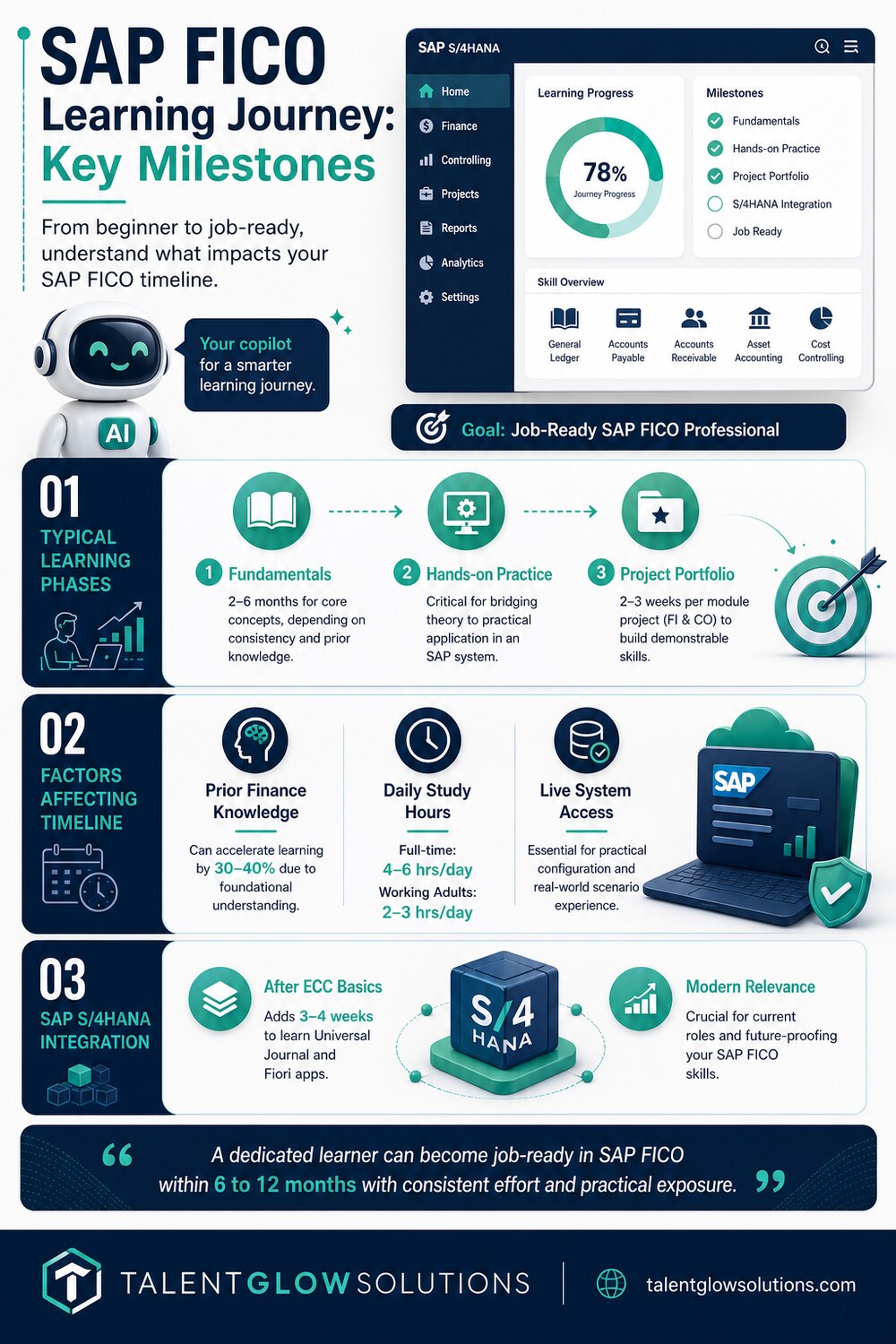
Learning SAP FICO involves distinct stages, each building upon the last. For most beginners, mastering the fundamentals of SAP FICO takes between 2 to 6 months. This initial phase focuses on understanding core concepts like General Ledger, Accounts Payable, Accounts Receivable, and Cost Center Accounting.
After grasping the basics, the next critical stage is hands-on practice. This involves working directly within an SAP system to configure settings and simulate business processes. Relying solely on theoretical knowledge from books or tutorials is a common pitfall that learners should avoid; practical exposure is essential for bridging theory to real-world application.
How does prior experience impact your learning speed?
Your existing background can significantly accelerate your learning curve. Prior accounting or finance knowledge can speed up SAP FICO learning by 30-40%. This is because you already possess a foundational understanding of the underlying business concepts that SAP FICO automates and manages.
Conversely, individuals without a finance background may need to dedicate extra time to grasp these core accounting principles before diving deep into SAP functionalities. This initial investment in understanding finance concepts will ultimately make the SAP-specific learning much smoother and more intuitive.
How many hours should you dedicate to learning each day?
The amount of time you can commit daily directly influences your overall learning timeline. Full-time learners typically dedicate 4 to 6 hours daily to SAP FICO study. This intense focus allows for faster progress through modules and concepts.
For working adults, who often juggle other responsibilities, a commitment of 2 to 3 hours daily is more common. While the daily hours are fewer, consistency is key to making steady progress over a longer period. Both approaches can lead to success, but the total duration will vary.
Why is hands-on practice so crucial for SAP FICO?
Consistent hands-on practice in a live SAP system is paramount for truly understanding SAP FICO. It's not enough to just read about configurations; you need to actively perform them. This practical application solidifies theoretical knowledge and helps you troubleshoot real-world scenarios.
Many successful learners emphasize spending a significant portion of their study time, ideally around 80%, on configuration exercises. This practical work allows you to see how changes in the system impact financial processes and reports, building confidence and competence.
What about SAP S/4HANA? How does it fit in?
SAP FICO has evolved significantly with the introduction of SAP S/4HANA. After mastering the basics of SAP ECC (the previous generation), incorporating SAP S/4HANA specifics can add 3 to 4 weeks of learning. This includes understanding innovations like the Universal Journal and Fiori apps.
Learning S/4HANA is increasingly important for current job market relevance. Many companies are migrating or have already migrated to S/4HANA, making knowledge of its features and functionalities highly valuable for aspiring SAP FICO consultants.
Building a Project Portfolio: Your Path to Job Readiness
Beyond theoretical knowledge and hands-on practice, demonstrating your skills through a project portfolio is vital for job readiness. This involves working on at least one project per module, such as an end-to-end implementation scenario for both FI and CO.
Building a demonstrable project portfolio typically takes 2 to 3 weeks per project. These projects showcase your ability to apply SAP FICO knowledge in practical business contexts, making your resume stand out to potential employers. Structured training programs, like those offered by TalentGlowSolutions, integrate project-based learning to ensure you build this crucial experience.
| Learning Factor | Impact on Timeline | Typical Duration/Effort |
|---|---|---|
| Prior Finance/Acct. | Accelerates learning by 30-40% due to foundational understanding. | Reduces overall study time, especially for initial concepts. |
| Daily Study Hours | More hours per day lead to a shorter overall timeline. | Full-time: 4-6 hours/day; Part-time: 2-3 hours/day. |
| Hands-on Practice | Critical for practical application and bridging theory to real-world scenarios. | Consistent system access and configuration exercises. |
| Project Building | Essential for demonstrating skills and preparing for interviews. | 2-3 weeks per module project (e.g., FI and CO). |
| S/4HANA Integration | Adds modern relevance and specific system knowledge. | 3-4 weeks after mastering ECC basics. |
What is the total realistic timeline to become job-ready?
Combining all these factors, a realistic timeline to become job-ready in SAP FICO is generally 6 to 12 months. This includes:
- Fundamental Learning: 2-6 months for core concepts (thesmarthands.com).
- Practical Application: Continuous hands-on work throughout the learning process.
- S/4HANA Specifics: An additional 3-4 weeks after ECC basics for modern relevance.
- Project Portfolio Development: 2-3 weeks per module for demonstrable projects.
This comprehensive approach ensures you have both the theoretical understanding and the practical experience employers seek. TalentGlowSolutions offers mentor-led, project-based training to guide you through each of these stages, providing support and mentorship to help you achieve your career goals. We offer 100% placement assistance, though we do not guarantee a job.
Sources
Frequently asked questions
Do I need a finance background to learn SAP FICO?
While not strictly required, a prior accounting or finance background can significantly accelerate your learning by 30-40%. It provides a strong foundation in the business concepts that SAP FICO manages, making the technical aspects easier to grasp.
Is SAP FICO certification necessary for a job?
While not always mandatory, an SAP FICO certification can enhance your credibility and demonstrate a verified level of expertise to potential employers. It shows a commitment to the field and a solid understanding of the module.
What's the difference between SAP ECC FICO and SAP S/4HANA Finance?
SAP ECC FICO is the traditional version, while SAP S/4HANA Finance is the modern, redesigned suite optimized for the HANA database. S/4HANA introduces innovations like the Universal Journal and Fiori apps, offering improved performance and user experience. Learning S/4HANA is crucial for current industry relevance.
How important is hands-on practice in learning SAP FICO?
Hands-on practice is critically important. Relying solely on theoretical knowledge is a common pitfall. Consistent practical exposure in an SAP system, focusing on configuration and real-world scenarios, is essential for bridging theoretical understanding to practical application and becoming job-ready.
Can I learn SAP FICO while working full-time?
Yes, many working adults successfully learn SAP FICO. While full-time learners might dedicate 4-6 hours daily, working professionals typically commit 2-3 hours daily. Consistency over a longer period is key to making steady progress alongside your existing commitments.
Ready to launch your career?
For personalized guidance on your SAP FICO learning path and to explore project-based training, connect with TalentGlowSolutions.
Explore Programs Talk to us