Career Guidance
SAP FICO vs. SAP SD: Choosing Your Path as a Commerce Graduate

Embarking on an SAP career can be a strategic move for commerce graduates, offering diverse opportunities across various modules. Two prominent modules, SAP FICO (Financial Accounting and Controlling) and SAP SD (Sales and Distribution), often stand out as natural fits for those with a B.Com or M.Com background. Understanding the core functions and daily tasks of each can help you decide which path aligns best with your skills and career aspirations.
What is SAP FICO and Why is it Good for Commerce Graduates?
SAP FICO is a crucial module that manages all financial transactions, accounting records, budgeting, cost control, and financial reporting within an organization. It's an excellent fit for commerce graduates because their academic background in accounting and financial statements directly applies to its functionalities. This existing knowledge provides a significant advantage when learning and working with FICO.
SAP FICO is divided into two main components: Financial Accounting (FI) and Controlling (CO). FI handles external reporting, like balance sheets and profit and loss statements, ensuring compliance with legal requirements. CO focuses on internal reporting, helping management make informed decisions through cost analysis and profitability tracking.
What Does a Day in SAP FICO Look Like?
A typical day for an SAP FICO professional involves a range of financial activities. You might be managing general ledger entries, processing accounts payable (AP) and accounts receivable (AR), or handling asset accounting. This role demands precision and a deep understanding of financial principles.
Key areas of focus in SAP FICO include:
- General Ledger (GL) Accounting: Managing all financial transactions and balances.
- Accounts Payable (AP): Processing vendor invoices and payments.
- Accounts Receivable (AR): Managing customer invoices and incoming payments.
- Asset Accounting: Tracking the lifecycle of company assets.
- Bank Accounting: Reconciling bank statements and managing cash flows.
- Cost Center Accounting: Monitoring and allocating costs within departments.
Commerce graduates naturally excel in these areas due to their foundational knowledge in accounting. This makes the transition into an SAP FICO role smoother and more intuitive.
What is SAP SD and How Does it Relate to Commerce?
SAP SD, or Sales and Distribution, is a core module that handles all processes related to sales, order management, shipping, and billing. While it might seem less directly related to traditional commerce studies than FICO, it is integral to the commercial operations of any business. Commerce graduates often have a strong grasp of business processes and customer interactions, which are vital for SD.
SAP SD covers the entire sales cycle, from receiving a customer inquiry to delivering the product and processing the payment. It integrates closely with other modules like FICO and MM (Materials Management) to ensure smooth business operations. Understanding how sales impact financial records and inventory is where a commerce background becomes highly valuable.
What Does an SAP SD Professional Do Daily?
An SAP SD professional's day revolves around ensuring efficient sales and distribution processes. They might be configuring pricing procedures, managing customer master data, or overseeing the delivery process. Their work directly impacts customer satisfaction and revenue generation.
Typical responsibilities in SAP SD include:
- Sales Order Processing: Creating and managing customer orders.
- Delivery Processing: Organizing and tracking the shipment of goods.
- Billing and Invoicing: Generating invoices and managing billing documents.
- Pricing and Conditions: Configuring complex pricing structures.
- Credit Management: Assessing and managing customer credit limits.
- Foreign Trade: Handling import/export documentation and processes.
Commerce graduates with an interest in logistics, supply chain, and customer relationship management will find SAP SD a compelling career path. It offers a dynamic environment focused on business growth and operational efficiency.
SAP FICO vs SAP SD: Which Module Suits a Commerce Graduate Better?
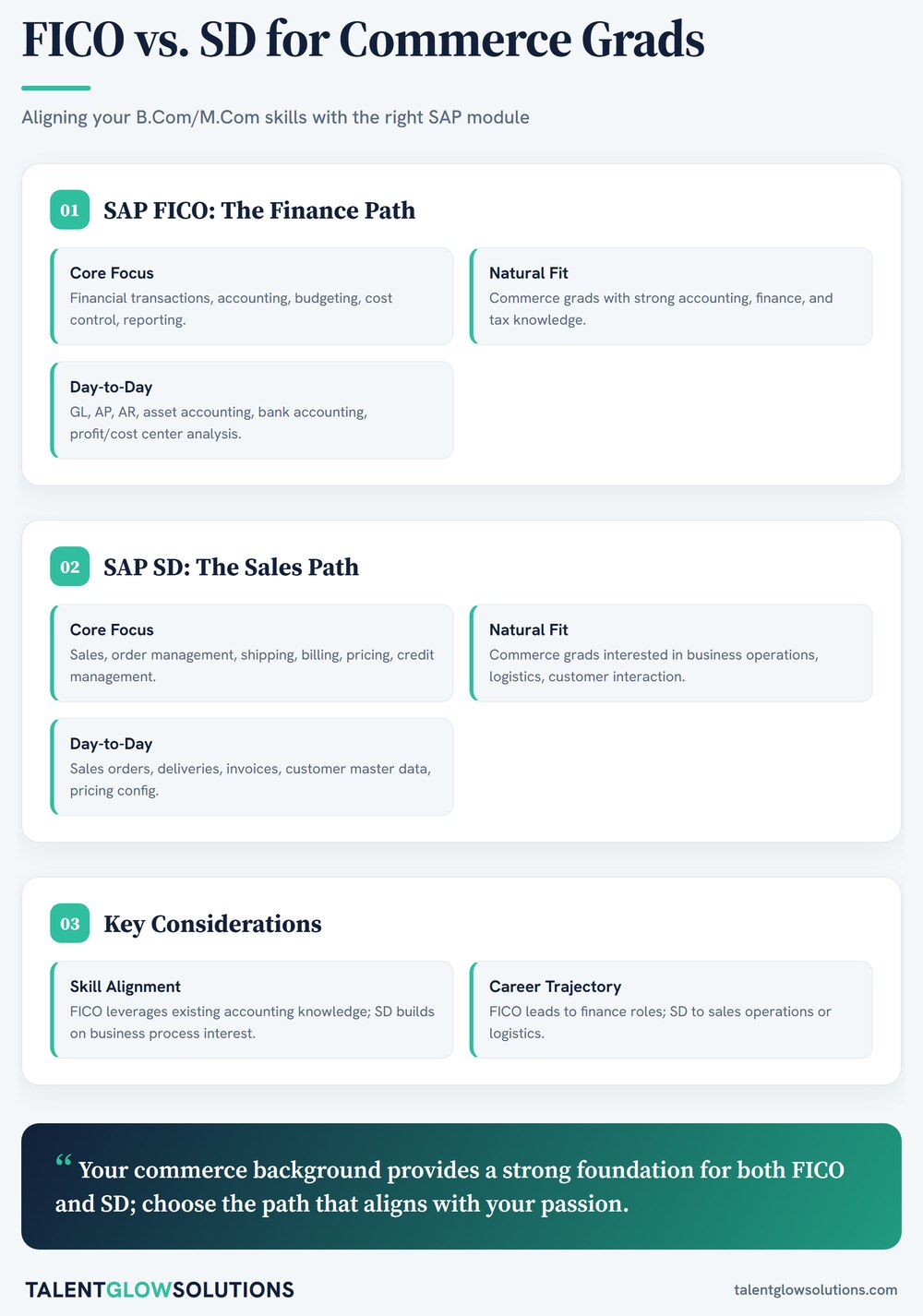
The choice between SAP FICO and SAP SD largely depends on your specific interests and the areas of your commerce degree you enjoyed most. Both modules offer robust career opportunities for B.Com and M.Com graduates, leveraging different aspects of their education.
| Feature | SAP FICO | SAP SD |
|---|---|---|
| Primary Focus | Financial accounting, cost control, reporting | Sales, order processing, shipping, billing |
| Key Skills Used | Accounting principles, financial analysis, taxation | Business processes, logistics, customer relations |
| Day-to-Day Tasks | GL entries, AP/AR, asset accounting, financial reports | Sales orders, deliveries, invoices, pricing config |
| Career Path | Finance consultant, financial analyst, cost accountant | Sales consultant, logistics analyst, business analyst |
| Natural Alignment | Strong with accounting, finance, audit background | Strong with sales operations, supply chain interest |
If you are passionate about numbers, financial accuracy, and compliance, FICO is likely your stronger fit. If you are more inclined towards customer interaction, optimizing sales processes, and managing the flow of goods, then SD could be more appealing. Both paths offer rewarding careers in the SAP ecosystem.
How Can Training Help You Choose and Succeed?
Regardless of your choice, specialized training is essential to master either SAP FICO or SAP SD. Programs that offer mentor-led instruction on a live S/4HANA system provide invaluable hands-on experience. This practical approach ensures you understand real-world scenarios and can confidently apply your knowledge.
At TalentGlowSolutions, our SAP FICO, MM, SD, PP, EWM, BASIS, and ABAP modules are designed to equip learners with comprehensive skills. With dedicated support and mentorship, you can build a strong foundation in your chosen SAP module. This prepares you for the challenges and opportunities in the SAP job market.
What are the Career Prospects for FICO and SD?
Both SAP FICO and SAP SD offer promising career prospects in the ever-expanding SAP ecosystem. Companies across various industries rely on these modules for their core business operations, creating a consistent demand for skilled professionals. A strong understanding of either module makes you a valuable asset to many organizations.
For FICO, roles often include SAP FICO Consultant, Financial Analyst, or Cost Accountant. In SD, common positions are SAP SD Consultant, Sales Operations Analyst, or Logistics Coordinator. The skills gained are highly transferable and sought after, providing a stable and growth-oriented career trajectory.
Sources
Frequently asked questions
Is SAP FICO harder than SAP SD for commerce graduates?
Neither module is inherently 'harder'; rather, they require different skill sets. SAP FICO aligns more directly with traditional accounting and finance knowledge, which commerce graduates already possess. SAP SD, while also suitable, focuses more on sales processes and logistics, which might require a different learning curve depending on your specific interests.
Can I learn both SAP FICO and SAP SD?
While it's possible to learn both modules, it's generally recommended to master one first to build a strong foundation. Becoming proficient in one module makes you a specialist, which is often more appealing to employers. Once you have experience in one, you can always expand your knowledge to other modules like SD or even MM (Materials Management).
Do I need a technical background for SAP FICO or SAP SD?
No, a technical background is not strictly required. Both FICO and SD are functional modules, meaning they focus on business processes rather than coding. A commerce background provides an excellent foundation for understanding the business logic behind these modules, making them accessible to non-technical graduates.
What kind of jobs can I get after learning SAP FICO or SD?
With SAP FICO, you can pursue roles like SAP FICO Consultant, Financial Analyst, or Cost Accountant. For SAP SD, common roles include SAP SD Consultant, Sales Operations Analyst, or Logistics Coordinator. Both paths lead to roles vital for business operations across various industries.
Ready to launch your career?
Our mentor-led training in SAP FICO, SD, and other modules provides the support and practical experience you need to confidently start your SAP career.
Explore Programs Talk to us