Career Planning
Realistic Time Commitment for Structured SAP SAP Training

Embarking on SAP training is a significant career step, promising new opportunities in a high-demand field. However, many aspiring SAP professionals, especially those balancing existing jobs or academic commitments, wonder about the actual time investment required. Understanding how many hours a week does structured SAP training actually need is crucial for setting realistic expectations and ensuring successful completion.
This article provides a practical guide to the weekly time commitment for structured SAP training, helping you plan effectively to gain valuable skills without sacrificing your current responsibilities.
What is the realistic weekly time commitment for SAP training?
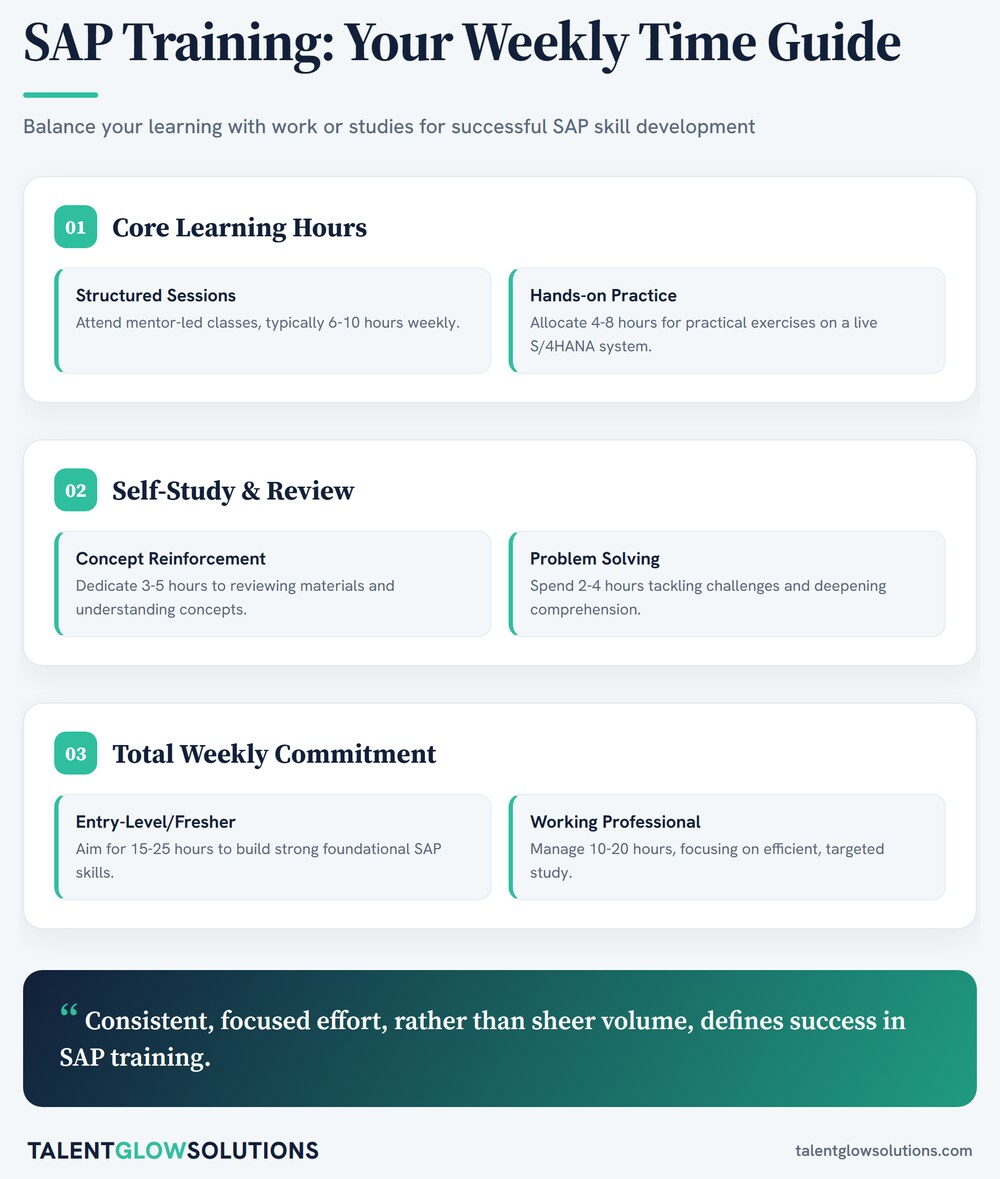
A realistic weekly time commitment for structured SAP training typically ranges from 10 to 25 hours, depending on your prior experience, the intensity of the program, and your learning style. This includes a mix of live instruction, hands-on practice, and independent study. For working professionals, a commitment closer to the lower end might be more sustainable, while freshers or those dedicating more time can push towards the higher end.
Consistency is more important than sporadic long hours. Regular engagement ensures that concepts are reinforced and skills are built progressively.
How do mentor-led sessions factor into weekly hours?
Mentor-led sessions are a core component of structured SAP training, providing direct instruction and guidance. These sessions typically account for 6 to 10 hours per week. They cover foundational concepts, module-specific functionalities, and real-world scenarios.
For example, in a module like SAP FICO, mentors guide you through financial accounting and controlling processes. In SAP MM, you'll learn material management workflows. These live interactions are invaluable for clarifying doubts and understanding complex topics from experienced professionals.
Why is hands-on practice on a live S/4HANA system essential?
Hands-on practice on a live S/4HANA system is absolutely essential for transforming theoretical knowledge into practical skills. You should allocate an additional 4 to 8 hours per week specifically for this practical application. This time is dedicated to configuring settings, executing transactions, and troubleshooting issues within a real SAP environment.
This practical experience is what makes you job-ready. Whether you're working on SAP SD sales order processing or SAP ABAP custom development, direct interaction with the system solidifies your learning. TalentGlowSolutions emphasizes project-based learning on live S/4HANA systems to ensure learners gain this critical experience.
What independent study and review are needed?
Beyond formal sessions and practical exercises, independent study and review are critical for deep understanding and retention. Plan for an additional 5 to 9 hours per week for self-paced learning. This includes reviewing course materials, reading documentation, watching supplementary videos, and practicing problem-solving.
This time allows you to revisit challenging topics at your own pace. For instance, if you're learning SAP PP, you might spend extra time understanding production orders or master data. If it's SAP BASIS, you could delve deeper into system administration concepts.
How does module choice affect time commitment?
The specific SAP module you choose can influence the intensity and focus of your weekly time commitment. While the overall hours might stay similar, the nature of the study can vary significantly. Some modules might require more conceptual understanding, while others demand extensive configuration practice.
| SAP Module | Primary Focus | Typical Learning Activities |
|---|---|---|
| FICO | Financial & Controlling | Configuration, report generation, accounting principles |
| MM | Materials Management | Master data setup, purchasing processes, inventory management |
| SD | Sales & Distribution | Sales order processing, pricing, shipping, billing |
| PP | Production Planning | Master data, production orders, capacity planning |
| EWM | Extended Warehouse Mgmt. | Warehouse configuration, goods movement, RF transactions |
| BASIS | System Administration | Installation, monitoring, user management, performance tuning |
| ABAP | Programming & Development | Coding, debugging, object-oriented concepts, report creation |
Can SAP training be balanced with a full-time job or studies?
Yes, SAP training can absolutely be balanced with a full-time job or academic studies, but it requires careful planning and discipline. Many successful SAP professionals have transitioned or upskilled while maintaining their existing commitments. The key is to create a consistent, manageable schedule.
Here are steps to effectively balance your training:
- Assess Your Availability: Honestly evaluate your free hours each week, considering work, family, and personal time.
- Set Realistic Goals: Don't try to cram too much. Focus on mastering concepts gradually.
- Create a Study Schedule: Block out specific times for classes, practice, and review. Treat these blocks as non-negotiable appointments.
- Utilize Weekends: Dedicate larger chunks of time on weekends for deeper dives and project work.
- Leverage Flexibility: Online training options and recorded sessions can offer flexibility for busy schedules.
- Stay Organized: Keep track of your progress, deadlines, and learning objectives.
- Seek Support: Don't hesitate to reach out to mentors or peers when you encounter difficulties.
What is the role of mentorship in managing time effectively?
Mentorship plays a crucial role in helping learners manage their time effectively and stay on track. A good mentor can provide personalized guidance, clarify complex topics, and offer strategies for efficient study. They can help you prioritize tasks and focus on the most critical areas, preventing you from getting overwhelmed.
At TalentGlowSolutions, our mentor-led approach ensures you have expert support throughout your journey, helping you navigate the learning curve and optimize your study hours. This guidance is particularly valuable for complex modules like SAP ABAP, where debugging skills are paramount, or SAP EWM, which involves intricate warehouse processes.
What are the long-term benefits of consistent SAP training?
The long-term benefits of consistent SAP training are substantial, leading to enhanced career prospects and specialized skill development. Investing the necessary weekly hours translates into a strong foundation in a highly sought-after enterprise software. SAP skills are globally recognized and open doors to various roles in implementation, support, consulting, and development.
Consistent effort ensures you not only pass exams but genuinely understand how SAP modules like SAP FICO or SAP SD integrate within a business. This deep understanding is what employers truly value, leading to sustained career growth in the SAP ecosystem. TalentGlowSolutions provides 100% placement assistance, offering guidance and support in navigating the job market, though we do not guarantee a job.
Frequently asked questions
Is 10 hours a week enough for SAP training?
For working professionals, 10-15 hours per week can be sufficient if consistently applied, focusing on quality over quantity. This typically includes mentor-led sessions and dedicated hands-on practice.
How long does it take to become proficient in an SAP module?
Proficiency in an SAP module typically takes several months of structured training and consistent practice. The duration depends on the module's complexity and your dedicated weekly hours.
Do I need a technical background for SAP training?
While a technical background can be helpful for modules like ABAP or BASIS, many functional modules like FICO, MM, and SD are accessible to individuals with relevant business domain knowledge, even without a strong technical background.
How much does SAP certification cost?
The cost of SAP certification exams is set by SAP and varies by region and specific certification. You can find current pricing details and registration information on the official SAP certification website.
Can I switch SAP modules during training?
Switching modules depends on the training provider's policies and the stage of your current training. It's best to discuss this with your training institute to understand the options and implications for your learning path.
Ready to launch your career?
TalentGlowSolutions offers mentor-led SAP training and career support to help you achieve your professional goals.
Explore Programs Talk to us