Hiring Insights
Spotting Inflated SAP Experience: Red Flags for Hiring Managers

Hiring for SAP roles demands a keen eye. The complexity and demand for SAP professionals can unfortunately lead some candidates to exaggerate their qualifications. Identifying warning signs a candidate's SAP experience is inflated is crucial for employers to avoid costly mis-hires and ensure project success. This article will equip you with strategies to effectively screen candidates and pinpoint genuine expertise.
Why is identifying inflated SAP experience so critical?
Misrepresenting SAP experience can lead to significant project delays, budget overruns, and ultimately, failure to achieve business objectives. An individual lacking true proficiency may struggle with complex configurations, troubleshooting, or integrating different SAP modules, impacting team productivity. It's not just about technical skills; it's about the ability to contribute effectively to a demanding enterprise environment.
What are the most common red flags on an SAP resume?
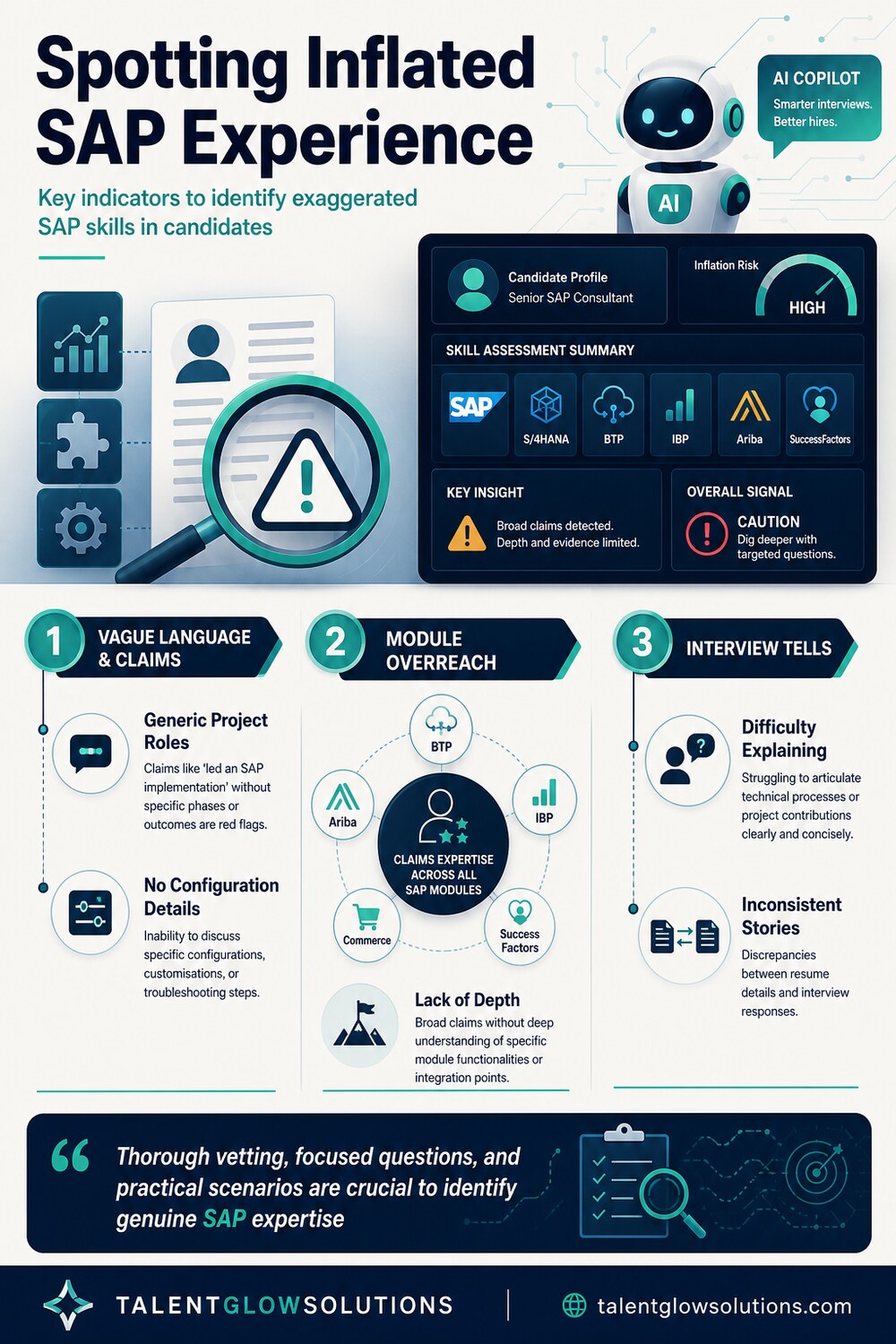
The resume is your first line of defense. Look for vague language that lacks specific details. For instance, a candidate stating they "led an SAP implementation" without elaborating on the phases, their specific role, the technologies used, or the measurable outcomes, is a significant red flag. Genuine experience is typically backed by concrete examples and quantifiable achievements.
- Generic Project Descriptions: Phrases like "involved in various SAP projects" without detailing specific responsibilities or contributions.
- Lack of Technical Specifics: Absence of module names, version numbers, or specific configuration elements they worked on.
- Broad Module Claims: Stating expertise across an improbable number of diverse SAP modules without depth.
How can you spot inflated module expertise?
Candidates who claim expertise across every SAP module or platform, such as SAP BTP, IBP, Ariba, SuccessFactors, and Commerce, often raise a red flag. True SAP consultants usually specialize in a few core modules and have a foundational understanding of others. Deep expertise in one area is generally more valuable than superficial knowledge across many.
Consider the breadth versus depth of their claimed knowledge. It's rare for one individual to be a master of everything from financial accounting (FICO) to supply chain planning (IBP) and HR (SuccessFactors). Probe into their experience with specific functionalities within each claimed module.
What interview questions reveal a candidate's true SAP skills?
During interviews, shift from theoretical questions to scenario-based inquiries. Ask candidates to walk you through a specific configuration process they implemented, or how they resolved a particular SAP issue. Their ability to articulate the steps, challenges, and solutions will quickly reveal their practical experience.
- "Describe a complex SAP configuration you designed. What were the key steps and challenges?"
- "Walk me through a time you had to troubleshoot an integration error between two SAP modules. What was your approach?"
- "Explain the data flow from a sales order in SD to the corresponding accounting document in FICO."
- "How would you handle a user request for a custom report that isn't available out-of-the-box?"
What are the specific 'tells' during technical discussions?
Genuine SAP professionals can discuss technical specifics with ease. They will use precise terminology, explain concepts clearly, and provide examples from their past work. Watch out for candidates who use buzzwords without understanding their underlying meaning or who struggle to explain fundamental processes within their claimed modules.
| Red Flag | Green Light |
|---|---|
| "I worked on the finance module." | "I configured GL accounts and cost centers in FICO." |
| "We used standard SAP processes." | "I customized the procure-to-pay workflow in MM." |
| "I managed the project." | "I led the blueprinting phase for SD module implementation." |
| "I know all about integrations." | "I set up EDI interfaces for vendor invoices." |
How can you verify SAP project experience?
Beyond the interview, consider reference checks that specifically target their SAP contributions. Ask previous supervisors or colleagues about the candidate's precise roles, responsibilities, and achievements on SAP projects. Inquire about their ability to handle pressure, solve problems, and collaborate within an SAP environment. This external validation is invaluable.
- Request specific project examples: Ask for details on 2-3 significant SAP projects they contributed to.
- Verify roles and responsibilities: Confirm their actual involvement versus broad claims.
- Inquire about challenges and solutions: How did they address real-world SAP problems?
- Assess teamwork: How did they collaborate with functional and technical teams?
What about broad claims of platform expertise?
Be particularly cautious of candidates who claim extensive experience across various SAP platforms like SAP BTP (Business Technology Platform), IBP (Integrated Business Planning), Ariba (procurement), SuccessFactors (HR), and Commerce (e-commerce). These platforms are diverse and require distinct skill sets. While some overlap exists, deep expertise in all is highly improbable for a single individual, as noted by Bull City Talent. Always probe for specific project examples on each claimed platform.
Identifying inflated SAP experience requires a structured and critical approach. By focusing on specific details, challenging broad claims, and asking targeted questions, employers can significantly improve their chances of finding truly qualified SAP professionals. TalentGlowSolutions provides mentor-led, project-based training that helps learners gain practical, real-world experience, preparing them for the demands of genuine SAP roles.
Sources
Frequently asked questions
What is considered a red flag for inflated SAP experience?
Vague language on a resume or in an interview, such as "led an SAP implementation" without explaining phases or outcomes, is a significant red flag. Additionally, claiming expertise across every SAP module or platform without specific depth is suspicious.
How can I tell if a candidate truly understands SAP modules?
True understanding is revealed through specific examples. Ask candidates to detail configurations they implemented, specific challenges they faced within a module, and how they resolved them. They should be able to articulate technical processes clearly and concisely.
Should an SAP candidate know every SAP module?
No, it's highly unlikely and a red flag if a candidate claims deep expertise across every SAP module or platform like SAP BTP, IBP, Ariba, SuccessFactors, and Commerce. Most SAP professionals specialize in a few core modules.
What kind of questions should I ask to uncover inflated SAP skills?
Focus on scenario-based and technical questions. For example, ask them to describe a complex configuration they designed, a troubleshooting process they followed, or to explain data flow between specific modules. This reveals practical application over theoretical knowledge.
Ready to launch your career?
Our mentor-led programs provide comprehensive training and placement assistance to help individuals build genuine, project-based SAP expertise for their careers.
Explore Programs Talk to us