Hiring Strategy
SAP EWM Specialist vs. General Warehouse Hire: Making the Right Choice
Optimizing warehouse operations is crucial for any business, and the choice between a general warehouse hire and an SAP EWM specialist can significantly impact efficiency and cost. This decision becomes particularly important as more companies adopt SAP S/4HANA with its embedded Extended Warehouse Management (EWM) capabilities. Understanding the nuances of your warehouse needs and EWM's role is key to making the right hiring call.
What is Embedded EWM in S/4HANA?
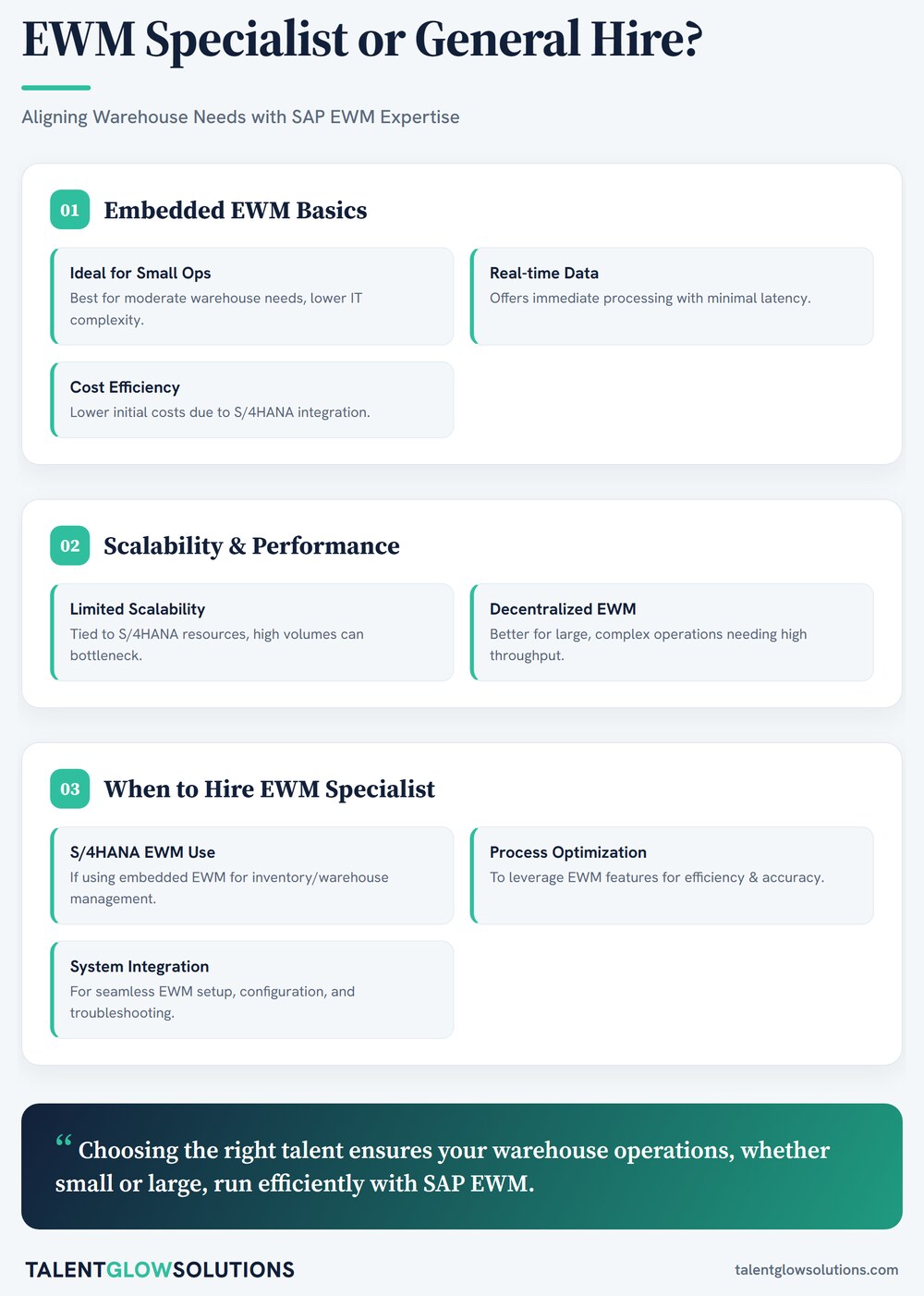
Embedded EWM refers to the EWM functionality directly integrated within the SAP S/4HANA system, rather than as a separate, decentralized system. This integration allows for real-time data processing with lower latency, making it ideal for smaller operations with moderate warehouse needs. It also generally entails minimal IT complexity and cost compared to a standalone EWM system.
- Real-time integration: Data flows seamlessly between EWM and other S/4HANA modules like FICO, MM, and SD.
- Simplified landscape: No separate EWM server means fewer interfaces to manage and maintain.
- Cost-effective: Lower total cost of ownership (TCO) due to reduced infrastructure and integration efforts.
- Ideal use cases: Best suited for companies managing straightforward warehousing processes without extremely high transaction volumes.
When is a General Warehouse Hire Sufficient?
A general warehouse hire is sufficient when your warehouse operations are primarily manual, or when your use of SAP EWM is limited to basic inventory tracking and transaction execution without complex configuration. These roles typically focus on physical tasks, such as receiving, picking, packing, and shipping goods, often guided by system-generated instructions rather than configuring the system itself. They are crucial for the day-to-day physical flow of goods.
- Basic operations: Handling standard goods movement, stock putaway, and retrieval.
- Limited EWM interaction: Primarily executing tasks generated by EWM, not setting up processes.
- Cost-effective for simple tasks: Lower salary overhead compared to a specialized EWM role.
- Focus on physical logistics: Expertise in material handling, safety protocols, and operational efficiency.
When Does a Company Need an SAP EWM Specialist Instead of a General Warehouse Hire?
A company needs an SAP EWM specialist when it is implementing, optimizing, or troubleshooting its embedded EWM system within S/4HANA. An EWM specialist possesses deep knowledge of the module's functionalities, configuration, and integration points, which is critical for leveraging EWM to its full potential. This includes setting up complex warehouse processes, optimizing picking strategies, and ensuring data accuracy across the supply chain.
- Implementation & Configuration: Setting up warehouse structures, storage types, and process flows within EWM.
- System Optimization: Fine-tuning EWM settings to improve efficiency, reduce errors, and enhance throughput.
- Complex Process Design: Developing and implementing advanced strategies for wave management, yard management, or value-added services (VAS).
- Integration Challenges: Resolving issues related to EWM's interaction with other SAP modules (FICO, MM, SD, PP, ABAP, BASIS).
- Training & Support: Providing in-depth training to end-users and offering expert-level support for EWM-related queries.
Scalability Considerations for Embedded EWM
While embedded EWM offers many advantages for smaller operations, its scalability is limited by S/4HANA system resources. This means that companies with high transaction volumes or extremely complex warehouse processes may experience performance bottlenecks. When your warehouse grows significantly, or transaction loads become very high, a decentralized EWM system might be a more suitable choice. A decentralized EWM runs on its own server, offering greater independence and scalability.
| Feature | Embedded EWM | Decentralized EWM |
|---|---|---|
| Integration | Directly within S/4HANA, real-time | Separate system, asynchronous |
| Scalability | Limited by S/4HANA resources | Independent, highly scalable |
| IT Complexity | Lower, unified system | Higher, separate infrastructure |
| Cost | Generally lower TCO | Higher TCO, dedicated server |
| Ideal Use | Moderate warehouse needs | High volume, complex operations |
The Role of an EWM Specialist in Optimization
An SAP EWM specialist plays a pivotal role in optimizing warehouse processes by configuring the system to match specific operational requirements. They can design and implement strategies that significantly improve efficiency, such as optimizing putaway and picking routes, managing inventory accurately, and streamlining shipping processes. Their expertise ensures that the embedded EWM system is not just functional but also performs at its peak. This involves understanding business needs and translating them into effective system configurations.
- Process mapping: Analyzing current warehouse processes and identifying areas for EWM-driven improvement.
- Master data management: Ensuring accurate setup of product, storage, and resource master data within EWM.
- Performance tuning: Monitoring system performance and making adjustments to maximize efficiency and response times.
- Reporting and analytics: Developing custom reports and dashboards to provide insights into warehouse operations.
How to Train Your Team for EWM Expertise
To build in-house EWM expertise, consider specialized training programs that cover the intricacies of SAP EWM. TalentGlowSolutions, for example, offers mentor-led, project-based training on a live S/4HANA system for various SAP modules, including EWM. Such training helps existing staff or new hires develop the practical skills needed to manage and optimize EWM efficiently. This investment in training can bridge the gap between general warehouse knowledge and the specialized skills required for embedded EWM.
- Identify key personnel: Determine which roles would benefit most from in-depth EWM training.
- Choose a comprehensive program: Look for training that covers EWM configuration, master data, process flows, and integration.
- Emphasize practical application: Ensure the training includes hands-on experience with a live SAP S/4HANA system.
- Support certification readiness: Encourage and prepare staff for SAP's own certification exams to validate their expertise.
- Foster continuous learning: Provide resources for ongoing skill development as SAP EWM evolves.
Making the right hiring decision between a general warehouse employee and an SAP EWM specialist is crucial for your operational success. It depends heavily on the complexity of your warehouse, your transaction volumes, and how deeply you leverage SAP EWM within S/4HANA. Investing in specialized EWM talent or training existing staff can significantly enhance your supply chain efficiency and profitability.
TalentGlowSolutions offers comprehensive, mentor-led SAP EWM training, including 100% placement assistance (we do not guarantee a job), to help individuals develop the skills employers need to optimize their SAP warehouse management processes.
Sources
Frequently asked questions
What is the primary benefit of embedded EWM?
The primary benefit of embedded EWM is its real-time data processing with lower latency and minimal IT complexity and cost, making it ideal for smaller operations with moderate warehouse needs. It simplifies the system landscape by integrating directly into S/4HANA.
When should a company consider a decentralized EWM system?
A company should consider a decentralized EWM system when it has high transaction volumes, complex warehouse processes, or needs greater scalability beyond what S/4HANA system resources can support. Decentralized EWM operates as a separate system, offering more independence.
What skills does an SAP EWM specialist bring to a company?
An SAP EWM specialist brings expertise in configuring, optimizing, and troubleshooting the EWM module, including setting up warehouse structures, designing complex process flows, and ensuring seamless integration with other SAP modules. They are crucial for maximizing EWM's efficiency.
How does embedded EWM impact IT costs?
Embedded EWM generally leads to lower IT costs because it eliminates the need for a separate EWM server and reduces the complexity of managing multiple interfaces. This results in lower infrastructure, integration, and maintenance expenses compared to a decentralized system.
Can a general warehouse employee learn SAP EWM?
Yes, a general warehouse employee can learn SAP EWM through specialized training programs. Such training can equip them with the necessary skills to understand EWM functionalities, execute tasks, and even perform basic configurations, transforming them into more specialized assets for the company.
Ready to launch your career?
Elevate your team's capabilities with TalentGlowSolutions's expert-led SAP EWM training and mentorship.
Explore Programs Talk to us