Hiring Strategy
Streamlining Tech & SAP Hiring: How to Reduce Time to Hire Effectively

Hiring for tech and SAP roles often feels like a race against the clock. The longer a position remains open, the more it impacts team productivity and project timelines. For hiring managers, understanding where weeks are actually lost in the recruitment process is the first step to reclaiming that time and securing top talent faster.
Why is Reducing Time to Hire Critical for Tech and SAP Roles?
Reducing the time to hire is crucial for several reasons in the competitive tech and SAP landscape. Firstly, top tech talent, especially those with specialized SAP skills, are in high demand and often have multiple offers. A prolonged hiring process means these candidates are likely to accept positions elsewhere before you can extend an offer.
Secondly, open positions directly impact team workload and project delivery. Delays in hiring can lead to burnout for existing team members and push back critical project milestones. A faster hiring cycle keeps your team optimized and projects on track.
Where Do Weeks Get Lost in the Hiring Process?
Hiring managers often encounter several common bottlenecks that significantly extend the time to hire. These aren't always obvious, but they accumulate, turning a potentially quick hire into a drawn-out saga. Identifying these specific friction points is essential for targeted improvements.
How Does Screening Volume Impact Time to Hire?
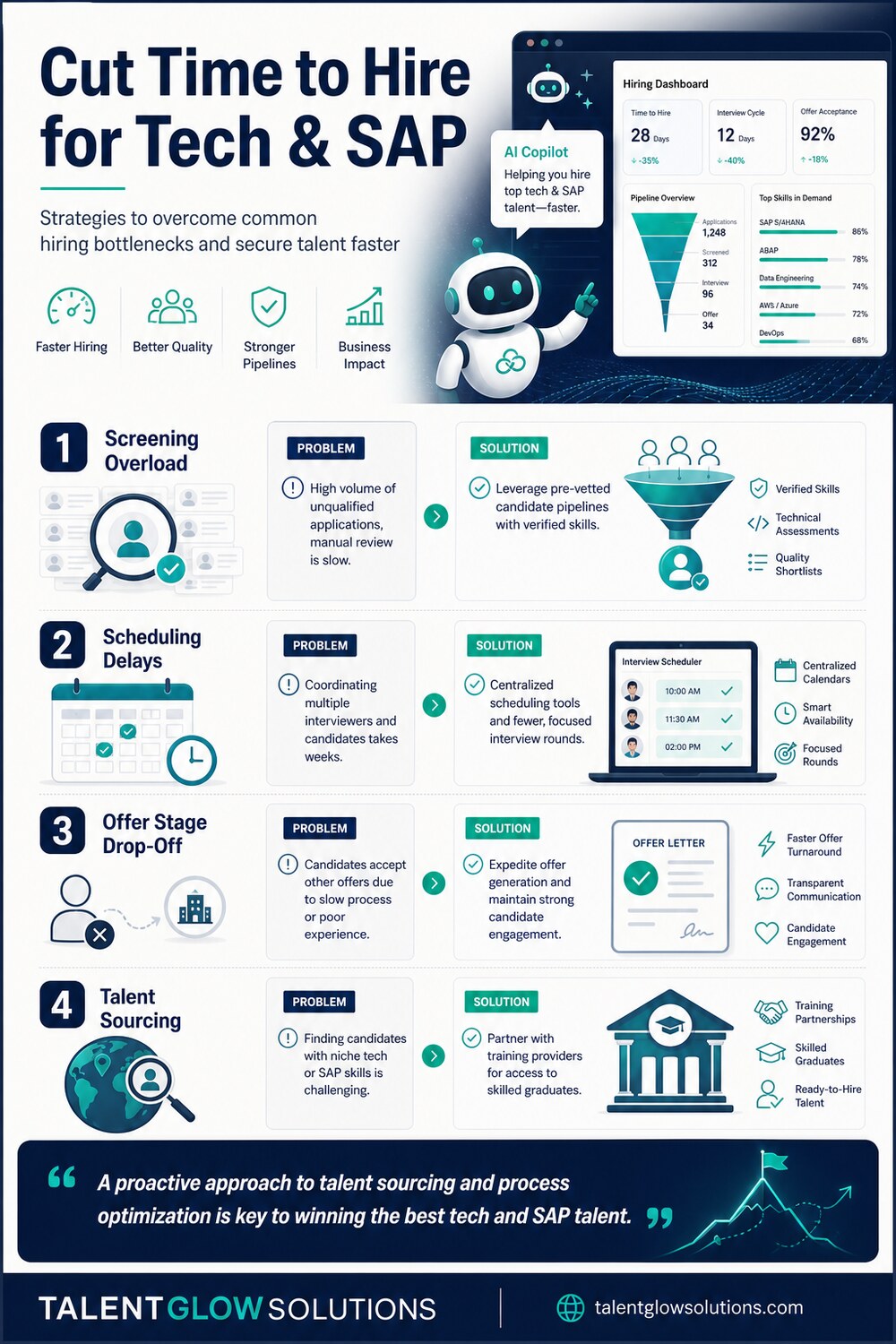
High screening volume is a major time sink, especially for popular tech and SAP roles. A single job posting can attract hundreds of applications, many of which are not a good fit for the specific technical requirements. Manually sifting through these resumes consumes valuable time that could be spent on more qualified candidates.
- Problem: Overwhelming number of applications, many lacking specific required skills.
- Impact: HR teams and hiring managers spend hours reviewing irrelevant profiles.
- Solution: Implement rigorous initial filters or leverage pre-vetted talent sources.
What are the Hidden Costs of Manual Interview Scheduling?
Panel scheduling can easily add weeks to the hiring timeline. Coordinating calendars for multiple interviewers (hiring manager, team leads, HR) and the candidate becomes a logistical nightmare. Each email exchange or reschedule adds days to the process, frustrating both internal teams and the candidate.
- Problem: Difficulty aligning calendars for multiple stakeholders.
- Impact: Delays in moving candidates through interview stages, leading to drop-offs.
- Solution: Utilize scheduling tools and optimize the number of interview rounds.
Why Do Candidates Drop Off During the Offer Stage?
Offer-stage drop-off is a painful experience after investing significant time and resources. Candidates often receive multiple offers, and a slow or unclear offer process from one company can push them towards another. Lack of transparency or prolonged internal approvals can make your company seem less desirable.
- Problem: Delays in extending offers or a poor candidate experience post-interview.
- Impact: Losing top candidates to competitors who move faster.
- Solution: Streamline offer approvals and maintain consistent candidate communication.
How Can Pre-Vetted Pipelines Reduce Time to Hire for Tech and SAP Roles?
One of the most effective strategies to reduce time to hire for tech and SAP roles is to leverage pre-vetted talent pipelines. These pipelines consist of candidates who have already been assessed for specific technical skills, project experience, and soft skills. This significantly cuts down on the initial screening burden for hiring managers.
Partnering with training providers, for instance, can connect you with individuals who have completed rigorous, project-based training in areas like Full-stack development, Data & AI, Cloud/DevOps, Cyber, or specific SAP modules (FICO, MM, SD, PP, EWM, BASIS, ABAP). These individuals often come with a portfolio of work and a clear understanding of industry practices.
| Hiring Stage | Traditional Approach | Pre-Vetted Pipeline Approach |
|---|---|---|
| Application Review | Manual screening of hundreds of diverse resumes. | Reviewing a curated list of skill-matched candidates. |
| Initial Interview | Basic technical screen by HR or junior recruiter. | Candidates already demonstrate foundational skills. |
| Technical Assessment | Custom tests or complex coding challenges. | Portfolio of project work often available for review. |
| Time Saved | Weeks spent on initial qualification and scheduling. | Days, focusing on cultural fit and advanced skills. |
How to Streamline Interview Processes and Scheduling?
Beyond pre-vetted candidates, optimizing your interview process is vital. Reduce the number of interviewers to a necessary minimum for each stage. Consolidate technical and behavioral questions where possible. Consider using centralized scheduling tools that allow candidates and interviewers to pick available slots, eliminating back-and-forth emails.
- Define clear interview stages: Each stage should have a specific purpose and set of questions.
- Limit interviewers: Involve only key decision-makers to speed up coordination.
- Use scheduling software: Tools can automate calendar invites and reminders.
- Provide timely feedback: Keep candidates informed about their status to maintain engagement.
What Strategies Prevent Offer-Stage Drop-Off?
To prevent candidates from dropping off at the offer stage, speed and clarity are paramount. Have your offer letters pre-approved and ready to go as soon as a decision is made. Ensure the compensation package is competitive and clearly articulated. Assign a single point of contact for the candidate to address any questions promptly.
- Expedite internal approvals: Have a rapid approval process for offer letters.
- Competitive offers: Benchmark salaries and benefits to ensure attractiveness.
- Maintain communication: Keep the candidate engaged and answer questions quickly.
- Positive candidate experience: Ensure the entire process, including the offer, is professional and respectful.
How Can Training Partnerships Help with Tech Talent Sourcing?
Collaborating with organizations that provide project-based, mentor-led training can be a strategic way to access a steady stream of qualified tech and SAP professionals. These programs equip individuals with practical skills and hands-on experience, making them ready to contribute from day one. For instance, training programs in SAP FICO, MM, SD, PP, EWM, BASIS, and ABAP focus on real-world applications.
These partnerships can significantly reduce your upfront sourcing and screening efforts. You gain access to candidates who have not only learned the theoretical concepts but have also applied them in simulated project environments, often building a portfolio of work that demonstrates their capabilities.
Continuous Improvement for Your Hiring Process
Reducing time to hire is not a one-time fix but an ongoing process of refinement. Regularly review your hiring metrics, identify new bottlenecks, and solicit feedback from both candidates and interviewers. Adapting your strategy based on these insights will ensure your hiring process remains efficient and effective in attracting top tech and SAP talent.
Consider how your current process impacts the candidate experience. A positive experience, even for those not hired, can build your employer brand and attract future talent. Focus on efficiency without sacrificing thoroughness. The goal is to make well-informed decisions quickly.
Frequently asked questions
What is a good time to hire for tech roles?
While there's no universal 'good' number, aiming for under 30-45 days is often considered competitive for specialized tech and SAP roles, depending on the seniority and niche skill set required. Faster is generally better to secure top talent.
How can I assess technical skills quickly?
Beyond resumes, leverage structured technical interviews, short coding challenges, or review project portfolios if available. Partnering with training providers can also offer candidates with verified, project-based skill development.
What are the common reasons for candidate drop-off?
Common reasons include slow hiring processes, competing offers, lack of communication, poor interview experience, or misaligned expectations regarding compensation or role responsibilities. Addressing these points can significantly improve retention.
Can automation help reduce time to hire?
Yes, automation tools can streamline various stages, including initial application screening (using keyword filters), interview scheduling, and even parts of the offer generation process. This frees up HR and hiring managers for more strategic tasks.
Should I reduce the number of interview stages to speed up hiring?
It's not about reducing the number of stages arbitrarily, but optimizing them. Ensure each stage adds unique value and isn't redundant. Consolidating interviews or combining technical and behavioral assessments can often speed up the process without compromising quality.
Ready to launch your career?
Our mentor-led, project-based training programs can help develop the precise tech and SAP skills your team needs.
Explore Programs Talk to us