Hiring Guide
SAP Consultant Hiring Checklist: Essential Verifications for Hiring Managers
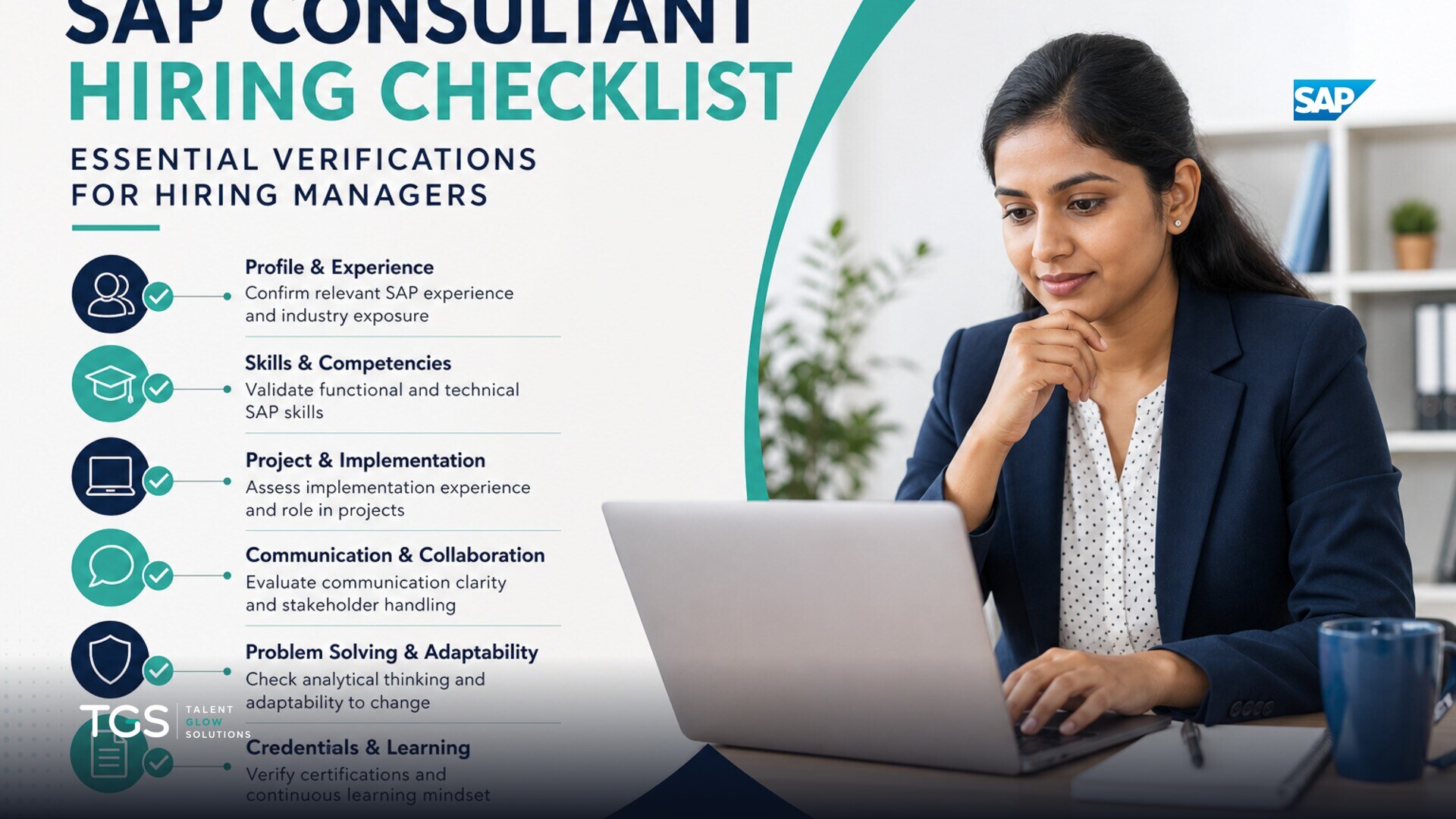
Hiring an SAP consultant can be a complex process, often challenged by candidates who present broad knowledge but lack the specific depth your projects demand. As a hiring manager, your goal is to identify individuals with genuine, hands-on experience and a deep understanding of the relevant SAP modules. This article provides a structured SAP consultant hiring checklist to help you verify critical skills and make informed hiring decisions.
Why is deep module expertise critical for SAP consultants?
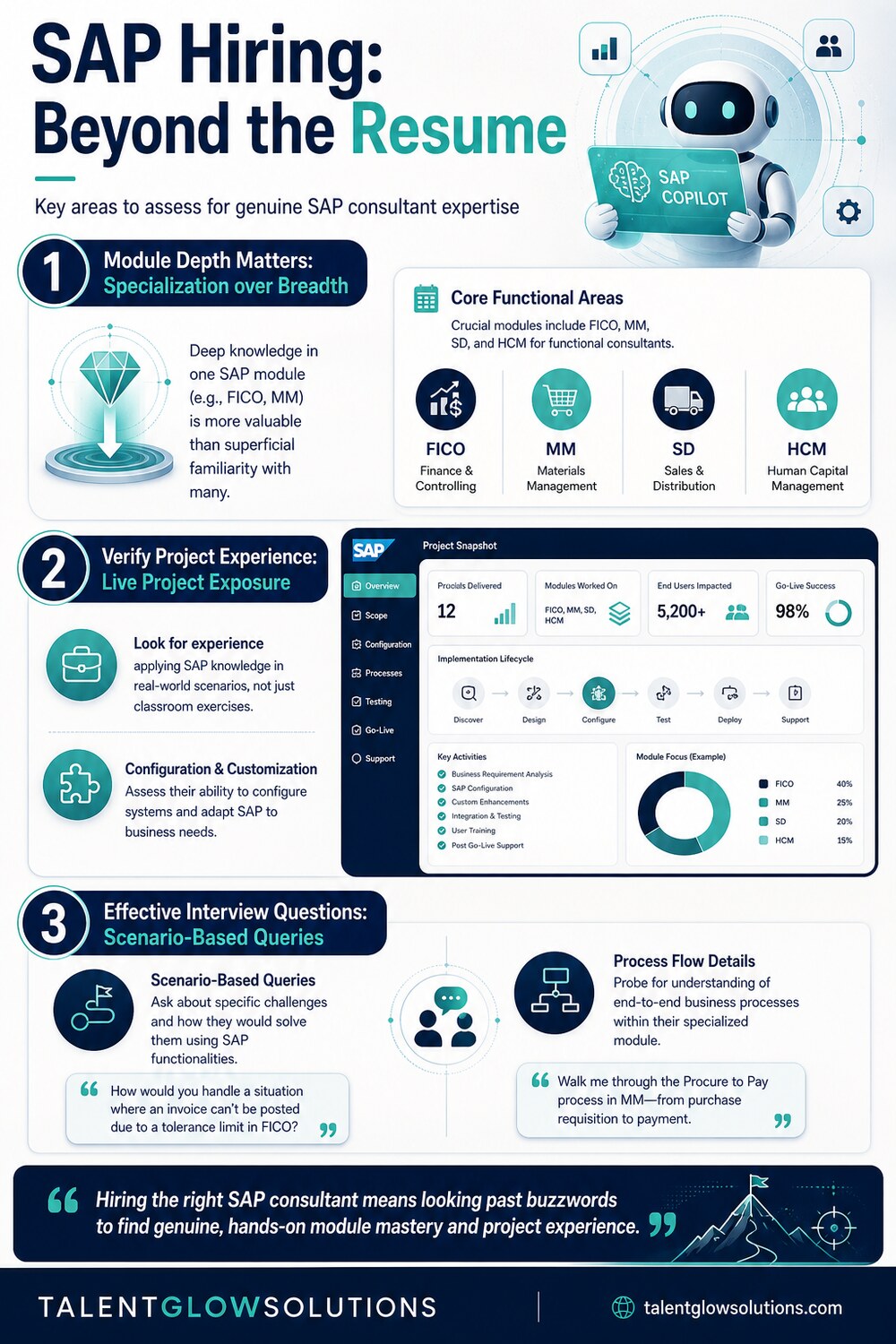
Deep understanding of specific SAP modules is crucial for an SAP Functional Consultant because it directly impacts their ability to solve business problems effectively. A consultant specializing in a module like FICO (Financial Accounting and Controlling) will possess an intricate knowledge of financial processes, reporting, and regulatory compliance within SAP. This depth allows them to configure the system precisely to meet your organization's unique financial requirements.
Employers expect hands-on knowledge of at least one SAP module, with depth in that module being more important than knowing multiple modules superficially. A consultant with deep expertise in MM (Materials Management), for instance, can navigate complex procurement processes, inventory management, and vendor relations with ease. This specialization ensures they can provide robust solutions and minimize implementation risks.
How can you assess a candidate's practical project experience?
Assessing practical project experience goes beyond simply listing past roles on a resume. Look for concrete examples of how candidates applied their SAP knowledge in live environments. Ask them to describe specific projects, their role in those projects, and the challenges they encountered.
Probe into their involvement in key project phases such as requirements gathering, system configuration, testing, and user training. A consultant with genuine experience will be able to articulate the specific configurations they implemented, the business processes they optimized, and the impact of their contributions. This reveals whether their experience is theoretical or truly hands-on.
What interview questions expose surface-level SAP knowledge?
To identify candidates with only surface-level knowledge, move beyond generic questions and focus on scenario-based inquiries. Instead of asking "Do you know FICO?", present a specific business problem and ask how they would solve it using SAP functionalities. For example, for an SAP FICO consultant, you might ask: "Describe the steps you would take to configure automatic payment programs (APP) in SAP, including common issues and how you troubleshoot them."
Another effective technique is to ask candidates to walk you through an end-to-end business process within their claimed area of expertise. For an SAP SD (Sales and Distribution) consultant, ask them to explain the complete order-to-cash cycle, detailing each SAP transaction code and configuration point involved. This reveals their understanding of process flow and system integration, quickly highlighting any gaps in practical knowledge.
How does module depth compare to breadth in SAP hiring?
When hiring an SAP consultant, depth in one or two core modules is generally more valuable than superficial knowledge across many. A consultant deeply proficient in SAP FICO can handle complex financial scenarios, while someone with shallow knowledge of several modules may struggle with detailed configurations. This focus ensures they can deliver specialized solutions without needing extensive additional training.
Consider the specific needs of your project. If you are implementing a new procurement system, a consultant with deep SAP MM expertise will be far more effective than one who has only a basic understanding of MM along with other modules. Prioritizing depth aligns the consultant's skills directly with your project requirements, leading to more efficient and successful outcomes. According to Adaface, employers expect hands-on knowledge of at least one SAP module, with depth being more important than superficial knowledge of multiple modules.
| Assessment Area | Deep Module Expertise (e.g., FICO) | Broad, Superficial Knowledge (e.g., many modules) |
|---|---|---|
| Problem Solving | Can troubleshoot complex issues and optimize specific processes. | May identify problems but struggle with detailed solutions or configuration. |
| Configuration | Proficient in customizing and configuring the module for unique needs. | Limited ability to perform complex configurations or adapt the system. |
| Project Impact | Drives efficient, robust solutions in their specialized area. | Requires more guidance, potentially leading to delays or incomplete solutions. |
| Business Alignment | Understands intricate business processes tied to their module. | May lack a comprehensive view of how the module supports specific business functions. |
What are key skills employers look for in SAP Functional Consultants?
Employers look for a combination of technical proficiency and soft skills in SAP Functional Consultants. Beyond deep module knowledge, critical skills include analytical thinking to understand business requirements and translate them into SAP solutions. Strong communication skills are essential for interacting with business users and technical teams, explaining complex concepts clearly.
Problem-solving abilities are paramount; consultants must be able to diagnose issues, propose effective solutions, and implement them within the SAP framework. Additionally, adaptability and a willingness to learn new functionalities or modules as business needs evolve are highly valued. The ability to work collaboratively in a team environment is also crucial for successful project delivery, as noted by The Smart Hands.
How can training programs enhance SAP consultant readiness?
Structured training programs can significantly enhance an SAP consultant's readiness by providing a solid foundation in core modules and practical, project-based exposure. Programs that emphasize mentor-led, project-based learning can bridge the gap between theoretical knowledge and real-world application. This approach ensures learners gain hands-on experience configuring and customizing SAP systems, similar to what they would encounter on the job.
For example, TalentGlowSolutions offers project-based training tracks in key SAP modules like FICO, MM, SD, PP, EWM, BASIS, and ABAP. These programs focus on practical application, helping individuals develop the deep module expertise and problem-solving skills employers seek. Such training prepares candidates not just for certifications, but for the actual demands of an SAP consulting role.
What is the role of SAP certifications in hiring decisions?
SAP certifications demonstrate a candidate's foundational knowledge of specific SAP modules, validated by SAP itself. While not always a mandatory requirement, a certification can serve as a valuable indicator of a candidate's commitment and understanding of SAP best practices. It confirms that the individual has passed a rigorous exam covering the module's functionalities.
However, certifications should be viewed as a complement to, rather than a replacement for, practical experience. A certified consultant who also possesses extensive project exposure in their chosen module will be a stronger candidate. Always prioritize a candidate's ability to articulate how they've applied their certified knowledge in real-world scenarios over the certification alone. TalentGlowSolutions prepares learners for SAP's own certification exams and helps them set up and attempt them, alongside issuing a course completion certificate.
Sources
Frequently asked questions
What is the most important skill for an SAP Functional Consultant?
The most important skill is a deep, hands-on understanding of at least one specific SAP module, such as FICO, MM, or SD. This depth allows them to effectively configure and troubleshoot within that module.
How can I tell if an SAP consultant has real-world experience?
Ask for specific examples of projects they worked on, their exact role, and how they configured or customized the SAP system to solve business problems. Focus on scenario-based questions that require detailed, practical answers.
Should I hire an SAP consultant with broad or deep module knowledge?
For most projects, deep expertise in one or two relevant SAP modules is more beneficial than superficial knowledge across many modules. Deep specialists can provide more robust and precise solutions.
Do SAP certifications guarantee a consultant's competence?
SAP certifications validate foundational knowledge but do not guarantee practical competence. They are a valuable asset but should be combined with verified hands-on project experience to ensure a well-rounded consultant.
Ready to launch your career?
For individuals looking to build deep, project-based SAP skills, TalentGlowSolutions offers mentor-led training and 100% placement assistance (we do not guarantee a job).
Explore Programs Talk to us