SAP Strategy
Build vs. Buy: When to Outsource Your SAP Support Team
Optimizing your SAP environment requires robust support, but the critical decision of how to staff it often comes down to a build vs. buy dilemma. Should you cultivate an in-house SAP support team, or leverage the specialized expertise and cost efficiencies of an external partner? This choice impacts operational agility, cost structures, and overall system reliability, especially for the core SAP Basis functions.
This article will guide employers through evaluating their specific needs, from project complexity to support ticket volume, to determine the most effective strategy for their organization. Understanding these trade-offs is crucial for maintaining a high-performing SAP landscape.
When Does an In-House SAP Support Team Make Sense?
An in-house SAP support team is ideal for organizations with highly unique, deeply customized SAP implementations that require constant, intimate knowledge of specific business processes. This model thrives in environments where day-to-day changes and strategic planning are closely intertwined with SAP operations.
For smaller, less complex SAP landscapes with predictable, low-to-moderate support ticket volumes, a dedicated internal resource can offer unparalleled familiarity. This person can become an expert on the company's specific configurations and user needs.
What Are the Advantages of Building Your Own SAP Team?
Building an in-house team provides several distinct advantages, primarily centered around control and deep integration. Your internal experts are fully immersed in your company culture and long-term vision.
They gain an intimate understanding of your specific business logic and customized SAP workflows. This can lead to quicker resolution of highly specialized issues and proactive identification of potential system improvements directly aligned with business goals.
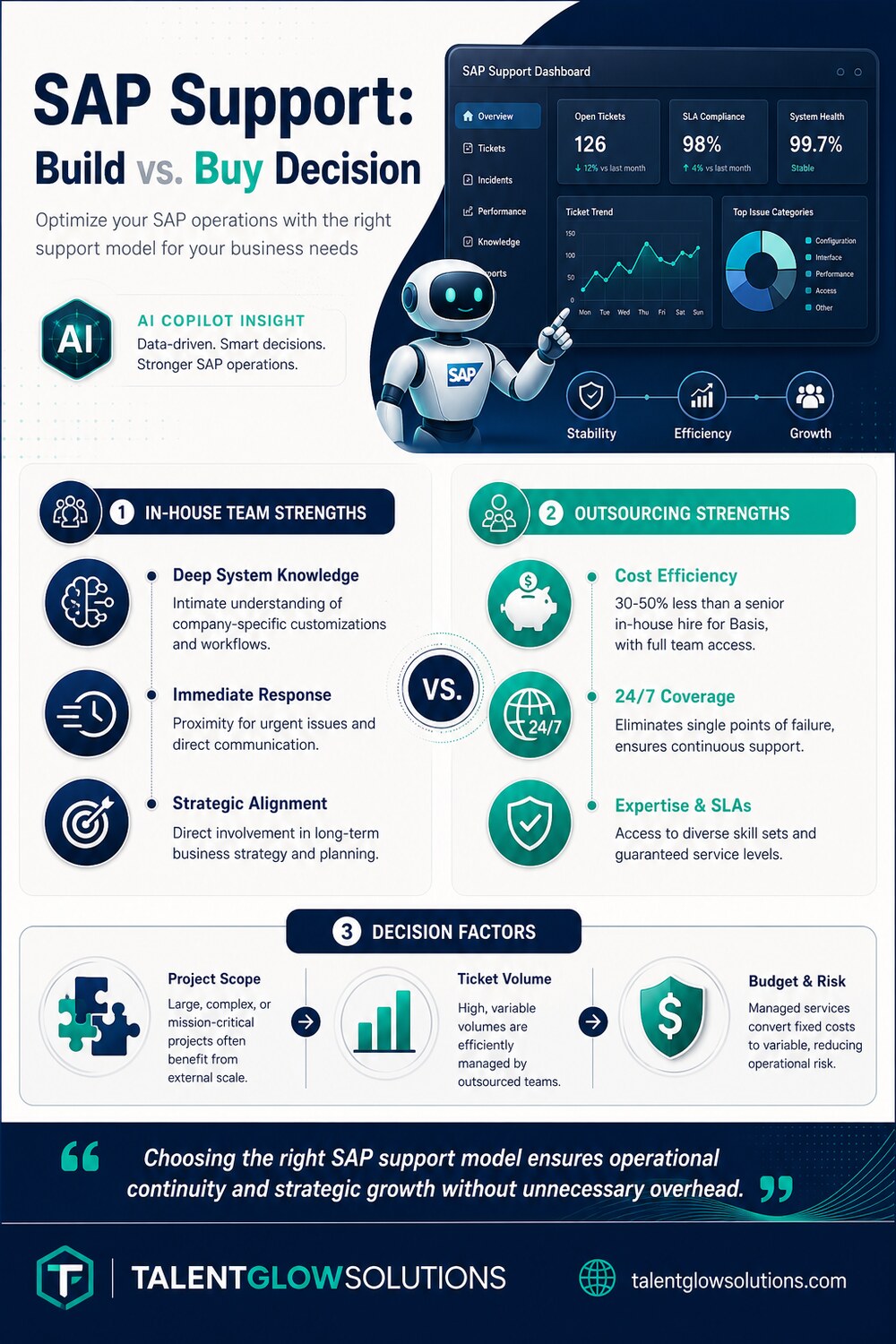
- Deep Contextual Knowledge: Internal teams develop an unparalleled understanding of your specific system customizations and business processes.
- Direct Communication: Easier, face-to-face communication and collaboration with other internal departments.
- Strategic Alignment: Direct involvement in strategic planning and system evolution, ensuring SAP supports long-term company objectives.
- Immediate Availability: For non-24/7 needs, an in-house team is physically present during business hours.
When Should You Consider Outsourcing Your SAP Support?
Outsourcing SAP support becomes a compelling option when an organization requires specialized expertise, 24/7 coverage, or cost efficiencies that are difficult to achieve with an internal team alone. This is particularly true for complex SAP Basis administration.
Organizations facing high or fluctuating support ticket volumes, or those needing support for a wide range of SAP modules (like FICO, MM, SD, PP, EWM, BASIS, ABAP), often find outsourcing to be more scalable and cost-effective. It allows access to a broader skill set without the overhead of multiple full-time hires.
How Does Outsourcing SAP Basis Support Compare in Cost?
Outsourcing SAP Basis administration can offer significant cost savings. Managed services for SAP Basis typically cost 30-50% less than employing a fully-loaded senior in-house hire.
This cost efficiency comes while simultaneously providing access to an entire team of specialists and guaranteed service levels through contractual Service Level Agreements (SLAs). This model shifts from a high fixed cost to a more predictable operational expense.
What Are the Benefits of Outsourcing SAP Support?
Outsourcing provides numerous benefits, especially for critical functions like SAP Basis. It addresses challenges such as single points of failure and the need for continuous support.
A single in-house SAP Basis administrator, for example, cannot provide true 24/7 coverage and represents a significant risk if they are unavailable. Outsourced partners mitigate this by providing a team of experts.
- Cost Savings: Managed services can be 30-50% cheaper than a senior in-house hire for SAP Basis, while offering a full team.
- 24/7 Coverage: External teams can provide round-the-clock support, eliminating single points of failure and ensuring business continuity (basisadmin.com).
- Access to Diverse Expertise: Partners offer a breadth of skills across various SAP modules (FICO, MM, SD, PP, EWM, BASIS, ABAP) and technologies.
- Service Level Agreements (SLAs): Outsourcing contracts often include strict SLAs, guaranteeing response and resolution times.
- Scalability: Easily scale support up or down based on project needs or changes in ticket volume without hiring or firing.
How Do Project Size and Ticket Volume Influence the Decision?
The scale and complexity of your SAP projects, alongside your typical support ticket volume, are key determinants in the build vs. buy for an SAP support team decision. Small, stable systems with few daily issues might be manageable internally.
However, large-scale implementations, frequent rollouts, or environments with high numbers of critical support tickets often necessitate the robust, scalable resources that an outsourced model provides. Consider the total cost of ownership, including recruitment, training, and retention.
| Feature | In-House SAP Support Team | Outsourced SAP Support Partner |
|---|---|---|
| Project Size | Best for small to medium, stable SAP landscapes. | Ideal for large, complex, or mission-critical projects. |
| Ticket Volume | Suitable for low, predictable volumes (e.g., <20/week). | Excellent for high, fluctuating, or 24/7 ticket volumes. |
| Cost Structure | High fixed costs (salaries, benefits, training). | Variable costs; potentially 30-50% less for Basis support. |
| Expertise Depth | Deep knowledge of your specific customizations. | Broad expertise across many SAP modules and technologies. |
| Availability | Limited to business hours, single point of failure. | True 24/7 coverage, team-based support, no single failure point. |
| Strategic Fit | Direct alignment with internal long-term strategy. | Focus on operational excellence, defined by SLAs. |
Can a Hybrid Model Work for SAP Support?
A hybrid model often presents the most balanced approach for many organizations, combining the strengths of both in-house and outsourced support. This strategy involves keeping core, business-critical SAP functions and deep, company-specific knowledge in-house.
Simultaneously, you can outsource specialized or high-volume tasks, such as SAP Basis administration, specific module support (like FICO or ABAP development), or 24/7 monitoring. This allows your internal team to focus on strategic initiatives and unique business requirements.
How to Implement a Hybrid SAP Support Strategy
Implementing a hybrid strategy involves carefully defining roles and responsibilities between your internal team and external partners. Start by identifying which tasks require constant internal oversight versus those that can be efficiently handled by specialists.
- Assess Core Competencies: Determine which SAP tasks are essential for your unique business operations and should remain in-house. This might include core business process mapping or specific reporting requirements.
- Identify Outsourcing Opportunities: Pinpoint areas like SAP Basis, specialized module support (e.g., EWM), or after-hours monitoring where external expertise adds value and cost efficiency.
- Define Clear SLAs: Establish robust Service Level Agreements with your outsourcing partner, detailing response times, resolution metrics, and communication protocols.
- Ensure Seamless Integration: Implement clear communication channels and processes to ensure your in-house team and external partners work together cohesively.
- Leverage Training Partners: Consider partners like TalentGlowSolutions to train and place project-based, mentor-led professionals in SAP modules like FICO, MM, SD, PP, EWM, BASIS, and ABAP to augment your internal team with specific, project-based skills without long-term hiring commitments.
What to Look for in an SAP Support Partner?
When selecting an SAP support partner, look for a provider that offers a proven track record, comprehensive service offerings, and clear communication. The partner should demonstrate expertise across the SAP modules relevant to your business.
Beyond technical skills, consider their ability to integrate with your existing team and processes, their commitment to data security, and their understanding of your industry-specific challenges. A strong partner acts as an extension of your own operations.
How Can TalentGlowSolutions Augment Your SAP Team?
TalentGlowSolutions offers project-based, mentor-led training in key SAP modules such as FICO, MM, SD, PP, EWM, BASIS, and ABAP. This can be an effective way to augment your SAP support team with skilled professionals.
Our placement-focused approach means we train individuals with practical, project-based experience, preparing them for real-world SAP challenges. While we provide 100% placement assistance, we do not guarantee a job, focusing instead on building strong foundational skills.
Sources
Frequently asked questions
What is the primary cost difference between in-house and outsourced SAP Basis support?
Outsourced managed services for SAP Basis typically cost 30-50% less than a fully-loaded senior in-house hire. This cost saving is often paired with access to a full team of experts and contractual Service Level Agreements (SLAs).
Does an in-house SAP Basis administrator provide 24/7 support?
No, a single in-house SAP Basis administrator cannot provide true 24/7 support and represents a single point of failure. Outsourced partners typically offer continuous coverage through a team of specialists.
When is an in-house SAP team more beneficial than outsourcing?
An in-house team is generally more beneficial for organizations with highly unique, deeply customized SAP implementations, where constant, intimate knowledge of specific business processes and close strategic alignment are paramount. This also suits smaller, stable SAP landscapes with low, predictable support ticket volumes.
What SAP modules can be supported through outsourcing or hybrid models?
Outsourcing or hybrid models can support a wide range of SAP modules, including FICO, MM, SD, PP, EWM, BASIS, and ABAP. This allows companies to access specialized expertise for specific functions as needed.
What should I prioritize when choosing an SAP support partner?
When choosing an SAP support partner, prioritize a proven track record, comprehensive service offerings across relevant SAP modules, clear communication, strong Service Level Agreements (SLAs), and a demonstrated understanding of your industry and specific business needs.
Ready to launch your career?
Empower your organization with skilled SAP professionals and robust support by exploring TalentGlowSolutions's mentor-led training and placement-focused programs.
Explore Programs Talk to us