Career Path
SAP PP Training for Engineering Graduates: Leverage Your Production Background
Many mechanical and production engineering graduates find themselves at a career crossroads, seeking to apply their deep understanding of manufacturing processes in a new, impactful way. SAP Production Planning (PP) offers a compelling path, allowing you to leverage your existing knowledge of the shop floor and production logistics within a global enterprise system. Your background in Bill of Materials (BOMs), routings, and Material Requirements Planning (MRP) is not just theoretical; it's a practical foundation for mastering SAP PP.
How does my engineering background help with SAP PP training?
Your engineering background provides a significant advantage when undertaking SAP PP training for engineering graduates from a production background. You already possess a foundational understanding of how products are designed, manufactured, and moved through a plant. This practical insight into production processes makes the concepts within SAP PP much easier to grasp and apply.
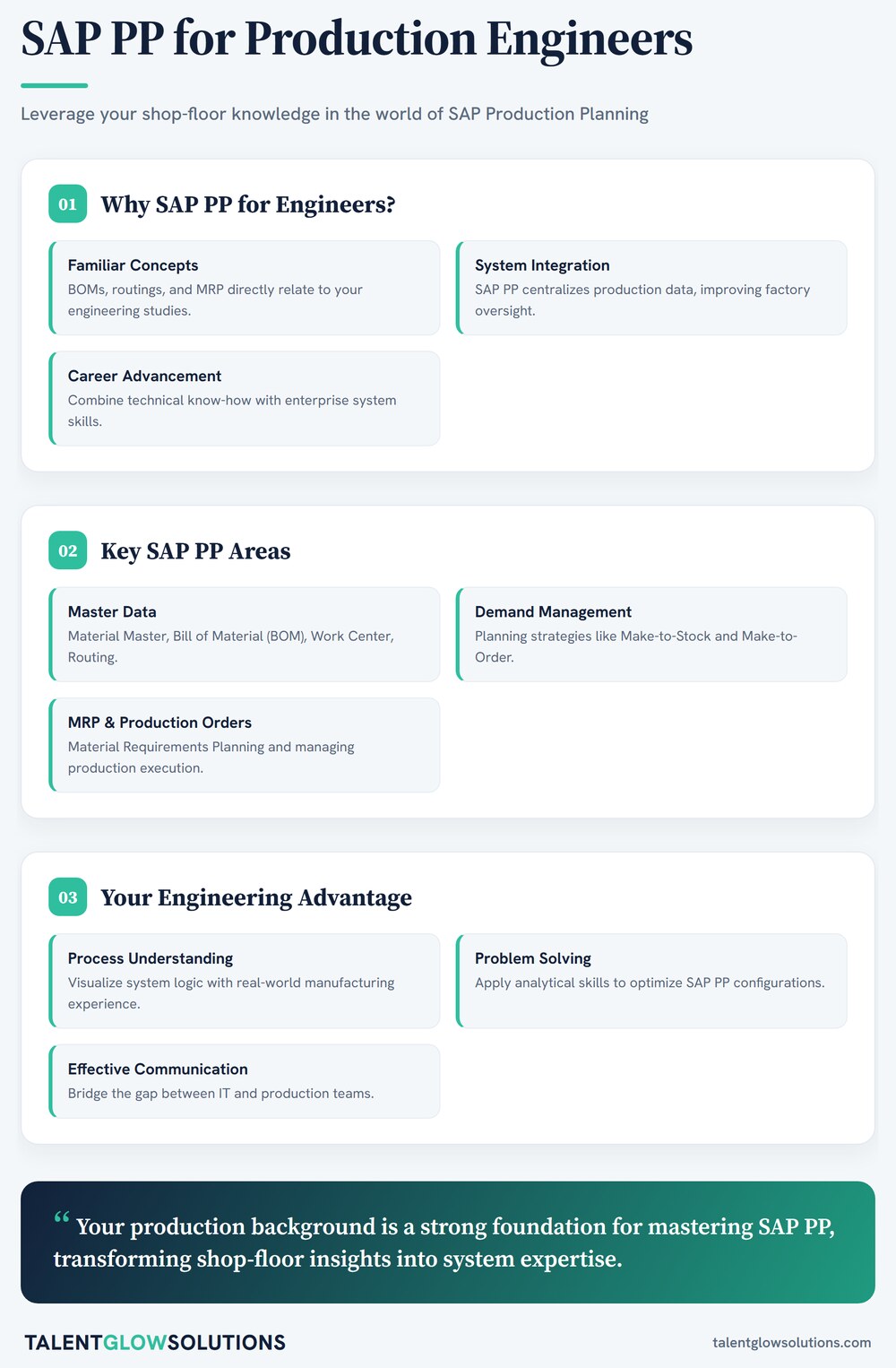
- Bill of Material (BOM) comprehension: Engineers are familiar with multi-level BOMs that define product components. In SAP PP, you'll configure and manage these digital BOMs, directly mapping your existing knowledge.
- Routing and Work Center Logic: You understand manufacturing steps and machine capabilities. SAP PP's routings define these sequences and work centers represent your machines or production lines.
- Material Requirements Planning (MRP) principles: The core of MRP - ensuring materials are available when needed - is a concept production engineers live by. You'll see how SAP PP automates and optimizes this critical function.
What are the core components of SAP Production Planning?
SAP Production Planning (PP) is a vital module in SAP that manages and controls all aspects of the production process. It integrates with other modules like Material Management (MM) and Sales and Distribution (SD) to ensure a smooth flow from demand to delivery. Understanding these core components is key to successful SAP PP training.
Here are the main areas:
- Master Data: This forms the backbone of all planning activities. It includes the Material Master (details about each product), Bill of Material (BOM, listing components), Work Center (where operations are performed), and Routing (sequence of operations).
- Demand Management: This involves forecasting and managing customer demand. It uses various planning strategies like Make-to-Stock (MTS) or Make-to-Order (MTO) to determine what and how much to produce.
- Material Requirements Planning (MRP): MRP calculates the quantities and dates for procuring or producing dependent materials. It ensures that all necessary components are available to meet production requirements.
- Production Order Execution: This covers the actual creation, release, confirmation, and settlement of production orders. It tracks the progress of manufacturing activities on the shop floor.
How does SAP PP handle Master Data?
Master Data is foundational for any effective planning in SAP PP. It provides the static information that defines materials, processes, and resources. Accurately setting up SAP PP master data is critical for the system to function correctly and reflect real-world production scenarios.
| Master Data Element | Description | Engineering Relevance |
|---|---|---|
| Material Master | Comprehensive data for every material (raw, semi-finished, finished). | Defines physical properties, units of measure, storage conditions. |
| Bill of Material (BOM) | A structured list of components needed to produce an assembly. | Directly analogous to product breakdown structures and assemblies. |
| Work Center | Represents a machine, group of machines, or production line. | Maps to actual machinery, labor, and capacity on the shop floor. |
| Routing | A sequence of operations performed at a work center to produce a material. | Corresponds to process plans, operation sheets, and manufacturing steps. |
What is the role of Demand Management in SAP PP?
Demand Management in SAP PP is where strategic planning meets operational execution. It translates sales forecasts and planned independent requirements into concrete production plans. For an engineering graduate, understanding demand management helps connect market needs to the actual manufacturing schedule.
- Sales and Operations Planning (SOP): High-level planning to align sales forecasts with production capacity.
- Demand Management: Converts the SOP plan into planned independent requirements (PIRs) for specific materials.
- Planning Strategies: Defines how production responds to demand, e.g., producing goods before customer orders (Make-to-Stock) or only after (Make-to-Order).
- Long-Term Planning (LTP): Simulates future production scenarios to evaluate capacity and resource needs.
Why is Material Requirements Planning (MRP) crucial?
Material Requirements Planning (MRP) is the engine that drives efficient material flow in SAP PP. It ensures that components and raw materials are available precisely when needed for production, preventing costly delays and stockouts. Your engineering understanding of supply chain dependencies makes MRP a logical extension of your knowledge.
MRP uses master data (BOMs, routings) and demand data to calculate net requirements. It then generates planned orders for in-house production or purchase requisitions for external procurement. This automated process significantly streamlines material planning compared to manual methods. Understanding how MRP runs, evaluates exceptions, and proposes solutions is a key skill for SAP PP professionals.
How does production order execution work in SAP PP?
Production order execution is the phase where planned activities turn into actual manufacturing. It involves managing the lifecycle of a production order, from creation to completion. For engineers, this is where the digital plan in SAP PP directly impacts the physical shop floor. Production order execution ensures that resources are allocated, operations are performed, and costs are tracked accurately.
- Order Creation: A production order is generated, either manually or from an MRP run.
- Order Release: The order is released, making it available for execution on the shop floor and allowing material withdrawals.
- Goods Issue: Raw materials are issued from inventory to the production order.
- Confirmation: Operations are confirmed as completed, updating the order status and actual costs.
- Goods Receipt: The finished product is received into inventory, increasing stock levels.
- Order Settlement: Actual costs are settled to the appropriate cost object.
What career opportunities exist after SAP PP training?
Completing SAP PP training for engineering graduates from a production background opens doors to various roles within the manufacturing and IT sectors. Your combined knowledge of engineering principles and SAP system functionality makes you a highly valuable asset. Potential career paths include SAP PP Consultant, Production Planning Analyst, Business Analyst, or even roles focused on supply chain optimization.
These roles often involve configuring SAP PP to meet specific business requirements, optimizing production processes, and providing user support. The ability to speak both the language of engineering and enterprise software is a significant advantage in these positions. With practical skills gained from mentor-led, project-based training on a live S/4HANA system, you can effectively bridge the gap between technical operations and strategic business goals.
What is the cost structure for SAP PP training?
The cost of SAP PP training varies based on several factors, including the training provider, the depth of the curriculum, and the duration of the course. When considering SAP PP training, it's important to inquire about what is included in the fee. This typically covers access to live SAP systems, study materials, and instructor-led sessions. Some programs may also offer additional support like placement assistance.
TalentGlowSolutions provides comprehensive SAP PP training designed to equip you with practical skills. We encourage prospective learners to contact us directly to discuss the program details and transparent fee structure. This allows us to understand your specific needs and provide accurate information about the investment required for your career advancement in SAP PP. We do not publish our fees online, as they can vary.
How does TalentGlowSolutions support my SAP PP career goals?
TalentGlowSolutions offers mentor-led SAP PP training on a live S/4HANA system, providing hands-on experience crucial for real-world application. Our project-based approach ensures you gain practical skills by working through scenarios relevant to the manufacturing industry. We offer placement assistance to guide you through the job search process, including resume building and interview preparation, helping you connect with potential opportunities. We do not guarantee a job, but we provide 100% placement assistance to support your career transition. Our focus is on empowering you with the expertise and confidence to pursue a successful career in SAP PP. We teach FICO, MM, SD, PP, EWM, BASIS, and ABAP modules.
Frequently asked questions
Is SAP PP difficult for engineering graduates to learn?
No, SAP PP is often more intuitive for engineering graduates, especially those with a production background. Concepts like Bill of Materials (BOMs), routings, and Material Requirements Planning (MRP) directly align with what you've already studied in mechanical or production engineering.
What is the difference between SAP PP and production engineering?
Production engineering focuses on the scientific and practical aspects of designing, planning, and optimizing manufacturing processes. SAP PP is a software module that digitizes and manages these very processes within an enterprise resource planning (ERP) system, applying the principles you already understand.
Do I need prior SAP experience to enroll in SAP PP training?
No prior SAP experience is typically required. Training programs, especially those designed for freshers or career changers, start with the fundamentals of SAP and guide you through the PP module step-by-step. Your engineering background provides a strong conceptual foundation.
What kind of projects will I work on during SAP PP training?
During SAP PP training, you'll typically work on project-based scenarios that simulate real-world manufacturing challenges. This can include configuring master data for a new product, setting up an MRP run for a production plan, or executing and confirming production orders on a live S/4HANA system.
Ready to launch your career?
Our mentor-led SAP PP training provides the support and practical experience you need to translate your engineering background into a thriving SAP career.
Explore Programs Talk to us