Career Paths
Self-Study vs. Structured Training for SAP: Which is Faster for Your Career?

Embarking on an SAP career is a significant step, and choosing the right learning path is crucial. Many aspiring SAP professionals weigh the pros and cons of self-study versus structured training, often wondering which approach is faster. While self-study might seem appealing due to its flexibility and perceived lower initial cost, it frequently leads to delays and incomplete skill development, making structured training a more efficient route to proficiency.
Why does self-study often slow down SAP learning?
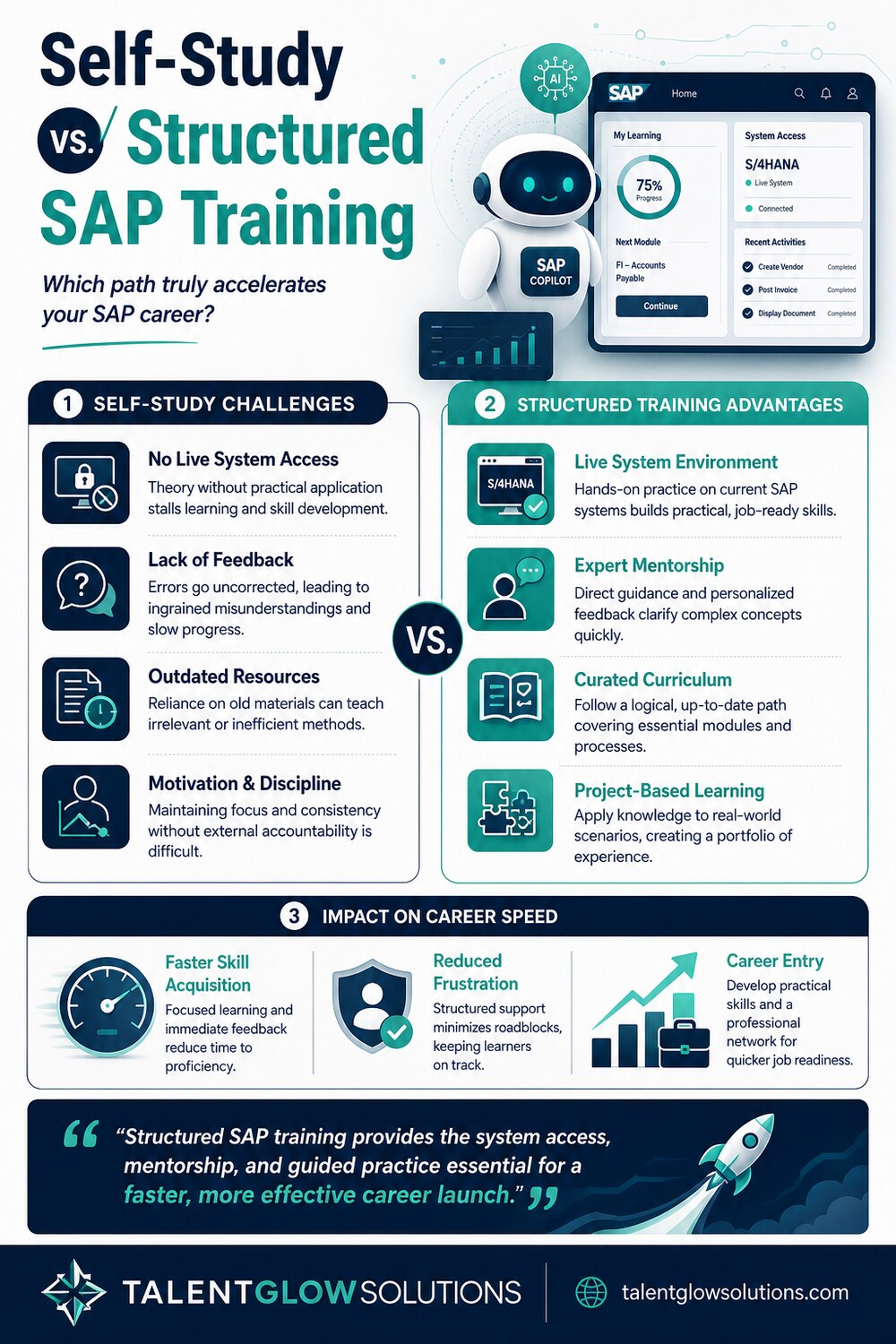
Self-study for SAP can be a prolonged and frustrating journey, primarily because it lacks critical components necessary for practical skill development. The most significant hurdle is often the absence of live SAP system access, making it impossible to apply theoretical knowledge to real-world scenarios. Without hands-on practice, understanding complex configurations and business processes remains superficial.
Another major slowdown in self-study is the lack of immediate feedback. When you encounter an error or a conceptual block, there's no expert to guide you. This can lead to hours or even days spent troubleshooting issues that a mentor could resolve in minutes. Incorrect practices can become ingrained, requiring more effort to unlearn later.
What are the common pitfalls of self-study for SAP?
Beyond system access and feedback, several other factors contribute to the inefficiency of self-study. Outdated learning materials are a common problem; free resources or old books might not cover the latest SAP versions or best practices. This means learning skills that are no longer relevant in the current job market.
Maintaining motivation and discipline over an extended period is also challenging. Without a structured curriculum, deadlines, or peer interaction, it's easy to lose momentum. The sheer volume and complexity of SAP can be overwhelming, leading to burnout and ultimately, giving up on the learning path altogether.
How does structured training accelerate SAP skill development?
Structured training programs are designed to provide a direct and efficient path to SAP proficiency. They offer access to live SAP systems, allowing learners to immediately practice what they learn. This hands-on experience is invaluable for understanding module functionalities like FICO (Financial Accounting and Controlling) or MM (Materials Management).
Expert mentor-led instruction is another key accelerator. Mentors provide clear explanations, practical examples, and immediate feedback, ensuring concepts are grasped correctly and efficiently. This personalized guidance helps learners navigate complex topics like SD (Sales and Distribution) or PP (Production Planning) much faster than trying to figure them out alone.
What are the benefits of project-based SAP learning?
Project-based learning, often a core component of structured training, significantly speeds up the learning process by immersing individuals in real-world business scenarios. Instead of just memorizing concepts, learners apply their knowledge to solve practical problems. For example, configuring an EWM (Extended Warehouse Management) process from end-to-end within a simulated project environment.
This approach builds a portfolio of practical experience, which is highly valued by employers. It demonstrates not just theoretical understanding but also the ability to execute tasks and troubleshoot issues. This practical exposure helps bridge the gap between learning and actual job readiness, making the transition into an SAP role much smoother and faster.
How does structured training prepare you for SAP certification?
Structured training programs typically align their curriculum with the objectives of official SAP certification exams. This means the content is specifically tailored to cover the necessary topics, preparing learners thoroughly. For modules like BASIS (System Administration) or ABAP (Advanced Business Application Programming), a structured path ensures all critical areas are addressed.
Trainers often share insights into exam formats and common question types, providing valuable strategies for success. While TalentGlowSolutions provides a course completion certificate, it also helps learners set up and attempt the separate SAP certification exam. This focused preparation can significantly reduce the time and effort required to pass the exam compared to self-study.
Self-Study vs. Structured Training: Which is faster for SAP?
When comparing self study vs structured training for sap which is faster, structured training consistently offers a quicker and more reliable route to job readiness. The table below highlights key differences:
| Feature | Self-Study for SAP | Structured Training for SAP |
|---|---|---|
| Live System Access | Often limited or non-existent, relying on theory only. | Guaranteed access to current SAP systems for hands-on practice. |
| Expert Feedback | Absent, leading to uncorrected errors and slow progress. | Immediate, personalized feedback from experienced mentors. |
| Curriculum Quality | Varies widely, prone to outdated or incomplete information. | Up-to-date, comprehensive, and logically sequenced. |
| Motivation | Requires high self-discipline; easily leads to burnout. | Supported by peer interaction, mentor accountability, and structured milestones. |
| Job Readiness | Slower to achieve due to lack of practical experience and industry insights. | Faster due to project-based learning and practical skill development. |
Structured training, with its guided curriculum, live system access, and expert mentorship, creates an environment where learning is optimized for speed and effectiveness. This focused approach minimizes the common roadblocks that often stall self-learners, allowing you to acquire valuable SAP skills more rapidly.
What is the cost difference between self-study and structured SAP training?
While self-study might appear to have no direct cost, the indirect costs can be substantial. These include the time lost due to inefficient learning, the opportunity cost of delayed career entry, and the potential for investing in outdated or ineffective resources. The time spent troubleshooting without help or learning irrelevant skills is a significant hidden expense.
Structured training programs involve a direct fee, which covers access to systems, expert instructors, and curated materials. To understand the investment, it's best to inquire directly with training providers about their specific program costs and what is included. Always ask about the duration, the modules covered (like FICO, MM, SD, PP, EWM, BASIS, or ABAP), and the level of support provided. This allows you to compare the value proposition against the potential frustrations and delays of a purely self-directed path.
How does mentorship impact SAP learning speed?
Mentorship is a critical factor in accelerating SAP learning. An experienced SAP mentor can demystify complex concepts, share industry best practices, and provide real-world insights that are impossible to gain from books alone. They can quickly identify areas where a learner is struggling and offer targeted support.
For example, navigating intricate configuration steps in FICO or debugging ABAP code becomes much faster with a mentor's guidance. This direct, personalized feedback loop helps learners avoid common mistakes and develop a deeper, more accurate understanding of SAP functionalities, significantly reducing the overall learning curve.
Can structured training help with career placement?
Structured training programs often include elements designed to support learners in their job search. This can involve resume building workshops, interview preparation, and networking opportunities. While no program can guarantee a job, the practical skills gained through project-based learning and the professional guidance received can significantly enhance a candidate's marketability.
TalentGlowSolutions, for instance, offers mentor-led, project-based training that prepares individuals for SAP roles, providing support and mentorship throughout the learning journey. This focus on practical application and career readiness helps learners present themselves effectively to potential employers, aiming for a smoother transition into an SAP career.
Frequently asked questions
Is it possible to learn SAP through self-study?
Yes, it is possible to learn some SAP concepts through self-study, but practical application is often limited without access to live SAP systems. This can significantly slow down skill development and job readiness.
What are the biggest disadvantages of self-studying SAP?
The biggest disadvantages include lack of live system access for hands-on practice, no expert feedback to correct errors, difficulty in finding up-to-date resources, and challenges in maintaining motivation and discipline over time.
How long does it take to learn SAP with structured training?
The time it takes varies by module and program intensity, but structured training is generally faster than self-study due to guided curriculum, live system access, and expert mentorship. Programs typically range from a few weeks to several months.
What SAP modules are most commonly taught in structured training?
Commonly taught SAP modules in structured training include FICO (Financial Accounting and Controlling), MM (Materials Management), SD (Sales and Distribution), PP (Production Planning), EWM (Extended Warehouse Management), BASIS (System Administration), and ABAP (Advanced Business Application Programming).
Does structured SAP training guarantee a job?
No, structured training does not guarantee a job. However, it provides valuable skills, practical experience through project-based learning, and career support that can significantly improve a candidate's prospects in the job market.
Ready to launch your career?
For comprehensive, mentor-led SAP training that equips you with job-ready skills and career support, explore our specialized programs.
Explore Programs Talk to us