Career Growth
Your 4-Week Plan: How to Prepare for a Technical Interview

Preparing for a technical interview can feel overwhelming, but with a structured approach, you can significantly boost your confidence and performance. This guide outlines a realistic 4-week preparation plan focusing on key areas: Data Structures and Algorithms (DSA), system design basics, behavioral questions, and mock interview strategy. Following this plan will equip you with the skills and mindset needed to succeed.
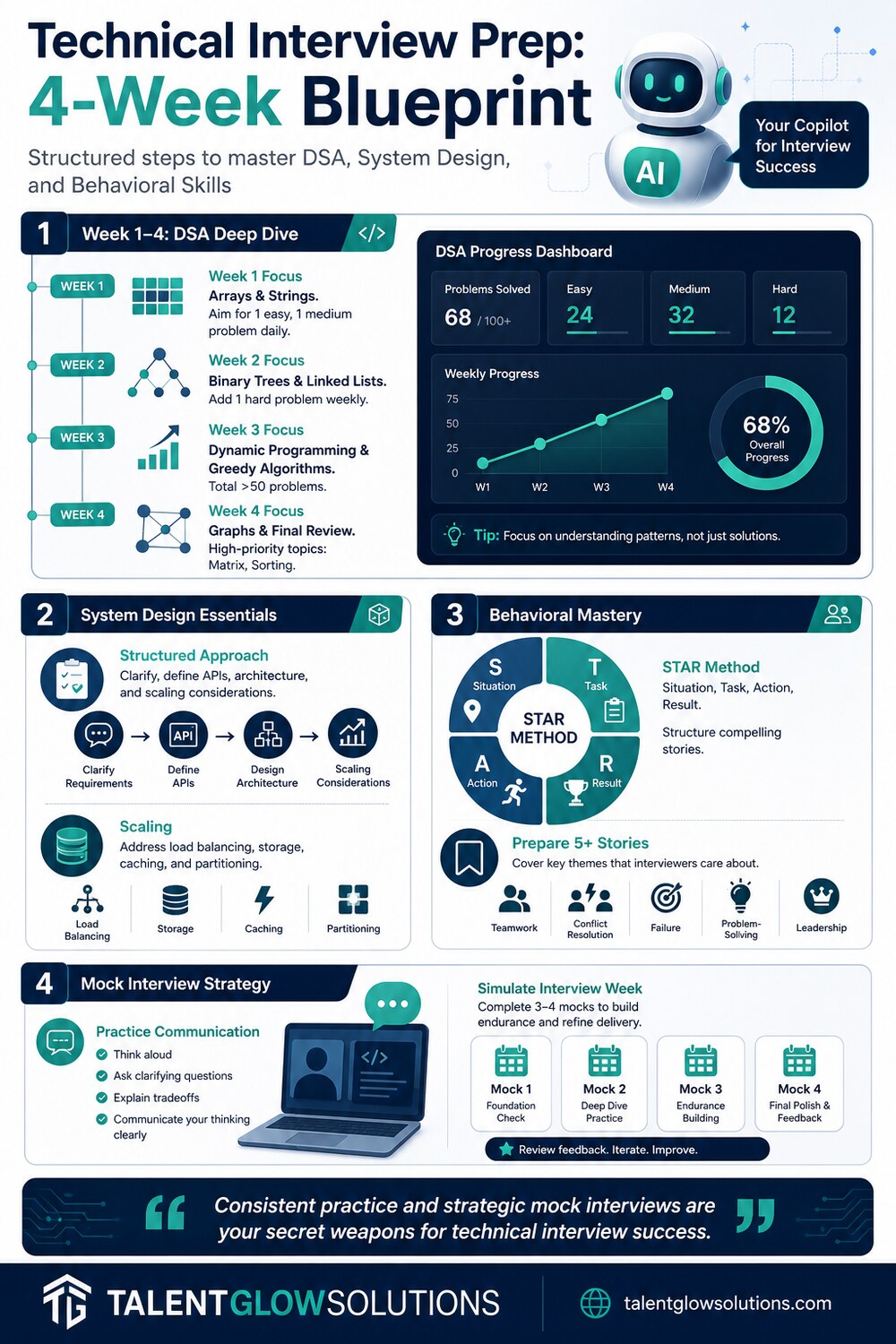
Week 1: Foundation in Data Structures & Algorithms (DSA)
Start your journey by solidifying your understanding of fundamental Data Structures and Algorithms. For the first week, concentrate on Arrays and Strings. These topics are common starting points and build a strong base for more complex problems.
- Daily Practice: Aim to complete and thoroughly understand at least one easy and one medium coding problem each day. This consistent practice is crucial for building problem-solving muscle and understanding various approaches to common scenarios.
- High-Priority Topics: Beyond Arrays and Strings, other high-priority DSA topics include Sorting and Searching, Matrix, Trees, and Graphs. You'll touch on these in subsequent weeks, but knowing their importance helps prioritize your learning.
Week 2: Expanding Your DSA Toolkit
In your second week, expand your DSA focus to include Binary Trees and Linked Lists. These data structures are frequently tested and require a good grasp of recursion and pointer manipulation. Many technical interviews test verbal problem-solving skills, so be ready to explain your logic.
- Problem Variety: Continue your daily routine of one easy and one medium problem. Additionally, challenge yourself by tackling one hard problem per week. This pushes your boundaries and exposes you to more intricate algorithmic challenges.
- Complexity Analysis: As you solve problems, always consider the time and space complexity (e.g., Big O notation) of your solutions. This demonstrates a deeper understanding of efficiency and optimization, a key aspect of technical interviews.
Week 3: Advanced Algorithms and System Design Intro
Week three introduces more complex algorithms like Dynamic Programming and Greedy Algorithms. These topics often appear in higher-level technical interviews and require a different problem-solving mindset. You should aim to complete more than 50 coding problems by the end of this week, ensuring a broad exposure.
- System Design Basics: Begin to learn a repeatable structure for system design questions. This includes clarifying requirements, defining APIs and data models, drawing high-level architecture, and addressing scaling challenges. Understanding this framework is vital for structuring your answers.
- Scaling Concepts: Focus on key scaling considerations such as load balancing, storage solutions, caching strategies, and data partitioning. These elements are critical for designing robust and scalable systems.
Week 4: Graphs, Final Review & Behavioral Prep
Your final week should be dedicated to Graphs and a comprehensive review of all DSA topics. Graphs are versatile and can represent many real-world problems, making them a common interview subject. This is also the time to fine-tune your behavioral responses.
- Behavioral Interview Questions: These open-ended questions are based on your past experience and are a significantly better predictor of on-the-job performance. Prepare compelling stories using the STAR method.
- STAR Method Steps:
- Situation: Describe the context or background of your experience.
- Task: Explain your responsibility or the challenge you faced.
- Action: Detail the specific steps you took to address the task or situation.
- Result: Conclude with the outcome of your actions and what you learned.
- Story Bank: Prepare at least 5 STAR stories covering various scenarios like teamwork, conflict resolution, dealing with failure, problem-solving, and leadership. This ensures you have relevant examples ready for any question.
Mock Interview Strategy: The Critical Practice
Mock interviews are absolutely critical for practicing communication, refining technical skills, and familiarizing yourself with common questions. Platforms like interviewing.io offer anonymous mock interviews with engineers from top companies, providing invaluable feedback. During technical interviews, it is crucial to think aloud, ask clarifying questions, and explain your process as you work.
| Aspect | Importance | Preparation Strategy |
|---|---|---|
| Communication | Explaining logic is as key as solving. | Practice thinking aloud, narrating your thought process, and asking clarifying questions. |
| Technical Skills | Apply DSA and system design knowledge. | Solve problems under timed conditions, focus on efficient solutions and complexity. |
| Behavioral Responses | Predicts on-the-job performance. | Rehearse STAR stories until they flow naturally and confidently. |
| Endurance | Multiple interviews can be draining. | Simulate an 'interview week' with 3-4 mocks to build stamina and identify weak points. |
Simulate at least one full "interview week" with 3-4 mocks to test your endurance and refine your delivery. This will help you identify areas for improvement and build confidence for the actual interviews. Remember to comment on engineering tradeoffs in your solution, showing a holistic understanding.
This 4-week plan provides a robust framework. TalentGlowSolutions offers mentor-led, project-based training tracks that can further support your technical interview preparation, providing guidance and hands-on experience to solidify your skills.
Sources
- helen-zhang.medium.com :: https://helen-zhang.medium.com/the-4-week-plan-to-nailing-your-next-coding-technical-interview-internship-level-c5368c47e1d
- techinterviewhandbook.org :: https://www.techinterviewhandbook.org/algorithms/study-cheatsheet/
- thita.ai :: https://thita.ai/blog/interview/7-day-30-day-and-90-day-coding-interview-preparation-plans-compared
- kellyservices.com :: https://www.kellyservices.com/insights/behavioral-interview-questions
- igotanoffer.com :: https://igotanoffer.com/blogs/tech/behavioral-interview-questions
- arc.dev :: https://arc.dev/talent-blog/behavioral-interview-questions-tech/
- dev.to :: https://dev.to/__be2942592/how-to-prepare-for-tech-interviews-the-complete-2026-guide-4nb
- tryexponent.com :: https://www.tryexponent.com/blog/how-to-prepare-for-a-mock-interview
- medium.com :: https://medium.com/@codegrey/trust-me-mock-interviews-are-the-secret-sauce-when-it-comes-to-interview-prep-907a2eebc1cb
- theengineeringdad.substack.com :: https://theengineeringdad.substack.com/p/how-to-master-the-interview-process
Frequently asked questions
What are the most important DSA topics for coding interviews?
High-priority DSA topics include Arrays, Strings, Sorting and Searching, Matrix, Trees, and Graphs. Focusing on these will cover a significant portion of common interview questions.
How many coding problems should I aim to solve?
For effective preparation, aim to complete and understand more than 50 coding problems. A suggested daily approach is to tackle one easy and one medium problem, adding one hard problem per week.
What is the STAR method for behavioral questions?
The STAR method (Situation, Task, Action, Result) is a five-step approach to structure your answers to behavioral questions, helping you tell compelling stories based on your past experiences. You should prepare at least 5 such stories.
Why are mock interviews so important?
Mock interviews are critical for practicing communication, refining technical skills under pressure, and familiarizing yourself with the interview format. They help you think aloud, ask clarifying questions, and explain your logic effectively.
What should I do during a technical interview problem?
During a technical interview, always think aloud, ask clarifying questions before coding, explain your thought process as you work through the problem, and comment on engineering tradeoffs in your solution. This demonstrates your problem-solving approach.
Ready to launch your career?
For personalized guidance and project-based experience that strengthens your technical skills, explore TalentGlowSolutions's training programs.
Explore Programs Talk to us