Career Guide
Transitioning to SAP EWM: Your Path from Warehouse to Consulting
Are you working in a warehouse or logistics role and looking to advance your career? The world of enterprise resource planning (ERP) is constantly evolving, and SAP Extended Warehouse Management (EWM) stands out as a strategic module within the SAP S/4HANA ecosystem. This guide will walk you through how to become an SAP EWM consultant with no prior SAP experience, leveraging your existing logistics knowledge.
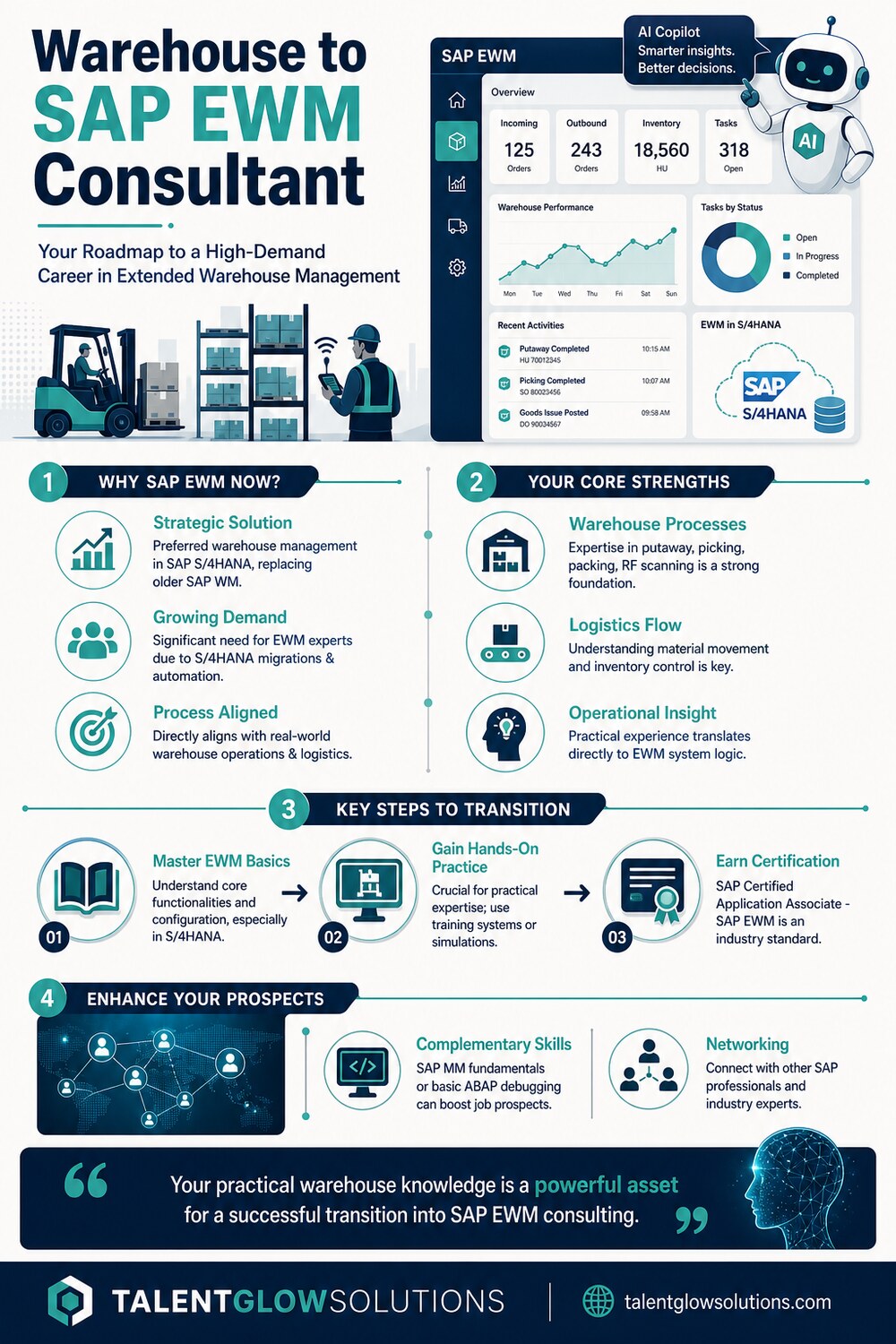
SAP EWM is now the preferred solution for warehouse management, replacing the older SAP WM module. This shift, driven by global SAP S/4HANA migrations and increased investment in warehouse automation, means there's a significant and growing demand for qualified SAP EWM consultants. Your practical understanding of how a warehouse operates is your biggest advantage.
Why is SAP EWM the Future of Warehouse Management?
SAP EWM (Extended Warehouse Management) is the strategic and preferred warehouse management solution within the SAP S/4HANA ecosystem. It offers advanced capabilities that significantly enhance operational efficiency compared to its predecessor, SAP WM. This makes it an essential module for companies aiming for modern, automated logistics.
One key advantage is native Material Flow Systems (MFS), which allows direct integration with automated equipment like conveyors and robots. This direct control over automation is a major upgrade. SAP EWM also provides advanced labor management features, helping optimize workforce utilization and productivity within the warehouse (promptedify.co.za).
How Does My Current Warehouse Experience Apply to SAP EWM?
Your experience as warehouse or logistics staff provides a fundamental on-ramp for aspiring SAP EWM consultants. The module is inherently process-oriented, aligning closely with actual warehouse operations you already know. This foundational understanding is invaluable.
Core warehouse processes such as putaway, picking, packing, and RF scanning are directly mirrored and managed within SAP EWM. Your practical knowledge of these daily tasks gives you a strong intuitive grasp of how the system should function. You understand the 'why' behind the system's design, which is a powerful asset for configuration and troubleshooting (techbrainz.com).
What are the Core Processes in SAP EWM?
Understanding the core processes is crucial for anyone looking to transition into SAP EWM. These processes are the backbone of efficient warehouse operations and form the basis of EWM configuration.
Here are some fundamental processes: * Goods Receipt: Managing incoming materials, including unloading, staging, and quality inspection. * Putaway: Strategically placing received goods into storage bins based on defined rules and optimization strategies. * Picking: Retrieving goods from storage for outbound deliveries, often optimized for efficiency (e.g., wave picking, pick by voice). * Packing: Preparing picked items for shipment, including packaging, labeling, and documentation. * Goods Issue: Processing the outbound delivery of goods from the warehouse. * Internal Warehouse Movements: Managing stock transfers, replenishment, and rearrangement within the warehouse. * Physical Inventory: Conducting stock counts and reconciling discrepancies. * Radio Frequency (RF) Framework: Utilizing mobile devices for real-time data entry and task execution on the warehouse floor (talents.vaia.com).
What is the Path to Becoming an SAP EWM Consultant?
The journey to becoming an SAP EWM consultant, especially with no prior SAP experience, involves a structured approach focusing on foundational knowledge and practical application. It's a career path with growing demand.
- Understand Core Warehouse Processes: Solidify your knowledge of putaway, picking, packing, and RF scanning. This is your existing strength.
- Learn SAP EWM Fundamentals: Focus on the basic functionalities, master data, and configuration concepts specific to SAP EWM within S/4HANA.
- Gain Hands-on Experience: Practical application is crucial. This can be achieved through dedicated training programs that offer access to live S/4HANA systems and project simulations.
- Pursue SAP EWM Certification: The SAP Certified Application Associate - SAP EWM with SAP S/4HANA (e.g., C_EWM_2020) is a widely recognized entry-level certification. This validates your foundational knowledge to potential employers (erpvits.com).
- Develop Complementary Skills: Consider learning SAP MM fundamentals or basic ABAP debugging. These skills can significantly improve your job prospects by making you a more versatile candidate (techbrainz.com).
- Seek Entry-Level Roles: Start with roles such as Associate Consultant or Support Consultant, which typically involve basic configuration, support tasks, and documentation.
How Can Training Help You Transition?
Structured training is crucial for developing practical SAP EWM expertise. It bridges the gap between your operational knowledge and the technical aspects of the SAP system. This hands-on experience, often gained through real-time project simulations or practice systems, is invaluable.
Training programs like those at TalentGlowSolutions offer mentor-led instruction on a live S/4HANA system. This approach ensures you not only learn the concepts but also apply them in a realistic environment. Such programs often include comprehensive modules covering FICO, MM, SD, PP, EWM, BASIS, and ABAP, providing a holistic view of the SAP ecosystem.
What are Common Challenges in SAP EWM Implementations?
While SAP EWM offers significant advantages, implementations can present several challenges. Being aware of these can help you understand the complexity of the consultant's role and how to contribute effectively.
| Challenge Area | Description |
|---|---|
| Complex Integrations | Integrating SAP EWM with existing ERP systems, especially non-SAP ones, can be intricate and require careful planning. |
| User Adoption | The learning curve for new users can be steep, leading to resistance and requiring robust training and change management efforts. |
| High Transaction Volumes | Managing large volumes of warehouse transactions efficiently within the system demands careful configuration and performance optimization. |
| Data Migration | Moving master and transactional data from legacy systems to SAP EWM can be a complex and time-consuming process. |
Understanding these challenges, as highlighted by sources like cloudbook.co.in and bolderscg.com, prepares you for real-world consulting scenarios. Your role as a consultant will often involve helping clients navigate these complexities.
What are Entry-Level SAP EWM Roles Like?
Entry-level SAP EWM roles are designed for individuals new to SAP consulting, offering a pathway to grow your expertise. These positions are often titled Associate Consultant, Junior Consultant, or Support Consultant.
In these roles, you'll typically be involved in tasks such as: * Basic configuration: Setting up simple warehouse processes and master data under supervision. * Support tasks: Assisting end-users with system issues and troubleshooting. * Documentation: Creating and updating system documentation, user manuals, and training materials. * Testing: Participating in testing phases of new functionalities or system enhancements. * Data analysis: Helping analyze warehouse data to identify areas for improvement.
These roles provide a solid foundation for understanding the practical application of SAP EWM and growing into more senior consulting positions (erpvits.com).
How Does SAP Learning Hub Support Your Journey?
SAP Learning Hub is an all-in-one subscription platform provided by SAP that can significantly support your learning journey. It offers a wealth of resources directly from SAP.
With SAP Learning Hub, you get access to e-learning courses, hands-on practice in real SAP environments, and it even includes up to four certification exam attempts per year. This platform is an excellent resource for self-paced learning and preparing for your SAP EWM certification.
Your existing knowledge of warehouse operations is a powerful advantage for a career in SAP EWM. With focused training and dedication, you can successfully transition into this high-demand field. TalentGlowSolutions provides mentor-led, project-based training on a live S/4HANA system, along with 100% placement assistance (we do not guarantee a job) to help you launch your SAP EWM consulting career.
Sources
- bestonlinecareer.com :: https://www.bestonlinecareer.com/blog/sap-ewm-jobs
- bolderscg.com :: https://www.bolderscg.com/sap-wm-vs-ewm-the-shift-from-basic-management-to-extended-control/
- promptedify.co.za :: https://promptedify.co.za/blog/sap-wm-vs-sap-ewm-understanding-the-key-differences-and-why-ewm-is-the-future
- techbrainz.com :: https://techbrainz.com/blog/sap-ewm-career
- erpvits.com :: https://www.erpvits.com/blog/sap-ewm-jobs/
- talents.vaia.com :: https://talents.vaia.com/companies/vbeyond/sap-ewm-rf-technical-consultant-111493621/
- bolderscg.com :: https://www.bolderscg.com/overcoming-the-sap-ewm-struggles/
- cloudbook.co.in :: https://cloudbook.co.in/blog/sap-s4hana-ewm-implementation-challenges/
Frequently asked questions
Do I need a technical background to become an SAP EWM consultant?
No, a technical background is not strictly required. Your practical experience in warehouse operations and logistics is highly valuable. SAP EWM is process-oriented, so understanding the 'business' side of warehousing is a strong foundation for learning the system's configuration and functionality.
What is the difference between SAP WM and SAP EWM?
SAP EWM (Extended Warehouse Management) is the strategic and preferred warehouse management solution within the SAP S/4HANA ecosystem, effectively replacing the older SAP WM module. EWM offers more advanced features like native Material Flow Systems (MFS) for automation integration and enhanced labor management, providing more comprehensive control over complex warehouse operations (bolderscg.com).
How long does it take to become an SAP EWM consultant?
The timeline can vary based on individual learning pace and prior experience. Typically, a dedicated training program combined with hands-on practice and certification preparation can take several months. Consistent effort in learning and practical application is key to a successful transition.
What kind of salary can I expect as an entry-level SAP EWM consultant?
Entry-level salaries for SAP EWM consultants can vary significantly based on location, company size, and specific responsibilities. Factors like your certification status, additional skills (e.g., SAP MM, basic ABAP), and the demand in the local market will influence compensation. It's best to research industry averages for similar roles in your target region.
Is SAP EWM relevant for small and medium-sized businesses (SMBs)?
Yes, SAP EWM is becoming increasingly relevant for SMBs, especially those with growing warehouse complexities or automation needs. While historically associated with larger enterprises, the scalability and advanced features of EWM can provide significant benefits to smaller operations looking to optimize their logistics and integrate with S/4HANA.
Ready to launch your career?
Let TalentGlowSolutions support your career transition with expert mentorship and hands-on SAP EWM training on a live S/4HANA system.
Explore Programs Talk to us