Career Guide
How to Become an SAP Functional Consultant with No Experience

Many aspiring professionals believe that a career in SAP consulting is exclusively for those with an IT or coding background. This is a common misconception, especially when it comes to SAP functional consulting. If you have a background in business operations, finance, supply chain, or sales, you already possess a foundational understanding that is highly valued in the SAP ecosystem. This article will guide you through the honest path to becoming an SAP functional consultant, even if you have no prior technical experience.
Can I become an SAP functional consultant without an IT background?
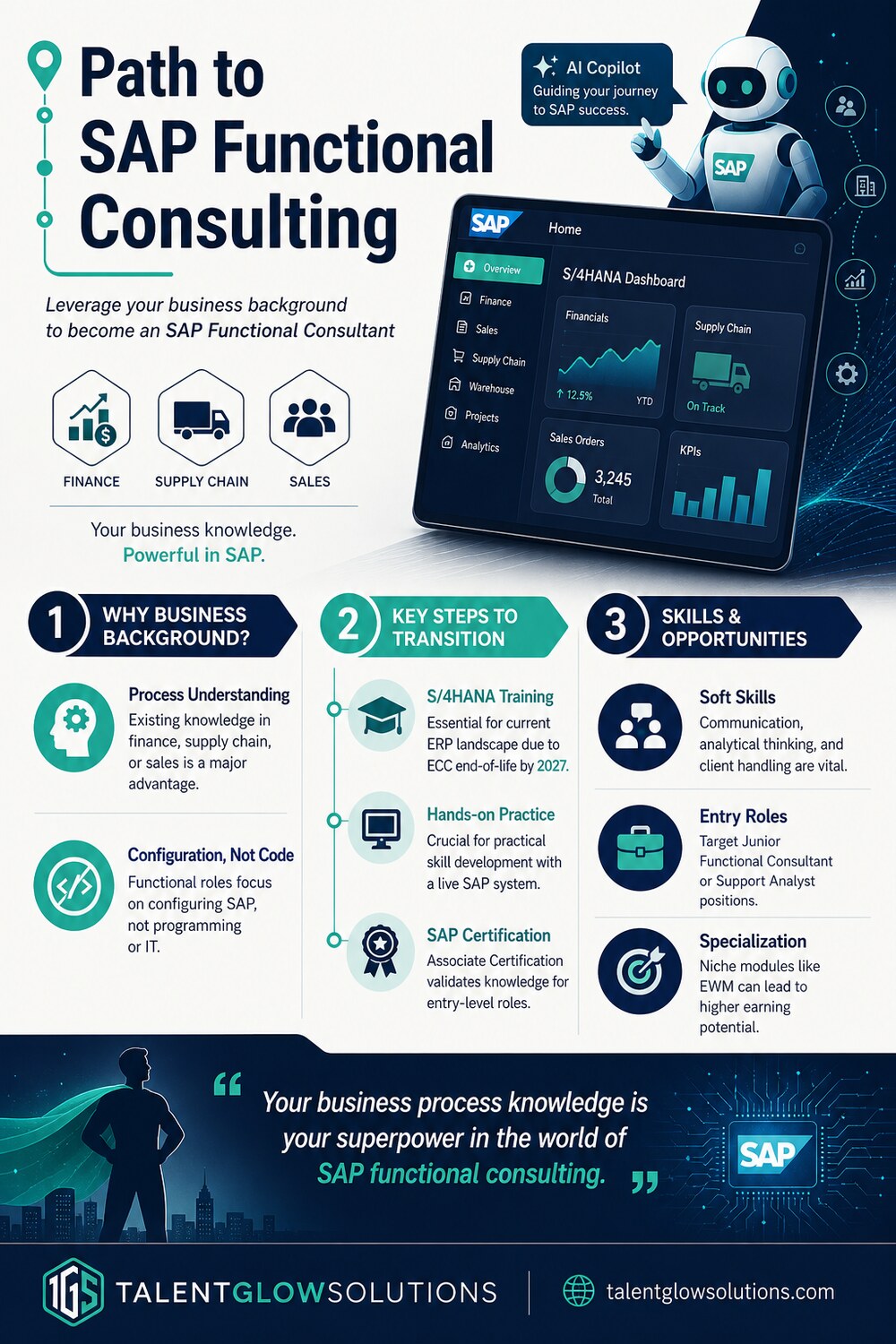
Yes, you absolutely can become an SAP functional consultant without an IT or coding background. The core focus of a functional consultant is to understand and configure business processes within the SAP system, not to write code. Your existing knowledge of how businesses operate—from procurement to financial reporting—is your strongest asset.
This role involves translating real-world business requirements into technical configurations within SAP. Professionals from diverse fields like finance, HR, or even IT support have successfully transitioned, debunking the myth that it's too late to switch careers after 40, as many started with zero SAP experience (community.sap.com).
Why is business experience an advantage for SAP functional roles?
Existing business experience provides a significant advantage because you already understand the processes that SAP systems are designed to manage. For example, a finance professional inherently grasps general ledger accounting, while a supply chain expert understands inventory management and logistics. This prior knowledge makes it easier to learn how SAP modules like FICO, MM, SD, PP, or EWM are configured to support these operations.
This deep understanding allows you to empathize with client needs and propose effective SAP solutions. You're not just learning a system; you're learning how to optimize processes you already know, which speeds up your learning curve and makes you a more effective consultant.
What SAP training should I prioritize for a functional career?
Prioritize SAP S/4HANA training and certification as it is the current generation of SAP ERP and crucial for future career success. Mainstream support for the older ECC version ends by 2027, making S/4HANA knowledge essential (sevenmentor.com, focuscloudgroup.org). Look for courses that offer hands-on practice with a live S/4HANA system to gain practical skills beyond theoretical knowledge.
TalentGlowSolutions offers mentor-led training on a live S/4HANA system across modules like FICO, MM, SD, PP, EWM, BASIS, and ABAP. This project-based approach helps you apply what you learn in a practical context. Gaining an SAP Associate Certification also validates your baseline knowledge and can substitute for job history in entry-level positions (erpprep.com).
How long does it take to become an SAP functional consultant?
The realistic path for a business-side professional to transition into an SAP functional consultant role can take between 5 to 10 months with consistent effort. This timeline typically includes dedicated training, hands-on practice, and preparing for certification. It's a commitment, but one that leverages your existing business acumen.
This period allows for comprehensive learning of a specific SAP module, developing practical configuration skills, and understanding consulting methodologies. The more intensely you engage with the training and practice, the quicker you can be ready for entry-level positions.
What are common entry-level roles for new SAP functional consultants?
Common entry-level roles to target include Junior SAP Functional Consultant, SAP Support Analyst, or positions within graduate and trainee programs. These roles allow you to gain practical experience under supervision and build your portfolio. Starting in support can be an excellent way to learn the system's intricacies and common user issues.
These positions often involve tasks like user support, basic configuration changes, testing, and documentation. They provide a stepping stone to more complex consulting engagements as you gain experience and confidence. Networking within the SAP community is also vital for discovering these opportunities.
What soft skills are essential for an SAP functional consultant?
Beyond technical knowledge, several key soft skills are required for success as an SAP functional consultant. These include strong business process understanding, effective communication, and client-handling abilities. Analytical thinking and problem-solving are also critical, as you'll often need to diagnose issues and design solutions.
Here's a breakdown of essential soft skills:
| Skill Category | Description |
|---|---|
| Business Acumen | Deep understanding of industry processes (finance, logistics, sales, etc.) |
| Communication | Clearly explaining complex technical concepts to non-technical stakeholders. |
| Client Management | Building rapport, managing expectations, and resolving conflicts with clients. |
| Analytical Thinking | Breaking down complex problems and identifying root causes in SAP. |
| Problem Solving | Developing and implementing practical, efficient SAP solutions. |
How can I overcome common challenges as a new SAP consultant?
New SAP consultants often face challenges such as difficulty understanding complex business processes, adapting to diverse client environments, and efficiently translating business requirements into SAP solutions (himalayas.app). Overcoming these requires a proactive approach to learning and continuous practice. Engage actively in your training, ask questions, and seek opportunities for hands-on experience.
- Deepen Business Process Knowledge: Continuously study the business functions relevant to your chosen SAP module. Understand the 'why' behind each process step.
- Practice with Real Scenarios: Use your live SAP system access to configure scenarios based on real-world business cases. This builds confidence and problem-solving skills.
- Develop Communication Skills: Practice explaining technical configurations in simple business terms. This is crucial for successful client interactions.
- Seek Mentorship: Learn from experienced consultants. Their insights into client handling and solution design are invaluable.
Is specialization important for an SAP functional consultant?
Yes, specializing in niche SAP modules can lead to higher salary premiums and unique career opportunities. While a broad understanding is good, deep expertise in specific areas makes you more valuable. Modules like SAP Integrated Business Planning (IBP) or Extended Warehouse Management (EWM) are examples of specialized areas that are in high demand (himalayas.app).
Continuous learning and staying updated with new SAP releases, especially S/4HANA innovations and cloud functionalities, are vital for long-term career success (himalayas.app). This commitment to ongoing education ensures your skills remain relevant and sought after in the evolving SAP landscape.
TalentGlowSolutions offers 100% placement assistance to help you navigate the job market, providing support and mentorship as you seek your first SAP role. We do not guarantee a job, but we equip you with the skills and guidance to pursue opportunities confidently.
Sources
Frequently asked questions
Do I need a computer science degree to become an SAP functional consultant?
No, a computer science degree is not required. SAP functional consulting focuses on configuring business processes within the SAP system, making a strong business background more relevant than an IT degree.
What is the difference between an SAP functional and technical consultant?
An SAP functional consultant configures the system to meet business requirements without coding, while a technical consultant (like an ABAP developer) works on programming, system development, and integrations using coding languages.
Which SAP module is best for someone with no IT experience?
Modules like FICO (Finance & Controlling), MM (Materials Management), or SD (Sales & Distribution) are often good starting points for those with relevant business experience, as they align directly with common business operations.
How much does SAP certification cost?
The cost of SAP certification exams is set by SAP and varies by region. TalentGlowSolutions prepares you for these exams and helps you set them up, but does not determine the exam fee itself. You can find current pricing on SAP's official certification website.
Can I switch to an SAP functional role after 40?
Yes, many successful SAP consultants started with zero SAP experience later in their careers, some transitioning from finance or HR roles, proving that age is not a barrier to entering this field (community.sap.com).
Ready to launch your career?
Our mentor-led, project-based SAP training provides the practical experience and guidance you need to confidently transition into a functional consulting role.
Explore Programs Talk to us