Hiring Strategy
The True Cost of Hiring a Software Developer: Full-Time vs. Augmented Talent

Hiring a software developer is a significant investment for any company. While the base salary is the most obvious expense, it's crucial for employers to understand the true loaded cost of bringing a new developer onto the team. Overlooking hidden expenses can lead to budget overruns and unexpected financial strain.
This article breaks down the comprehensive costs involved in hiring a software developer, comparing the traditional full-time employee model with the strategic advantages of augmented talent. By understanding the full financial picture, businesses can make more informed decisions about how to build and scale their technical teams efficiently.
Understanding Developer Base Salaries
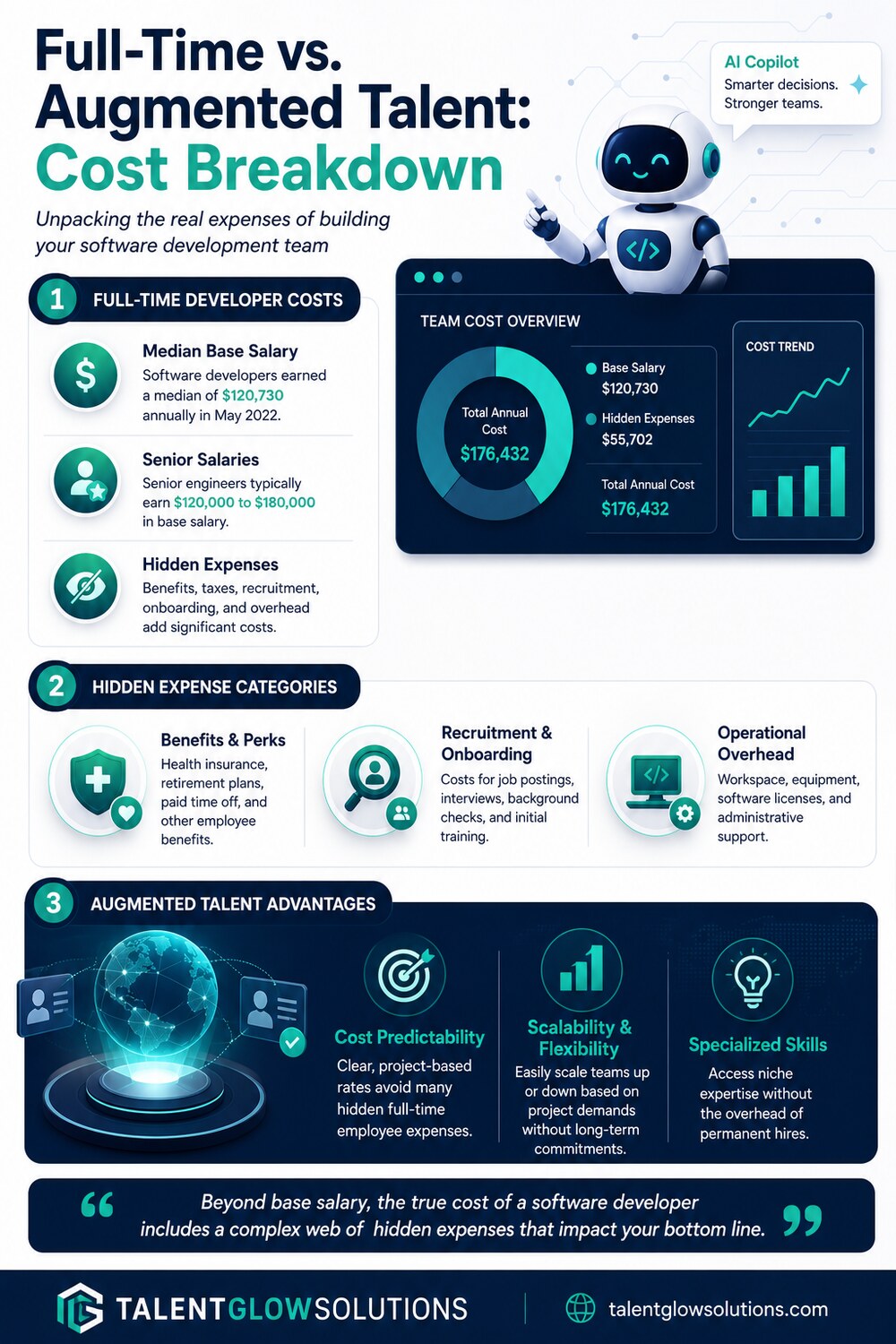
The starting point for any hiring budget is the developer's salary. In May 2022, the median annual salary for software developers in the United States was $120,730. This figure provides a baseline, but actual salaries can vary significantly based on experience, location, and specific skill sets.
For more experienced roles, such as senior software engineers, base salaries are considerably higher. Senior engineers typically earn between $120,000 and $180,000 in base salary. These figures highlight the substantial direct cost associated with securing top-tier development talent.
The Hidden Costs Beyond Salary
Beyond the base salary, a multitude of hidden expenses contribute to the overall cost of hiring a software developer. These costs can easily add 25-50% or more to the employee's annual compensation. Ignoring these factors can lead to an inaccurate assessment of your budget.
Consider these categories when calculating the total loaded cost:
- Benefits: Health insurance, dental, vision, life insurance, disability, and retirement plans (e.g., 401k matching).
- Payroll Taxes: Employer contributions to Social Security, Medicare (FICA), unemployment insurance (FUTA, SUTA), and workers' compensation.
- Recruitment Costs: Expenses associated with job postings, applicant tracking systems, recruiter fees, background checks, and interview processes.
- Onboarding & Training: Time and resources spent on initial training, setting up workstations, and integrating the new hire into the team.
- Operational Overhead: Office space, utilities, hardware (laptops, monitors), software licenses, professional development, and administrative support.
Recruitment and Onboarding Expenses
The process of finding and integrating a new developer is resource-intensive. Recruitment costs include everything from advertising job openings on various platforms to paying agency fees, which can sometimes be a significant percentage of the first year's salary. The time spent by internal hiring managers and HR personnel also represents a substantial cost.
Once hired, onboarding expenses become relevant. This involves setting up the developer's workspace, providing necessary equipment and software, and dedicating time for initial training and mentorship. Proper onboarding is critical for productivity but comes with its own price tag.
Operational Overhead and Productivity
Every employee requires a supportive work environment, and software developers are no exception. Operational overhead includes the cost of providing a physical workspace, if applicable, or managing remote infrastructure. This also encompasses the recurring costs of software licenses, development tools, and access to necessary platforms.
Furthermore, consider the time to productivity. A new developer will not be fully productive from day one. There's a learning curve as they get familiar with your codebase, systems, and team dynamics. This initial period of lower productivity is an indirect, but real, cost to the business.
Full-Time Employee vs. Augmented Talent: A Comparison
Understanding the comprehensive costs helps in comparing different talent acquisition models. While a full-time employee offers deep integration and long-term commitment, augmented talent provides flexibility and cost predictability.
| Feature | Full-Time Employee | Augmented Talent |
|---|---|---|
| Cost Structure | Base salary + extensive hidden costs | Project-based or hourly rates, fewer hidden costs |
| Commitment | Long-term, permanent | Short-term, project-specific, scalable |
| Benefits | Employer-provided (health, retirement, PTO) | Typically not employer-provided |
| Recruitment Burden | High internal effort, potential agency fees | Handled by provider, less internal burden |
| Scalability | Difficult to scale up/down quickly | Easy to scale based on project needs |
| Specialized Skills | Limited to in-house expertise, potential training | Access to diverse, specialized expertise on-demand |
The Strategic Advantage of Augmented Talent
For many businesses, especially those with fluctuating project demands or specific short-term skill gaps, augmented talent can be a highly strategic choice. This model allows companies to access specialized software development expertise without incurring the full loaded cost of a permanent employee.
Augmented teams, or individual contractors, often come with a clear, predictable cost structure. You pay for the work done, and the provider typically handles benefits, taxes, and overhead. This approach offers significant cost predictability and flexibility, allowing businesses to scale their development capacity up or down as needed, optimizing their budget and resources.
How TalentGlowSolutions Supports Your Hiring Needs
Firms that provide mentor-led, project-based, and placement-focused training, like TalentGlowSolutions, can be a valuable source for highly skilled individuals. Our programs focus on equipping future developers with practical, relevant skills through real-world projects, preparing them for immediate contributions to your team. By engaging with talent from such programs, businesses can access individuals who are not only technically proficient but also understand the demands of a professional development environment, potentially reducing your onboarding time and increasing efficiency.
Making the Right Decision for Your Business
Choosing between a full-time hire and augmented talent depends on your specific business needs, project scope, and long-term strategy. If you require deep institutional knowledge, continuous presence, and can absorb the full loaded cost, a full-time employee might be the best fit. However, if you need flexibility, specialized skills for a defined period, or want to manage costs more predictably, talent augmentation offers a compelling alternative.
Carefully analyze your budget, project pipeline, and the long-term strategic goals of your development initiatives. Understanding the true cost of hiring a software developer, beyond just their salary, empowers you to make a financially sound and strategically beneficial decision for your organization.
Sources
Frequently asked questions
What is the median salary for a software developer?
The median annual salary for software developers in the United States was $120,730 in May 2022, according to the U.S. Bureau of Labor Statistics.
What are the hidden costs of hiring a full-time software developer?
Hidden costs include benefits (health, retirement), payroll taxes, recruitment fees, onboarding expenses, equipment, software licenses, and operational overhead. These can add 25-50% or more to the base salary.
How much do senior software engineers earn?
Senior software engineers typically earn a base salary ranging from $120,000 to $180,000 annually, depending on experience, location, and specific skills.
What is augmented talent?
Augmented talent refers to engaging external developers or teams on a project basis, often through contracts or service agreements, to supplement your existing workforce without the overhead of a full-time hire.
How does augmented talent help manage costs?
Augmented talent offers more predictable costs as you pay for specific services or hours, avoiding many of the hidden expenses associated with full-time employees like benefits, taxes, and long-term operational overhead.
Ready to launch your career?
Explore how TalentGlowSolutions's mentor-led, project-based training can support your team with highly skilled tech professionals.
Explore Programs Talk to us