Career Guide
Is SAP a Good Career Choice in 2026? Comparing SAP vs. Generalist Roles

Deciding on a career path in tech can feel overwhelming with so many options available. For those looking ahead to 2026, the question "is SAP a good career choice in 2026?" is particularly relevant, especially when weighing it against more generalist software development roles. The landscape of enterprise software is shifting, driven by a critical deadline that's creating unprecedented demand for specialized SAP skills. This article explores the current state of SAP careers, comparing them to generalist paths and helping you determine if a focused SAP role aligns with your aspirations.
Why is there high demand for SAP professionals in 2026?
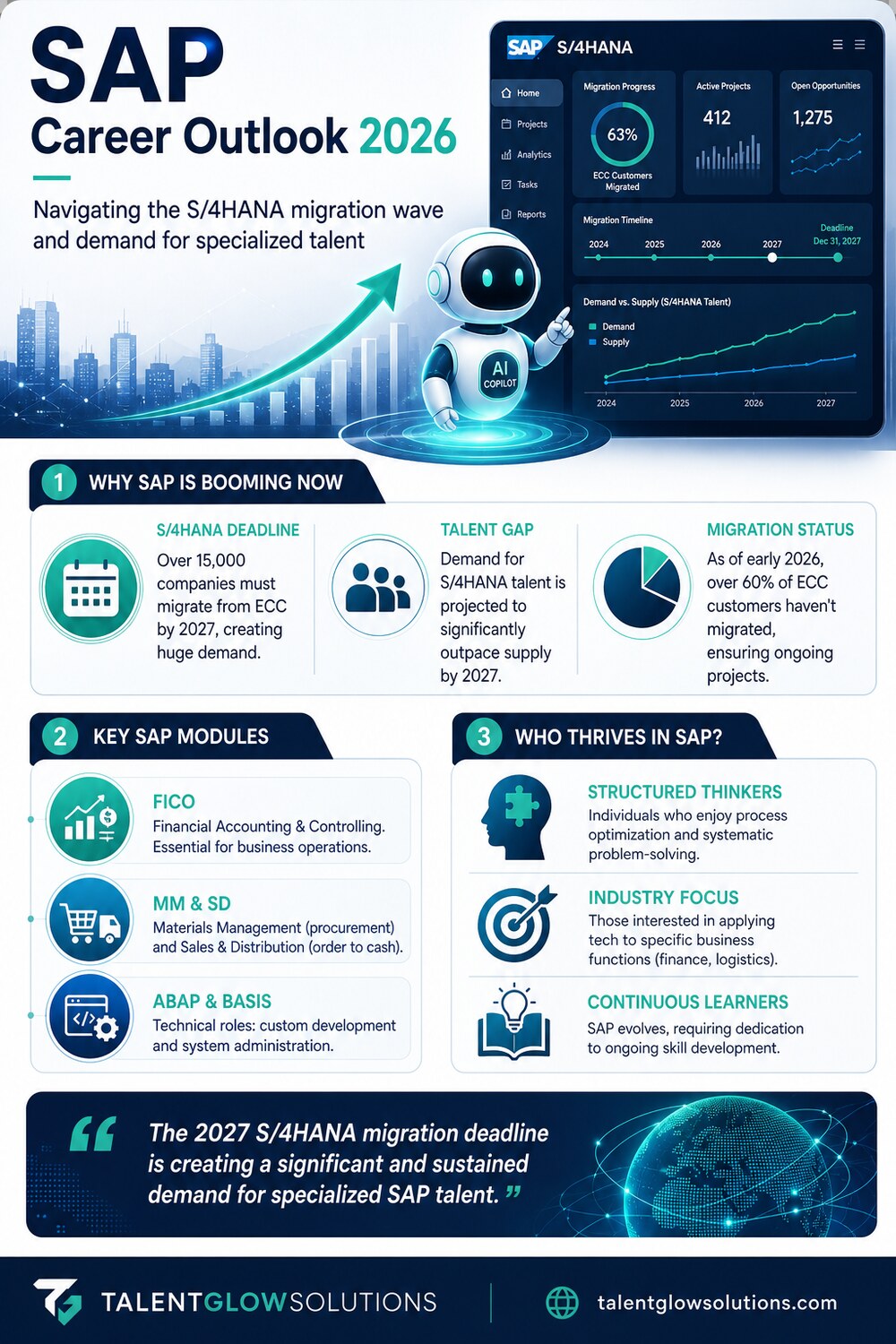
The demand for SAP professionals is experiencing a significant surge, primarily driven by the 2027 SAP ECC to S/4HANA migration deadline. Over 15,000 companies globally need to transition their core business systems from the older ECC platform to the modern S/4HANA by this date. This massive undertaking requires specialized expertise.
As of early 2026, a substantial portion of the market still needs to complete this migration. Specifically, over 60% of legacy SAP ECC customers had not yet migrated to S/4HANA, according to insights from thesiliconpartners.com. This indicates a robust and sustained need for implementation and consulting talent for the foreseeable future, making an SAP career highly relevant.
How does SAP demand compare to generalist software roles?
While generalist software roles offer broad applicability, SAP careers provide deep specialization within critical business functions. The S/4HANA migration creates a unique, concentrated demand that differs from the more diffused needs of general software development. This specialization often translates into unique opportunities.
- SAP Focus: Expertise in specific modules like FICO, MM, or SD means you're solving complex, industry-specific problems for large enterprises. This work is directly tied to a company's core operations.
- Generalist Focus: Generalist developers might work on a wider array of technologies and projects, from web applications to mobile development. Their skills are transferable across industries but may lack the depth required for niche enterprise systems.
What key skills are essential for SAP consultants in 2026?
To succeed as an SAP consultant in 2026, a strong understanding of S/4HANA functionalities is paramount. This includes not just technical know-how but also the ability to translate business requirements into SAP solutions. The role often involves a blend of technical and functional expertise.
Key skills extend beyond pure technical ability. Consultants need strong communication, problem-solving, and project management skills to navigate complex client engagements. Understanding business processes in areas like finance, logistics, or manufacturing is equally important.
Which SAP module is best for a beginner?
Choosing the right SAP module depends heavily on your background and career interests. SAP offers a range of modules, each catering to different business functions. For beginners, aligning a module with existing knowledge or a preferred domain can accelerate learning and career progression.
Consider your strengths: are you analytical and enjoy finance, or more interested in supply chain operations? TalentGlowSolutions offers project-based training in modules like FICO (Financial Accounting and Controlling), MM (Materials Management), SD (Sales and Distribution), PP (Production Planning), EWM (Extended Warehouse Management), BASIS (System Administration), and ABAP (Advanced Business Application Programming). Exploring these options can help you find your niche.
How do functional and technical SAP roles differ?
Functional SAP roles focus on configuring the software to meet specific business requirements, often acting as a bridge between business users and technical teams. They require a deep understanding of business processes and how SAP modules support them. An example is an FICO consultant setting up financial reporting.
Technical SAP roles, on the other hand, involve programming, system administration, and infrastructure management. This includes developing custom applications (ABAP) or managing the SAP system landscape (BASIS). These roles are crucial for system performance, security, and customization. Both paths are vital for successful SAP implementations.
| Feature | Functional SAP Consultant | Technical SAP Consultant |
|---|---|---|
| Primary Role | Configure SAP modules to business needs | Develop custom code, manage system infrastructure |
| Key Skills | Business process analysis, module configuration, user training | ABAP programming, system administration, database management |
| Focus Area | Finance, logistics, sales, production processes | System performance, security, integration, customizations |
| Interaction | Frequent with business users | Frequent with developers, system administrators |
| Example Task | Setting up new GL accounts in FICO | Developing a custom report using ABAP |
What is the career trajectory for an SAP professional?
The career trajectory for an SAP professional typically involves progressive specialization and leadership roles. Beginners often start as junior consultants or associate analysts, gaining hands-on experience in implementations and support. With experience, they can move into senior consultant roles, managing larger projects and teams.
Further advancement can lead to positions like Solution Architect, where you design complex SAP landscapes, or Project Manager, overseeing entire SAP transformation programs. The continuous evolution of SAP, especially with cloud solutions and new functionalities, means ongoing learning is key to sustained career growth.
What challenges might an SAP career present?
While rewarding, an SAP career also presents specific challenges that require dedication and adaptability. The complexity of enterprise systems means a steep learning curve. Keeping up with new releases, such as S/4HANA updates, demands continuous learning and skill refreshment.
- Complexity: SAP systems are vast and intricate, requiring significant time to master specific modules and their interdependencies.
- Continuous Learning: The SAP ecosystem evolves rapidly, necessitating ongoing training and certification to stay current with new technologies and best practices.
- Project Demands: Implementation projects can be demanding, often involving tight deadlines and extensive travel, particularly for consulting roles.
How can I start an SAP career in 2026?
Starting an SAP career in 2026 involves a combination of structured learning, practical experience, and strategic networking. Given the specialized nature of SAP, a focused training program can provide the foundational knowledge and hands-on skills employers seek. This is especially true with the urgent need for S/4HANA expertise.
- Gain Foundational Knowledge: Enroll in a comprehensive training program that covers core SAP concepts and specific modules like FICO, MM, or ABAP. Look for project-based training to simulate real-world scenarios.
- Pursue Certification: Prepare for and attempt SAP's official certification exams. While TalentGlowSolutions provides course completion certificates and prepares learners, the SAP certification is a separate exam set and priced by SAP.
- Build Practical Experience: Seek opportunities for internships or entry-level positions where you can apply your knowledge. Project-based learning, such as that offered by TalentGlowSolutions, helps build a portfolio of practical skills.
- Network Actively: Connect with SAP professionals on platforms like LinkedIn, attend industry webinars, and join SAP user groups. Networking can open doors to mentorship and job opportunities.
An SAP career in 2026 offers significant opportunities, particularly with the S/4HANA migration driving demand. It suits individuals who enjoy deep specialization, structured problem-solving, and continuous learning within the enterprise software domain.
Sources
Frequently asked questions
What is the 2027 SAP ECC to S/4HANA migration deadline?
The 2027 deadline marks the end of mainstream maintenance for SAP's legacy ECC system, compelling over 15,000 companies to migrate to the newer S/4HANA platform. This transition is a major driver of current SAP talent demand.
Is SAP a good career choice for someone without a technical background?
Yes, an SAP career can be suitable for individuals without a purely technical background, especially in functional consulting roles. These roles often require strong business process understanding and problem-solving skills, which can come from various professional experiences. Technical roles like ABAP or BASIS typically require more technical aptitude.
What are the most in-demand SAP modules for 2026?
Given the S/4HANA migration, modules directly impacting core business processes are highly in demand. This includes functional modules like FICO (Finance & Controlling), MM (Materials Management), and SD (Sales & Distribution), as well as technical skills in ABAP and BASIS for customization and system management.
How long does it take to become proficient in an SAP module?
Becoming proficient in an SAP module typically takes several months of dedicated study and practical application. Initial training programs can provide a strong foundation in 3-6 months, but true expertise develops over years of project experience and continuous learning within the dynamic SAP ecosystem.
Does TalentGlowSolutions offer SAP certification?
TalentGlowSolutions provides project-based, mentor-led training that culminates in a course completion certificate. We also offer support and mentorship to guide you in preparing for and attempting SAP's official certification exams, which are separate and administered by SAP itself.
Ready to launch your career?
Ready to specialize in high-demand SAP skills? TalentGlowSolutions provides mentor-led, project-based training with 100% placement assistance (we do not guarantee a job) to help you launch your SAP career.
Explore Programs Talk to us