Hiring Strategy
IT Staff Augmentation vs. Hiring Full-Time: Strategic Choices for Growth

Building a robust IT team is crucial for business growth, but the path to achieving it isn't always straightforward. Companies often face a pivotal decision: whether to opt for IT staff augmentation or commit to hiring full-time employees. Each strategy presents distinct advantages and disadvantages, impacting everything from budget and project timelines to team dynamics and long-term strategic goals. Understanding these differences is key to making an informed choice that aligns with your business objectives.
Understanding IT Staff Augmentation
IT staff augmentation involves integrating external specialists into your existing team for a specific period or project. These professionals work alongside your in-house staff, filling skill gaps, boosting capacity, or addressing urgent project needs without the overhead of permanent employment. This model is particularly effective for projects requiring niche expertise that isn't readily available internally or for handling peak workloads.
- Flexibility: Easily scale your team up or down based on project demands.
- Specialized Skills: Gain immediate access to highly specialized or emerging tech skills.
- Cost Efficiency: Avoids many costs associated with permanent hires.
The Real Costs of a Full-Time Employee
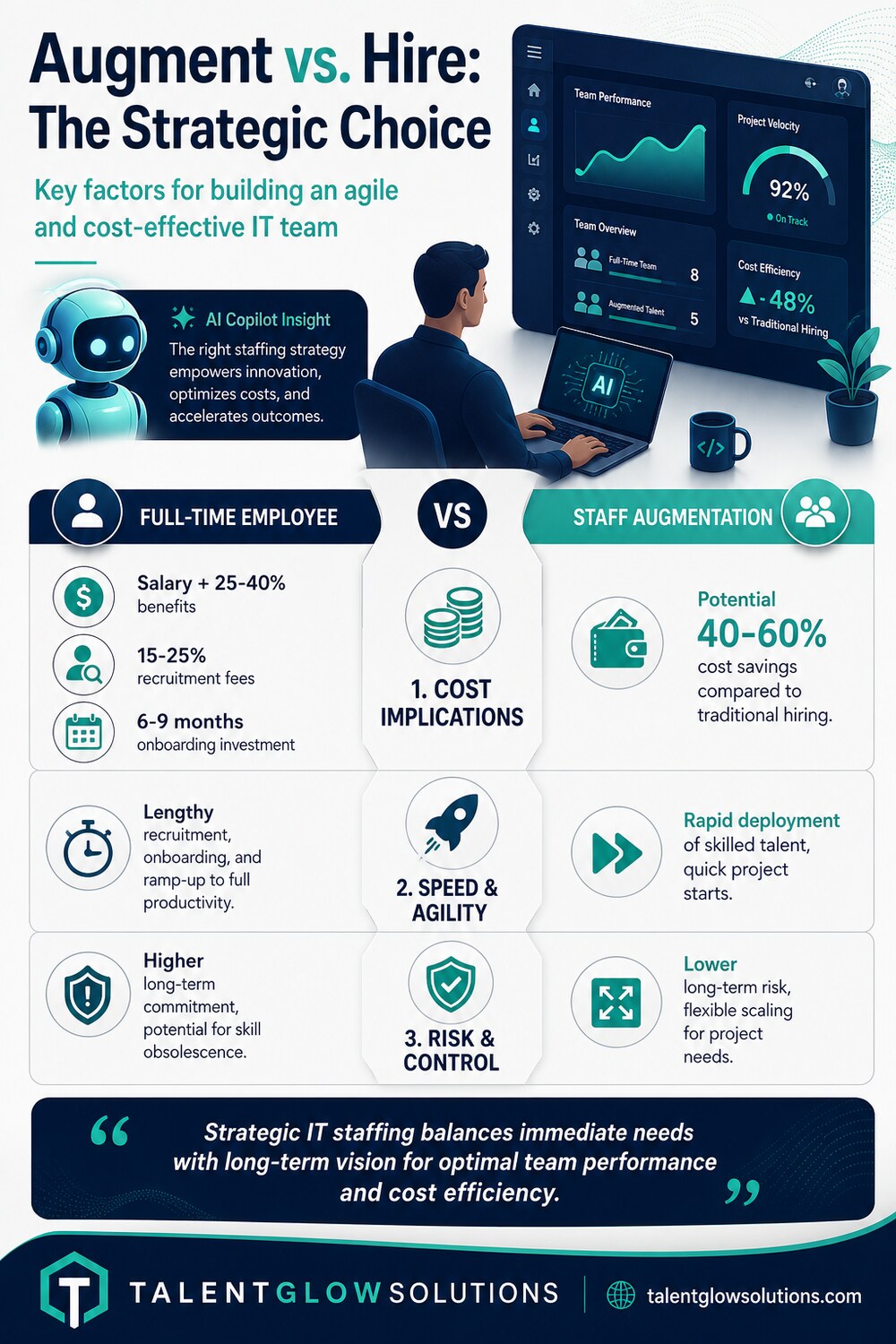
Hiring a full-time employee goes far beyond their base salary. Companies must account for a significant range of additional expenses. These include benefits, which can add an extra 25-40% to the base salary. Furthermore, the recruitment process itself isn't cheap, with fees often ranging from 15-25% of the annual salary. Beyond these direct financial outlays, there's a substantial time investment for onboarding and training, typically requiring 6-9 months before a new hire reaches full productivity.
- Base Salary: The primary compensation for the employee.
- Benefits Package: Health insurance, retirement plans, paid time off, and other perks.
- Recruitment & Onboarding: Costs associated with finding, interviewing, and integrating new staff.
- Training & Development: Ongoing investment to keep skills current and ensure productivity.
When Staff Augmentation Makes Sense
Staff augmentation is an excellent strategy for specific scenarios where speed, flexibility, and specialized skills are paramount. If your company has a short-term project, needs to quickly ramp up for a product launch, or requires expertise in a technology not central to your core business, augmentation can be highly beneficial. It allows you to tap into a global talent pool, bypassing the lengthy recruitment cycles of traditional hiring.
According to vettedoutsource.com, staff augmentation can deliver 40-60% cost savings compared to traditional hiring. This significant reduction in expenditure stems from avoiding recruitment fees, benefits packages, and the long-term commitment of a permanent employee. The ability to quickly integrate skilled professionals also means projects can start faster, reducing time-to-market.
Advantages of Hiring Full-Time Staff
While augmentation offers clear benefits, hiring full-time staff provides distinct advantages, particularly for long-term strategic roles and fostering company culture. A permanent employee becomes an integral part of your organization, contributing to its institutional knowledge and long-term vision. They are more likely to be deeply invested in the company's success and cultural values.
- Cultural Fit: Full-time employees integrate deeply into your company culture.
- Institutional Knowledge: They build and retain valuable long-term knowledge.
- Commitment: Higher loyalty and dedication to the company's mission.
- Direct Control: Greater managerial oversight and alignment with company goals.
Comparing Augmentation and Full-Time Hiring
| Feature | IT Staff Augmentation | Full-Time Hiring |
|---|---|---|
| Cost | Potential 40-60% savings; project-based | Base salary + 25-40% benefits, 15-25% recruitment fees |
| Speed | Rapid deployment of talent | Lengthy recruitment (months) |
| Flexibility | Highly flexible; scale up/down easily | Less flexible; long-term commitment |
| Skill Access | Immediate access to niche/specialized skills | Develops in-house skills over time |
| Control | Project-focused, less operational oversight | Full managerial control, deep integration |
| Risk | Lower long-term commitment risk | Higher long-term commitment, potential for skill gaps |
Making the Right Decision for Your Team
Choosing between IT staff augmentation vs. hiring full-time requires a careful assessment of your specific needs. Consider the duration of the project, the specificity of required skills, your budget constraints, and the desired level of internal control. For ongoing, core business functions that require deep institutional knowledge and cultural alignment, full-time hires are often the best fit. However, for short-term projects, sudden capacity needs, or highly specialized tasks, staff augmentation can be a more agile and cost-effective solution.
Many companies adopt a hybrid approach, maintaining a strong core of full-time employees while leveraging staff augmentation to address fluctuating demands and specific project requirements. This strategy allows businesses to maintain stability while remaining agile and responsive to market changes. By understanding the nuances of both options, you can build a resilient and high-performing IT team.
How TalentGlowSolutions Supports Your Staffing Needs
At TalentGlowSolutions, we understand the complexities of building and scaling IT teams. While we train individuals for full-time roles, our model also supports the talent pool that feeds into successful staff augmentation strategies. Our mentor-led, project-based training programs in areas like Full-stack, Data & AI, Cloud/DevOps, Cyber, SAP, and ServiceNow equip professionals with the practical, job-ready skills companies need. By focusing on real-world projects, we help develop individuals who can seamlessly integrate into your team, whether as permanent hires or augmented staff, contributing effectively from day one.
Our focus on placement-focused training ensures that individuals are not just learning theory but are also gaining the practical experience and soft skills necessary to thrive in diverse IT environments. This commitment to practical, relevant skills means that whether you're hiring for a permanent position or seeking augmented talent, you'll find professionals capable of making an immediate impact.
Strategic Planning for Future Growth
Ultimately, the decision of IT staff augmentation vs. hiring full-time should be part of a broader strategic workforce plan. Regularly assess your current and future skill requirements, project pipeline, and budget cycles. This proactive approach ensures that your staffing strategy remains dynamic and aligned with your business goals. Companies that effectively balance both augmentation and full-time hiring are better positioned for sustainable growth and innovation in a competitive market.
Remember, no single approach is universally superior. The optimal strategy is one that is tailored to your unique organizational context and evolving demands. Continuously evaluate your team's composition and performance to adapt your staffing strategy as needed.
Sources
Frequently asked questions
What is the main difference between IT staff augmentation and hiring full-time?
IT staff augmentation involves bringing in external specialists for specific projects or periods, while hiring full-time means onboarding a permanent employee who becomes an integral part of your organization with long-term commitment.
What are the hidden costs of hiring a full-time employee?
Beyond base salary, full-time employees incur costs like 25-40% for benefits, 15-25% of annual salary for recruitment fees, and a 6-9 month investment for onboarding and training until full productivity is reached.
Can staff augmentation save my company money?
Yes, staff augmentation can deliver significant cost savings, potentially 40-60% compared to traditional full-time hiring, primarily by avoiding benefits, recruitment fees, and long-term overhead.
When should I choose staff augmentation over a full-time hire?
Choose staff augmentation for short-term projects, when you need rapid access to specialized skills not available internally, or to quickly scale your team up or down based on fluctuating project demands.
What are the benefits of a full-time employee that augmentation can't provide?
Full-time employees offer deeper cultural integration, contribute to institutional knowledge, provide greater long-term commitment, and allow for more direct managerial control and alignment with core company values.
Ready to launch your career?
Explore how TalentGlowSolutions's mentor-led training can support your team building, whether you're looking for permanent hires or skilled augmented staff.
Explore Programs Talk to us