Career Roadmap
SAP Career Roadmap: A 90-Day Plan for Mechanical & Civil Engineering Graduates

Many mechanical and civil engineering graduates wonder how their skills translate into the tech world. The good news is that your analytical mindset, problem-solving abilities, and understanding of complex systems are highly valuable in the SAP ecosystem. SAP, a global leader in enterprise resource planning software, offers numerous functional modules that align perfectly with non-IT engineering disciplines.
This article outlines a clear SAP career roadmap for mechanical and civil engineering graduates, detailing how your background maps to specific SAP modules and providing a realistic 90-day learning plan to prepare you for your first interview.
Which SAP modules fit mechanical engineering graduates?
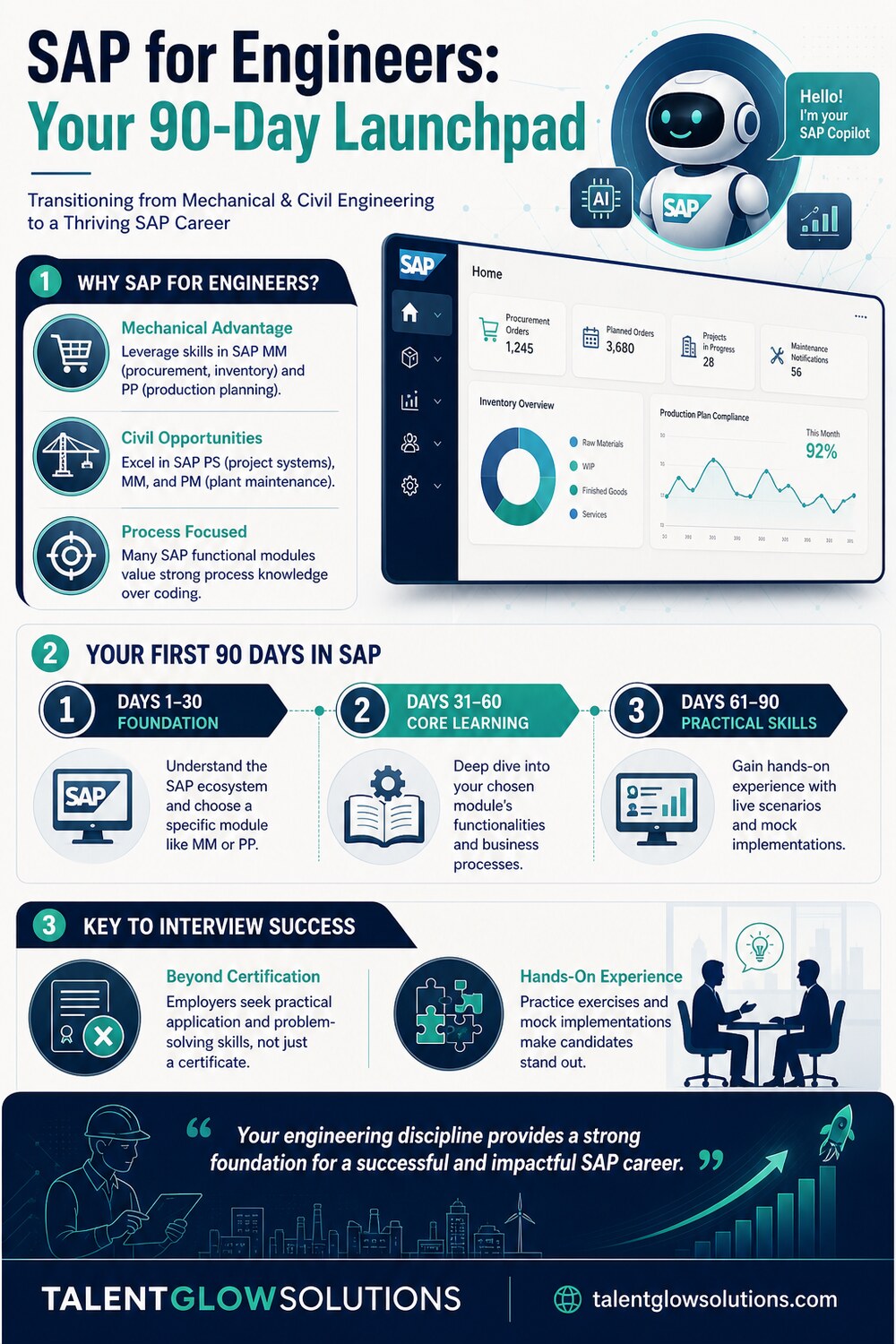
Mechanical engineers are well-suited for several SAP modules, particularly those focused on manufacturing and supply chain processes. Your understanding of production cycles, material flow, and machinery makes you an ideal candidate for these roles. These modules are often business-process oriented, meaning strong process knowledge is highly valued over coding skills.
Specifically, SAP MM (Materials Management) is a core functional module in SAP S/4HANA that manages purchasing, goods receiving, material storage, and inventory (blog.sap-press.com, techtarget.com, bilginc.com). Mechanical engineers can leverage SAP MM to optimize material procurement, manage inventory, and reduce supply costs (entri.app). Another key module is SAP PP (Production Planning), which supports discrete manufacturing processes, relevant for producing individual units or batches (sastrageek.com). Your expertise in manufacturing processes directly applies here.
How can civil engineers use SAP in their careers?
Civil engineers also have a strong pathway into SAP, especially in areas related to project management, procurement, and asset maintenance. Your experience in large-scale projects and infrastructure development provides a practical foundation for applying SAP solutions. These modules help manage complex projects and ensure operational efficiency.
SAP PS (Project Systems) is particularly useful for civil engineers, enabling comprehensive project planning, execution, and monitoring (urbanpro.com). Additionally, SAP MM (Materials Management) is crucial for managing the procurement of materials and equipment for construction projects (urbanpro.com). SAP PM (Plant Maintenance) is another relevant module, focusing on asset management and maintenance in infrastructure industries (urbanpro.com).
What does a realistic 90-day SAP learning plan look like?
Embarking on an SAP learning journey requires a structured approach, especially when transitioning from a non-IT background. A realistic 90-day SAP learning plan suggests a phased approach, focusing on building foundational knowledge before diving deep into specific functionalities. This structured learning helps prevent overwhelm and ensures a solid understanding.
| Learning Phase | Focus Area | Key Activities | Outcome | Duration |
|---|---|---|---|---|
| Days 1-30 | SAP Ecosystem & Module Selection | Understand core SAP concepts, navigate the interface, research modules | Clear understanding of SAP's role and chosen module (e.g., MM, PP) | 1 month |
| Days 31-60 | Core Module Deep Dive | Study module functionalities, business processes, configuration basics | In-depth knowledge of chosen module's operations and capabilities | 1 month |
| Days 61-90 | Practical Application & Interview Prep | Hands-on exercises, mock implementations, resume building, interview practice | Ability to discuss practical SAP applications and problem-solving | 1 month |
What should you focus on in the first 30 days of SAP learning?
The initial phase of your SAP journey, the first 30 days, should be dedicated to broad exploration and strategic decision-making. This period is about establishing a strong foundation and choosing the right direction for your specialization. Trying to learn too much too quickly is a common mistake; instead, pick one area and go deep (community.sap.com).
During this time, focus on understanding the overall SAP ecosystem and how different modules interact. Explore the core functionalities of SAP S/4HANA and identify which specific module aligns best with your mechanical or civil engineering background and career aspirations (youtube.com). For instance, mechanical engineers might lean towards MM or PP, while civil engineers might explore PS, MM, or PM.
How long does it take to prepare for an SAP certification?
Preparing for an SAP associate certification exam is a significant commitment that typically spans several weeks. While the actual study hours can vary, most prepared candidates dedicate between six to twelve weeks for preparation (erpprep.com). This timeframe allows for thorough understanding and practice.
SAP's associate learning journeys for certification generally require approximately 44 to 78+ recommended hours of study (erpprep.com). The upcoming 2026 performance-based formats will likely add a layer of necessary practice time, emphasizing hands-on application. The SAP Learning Hub offers an all-in-one subscription for e-learning, hands-on practice, and includes up to four SAP certification exam attempts per year (erpprep.com).
Why is practical experience more important than just certification?
While SAP certification demonstrates foundational knowledge, employers prioritize candidates who can show practical application and problem-solving skills. Focusing solely on certification is a critical pitfall for new SAP learners (community.sap.com). Companies want to see how you can apply SAP to solve real business problems, not just that you passed an exam.
Hands-on experience gained through live scenarios, mock implementations, and practice exercises is essential for making candidates stand out in SAP job interviews (community.sap.com). This practical exposure helps you understand the business context of SAP functionalities and articulate how you would use them in real-world situations. Training programs that offer mentor-led, project-based learning can provide this crucial practical experience.
How can TalentGlowSolutions support your SAP career transition?
TalentGlowSolutions offers specialized training tracks designed to help mechanical and civil engineering graduates transition into successful SAP careers. Our mentor-led, project-based, and placement-focused training for modules like FICO, MM, SD, PP, EWM, BASIS, and ABAP ensures you gain the practical skills employers demand. We provide 100% placement assistance, though we do not guarantee a job.
Our programs are structured to guide you through the SAP ecosystem, focusing on deep module expertise and hands-on application. We help you build a portfolio of practical projects, preparing you thoroughly for SAP certification exams and the interview process. This holistic approach ensures you are not just certified, but truly capable and confident in your new SAP role.
Sources
Frequently asked questions
Do mechanical engineers need coding skills for SAP?
No, many SAP functional modules, like MM and PP, are business-process oriented rather than coding-heavy. Strong process knowledge and understanding of manufacturing or supply chain operations are far more valuable than coding skills for these roles.
Which SAP module is best for project management in civil engineering?
For civil engineers involved in project management, SAP PS (Project Systems) is highly recommended. It provides comprehensive tools for planning, executing, and monitoring large-scale projects, aligning well with the typical responsibilities of a civil engineer.
How much does SAP certification cost?
The cost of SAP certification exams is set by SAP and varies by region and specific exam. It's best to check the official SAP Certification website for the most current pricing information in your country. TalentGlowSolutions does not publish SAP exam fees.
Is SAP certification alone enough to get a job?
While SAP certification is beneficial, it's generally not enough on its own. Employers highly value practical experience, problem-solving skills, and the ability to apply SAP knowledge to real business scenarios. Hands-on projects and mock implementations are crucial for standing out.
Should I learn multiple SAP modules at once?
It is generally recommended to pick one SAP module, go deep, and become proficient in it before attempting to learn multiple modules. This approach allows you to build specialized expertise and avoid common pitfalls of trying to cover too much too quickly.
Ready to launch your career?
Transition your engineering expertise into a high-demand SAP career with TalentGlowSolutions's expert guidance and project-based training.
Explore Programs Talk to us