Career Guide
Switching to SAP: A Realistic Path for Non-IT Professionals

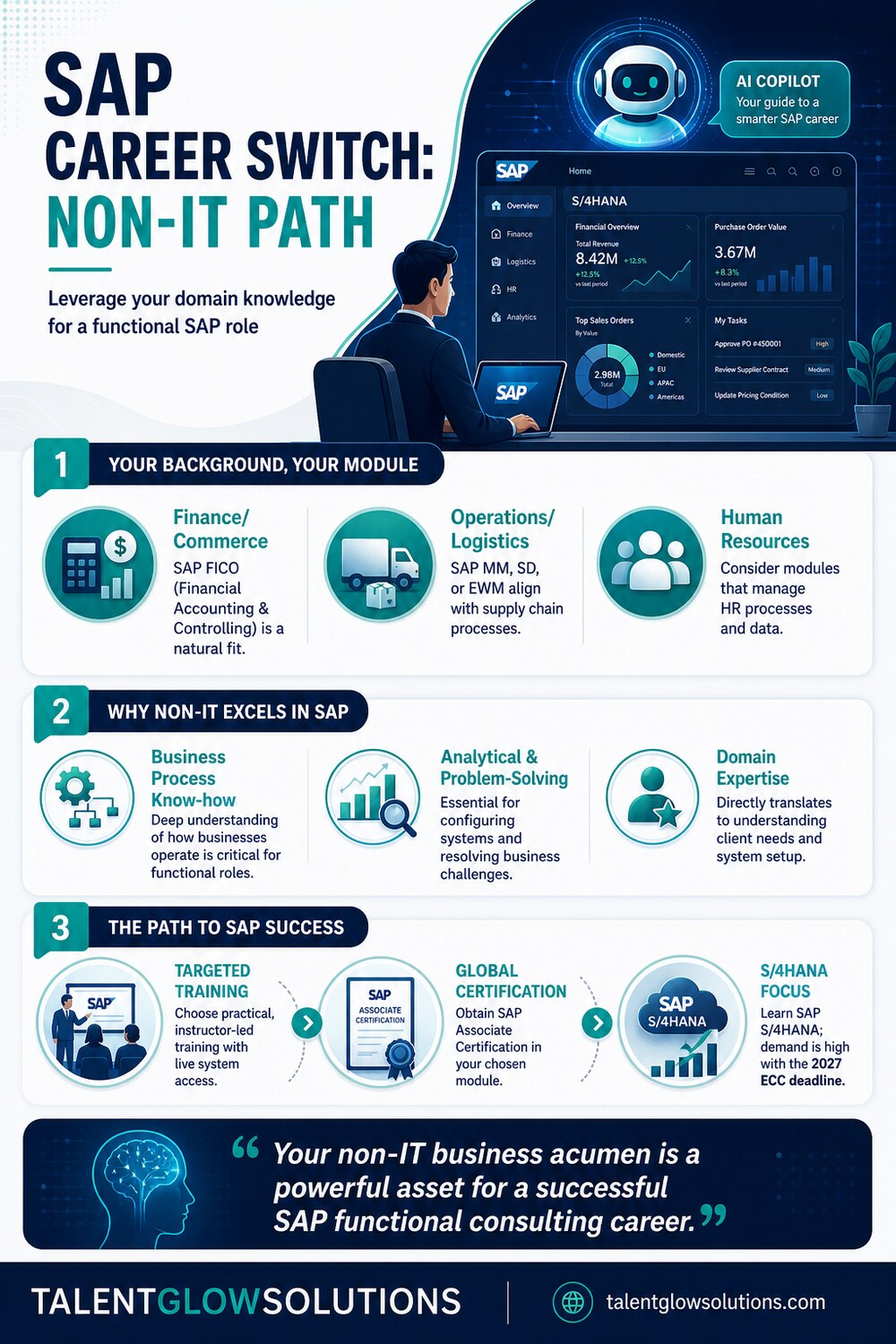
Many professionals from non-IT backgrounds wonder if a career in SAP is within reach. The answer is a resounding yes. Your existing business knowledge, whether from finance, operations, or other non-technical fields, provides a strong foundation for a successful transition into SAP, particularly in functional consulting roles. These roles focus on how businesses use SAP, not on writing code.
Can a Non-IT Professional Become an SAP Consultant?
Yes, non-IT professionals can absolutely build successful careers in SAP, primarily in functional roles. These positions focus on understanding and configuring business processes within the SAP system. Your expertise in areas like finance, logistics, or human resources is a significant advantage, as functional consultants act as a bridge between business needs and SAP solutions, configuring system settings and designing business processes rather than writing ABAP code (luxten.in).
This means you're not expected to be a programmer. Instead, you'll leverage your understanding of how a business operates to ensure SAP systems support those operations effectively. It's about problem-solving and analytical thinking applied to enterprise resource planning.
Which SAP Module Fits a Commerce or Finance Background?
For individuals with a background in finance, commerce, or accounting, SAP FICO (Financial Accounting and Controlling) is the most suitable module. This module directly focuses on core financial processes. It covers critical areas like financial accounting, cost controlling, and comprehensive reporting (cloudbook.co.in).
Transitioning to SAP FICO allows you to apply your existing knowledge of ledgers, balance sheets, and profit-and-loss statements directly. You'll learn how to configure the SAP system to manage these financial aspects, making it a natural career progression.
What SAP Modules are Best for Operations and Logistics Professionals?
Professionals in operations, logistics, or supply chain management have several highly relevant SAP modules. SAP MM (Materials Management), SAP SD (Sales and Distribution), and SAP EWM (Extended Warehouse Management) are excellent choices. These modules manage the flow of goods, sales processes, and warehouse operations, respectively (pathlock.com).
Your experience with inventory, procurement, sales cycles, or warehouse efficiency directly translates. For example, in SAP MM, you'd configure systems for purchasing and inventory, while in SAP SD, you'd focus on order-to-cash processes. SAP EWM is ideal for those deeply involved in complex warehouse logistics.
What Skills Transfer from a Non-IT Career to SAP?
Several key skills from non-IT backgrounds are highly transferable and valuable in SAP. These include strong business process understanding, deep domain knowledge, analytical thinking, and robust problem-solving abilities. Functional consultants rely heavily on these skills to bridge the gap between business requirements and technical solutions (elearningsolutions.co.in).
| Non-IT Skill | SAP Functional Role Application |
|---|---|
| Business Process Understanding | Designing and configuring SAP workflows to match business operations. |
| Domain Knowledge (e.g., Finance) | Translating specific industry needs into SAP system settings. |
| Analytical Thinking | Debugging issues, optimizing system performance, and reporting. |
| Problem-Solving | Identifying root causes of system or process inefficiencies. |
| Communication | Liaising between technical teams and business stakeholders. |
This table illustrates how your existing capabilities are directly applicable to the demands of an SAP functional consultant role. Your ability to understand the 'why' behind a business process is paramount.
What is the Realistic Path to Becoming an SAP Consultant?
A realistic path involves several clear steps to ensure a successful career switch. First, choose an SAP module that directly aligns with your existing domain knowledge (mythinktree.com). This leverages your strengths from the start.
Next, undergo practical, instructor-led training that includes live system access. Self-study can be challenging due to system complexity (entri.app). Finally, obtaining global SAP Associate Certification in your chosen module is crucial for validating your skills. Focusing on SAP S/4HANA is also critical, as it is a major focus area for SAP (focuscloudgroup.org).
Here's a step-by-step breakdown:
- Assess Your Background: Identify your strongest domain knowledge (e.g., finance, supply chain, HR).
- Select an Aligned Module: Choose an SAP module (like FICO, MM, SD, EWM, PP, BASIS, ABAP) that complements your expertise.
- Enroll in Practical Training: Opt for training programs that offer hands-on experience with live SAP systems and expert mentorship.
- Master SAP S/4HANA: Dedicate effort to learning SAP S/4HANA functionalities, as it's the future of SAP.
- Achieve Global Certification: Prepare for and pass the official SAP Associate Certification exam in your chosen module.
- Gain Project Experience: Seek opportunities, even entry-level, to apply your knowledge in real-world SAP implementation or support projects.
Why is SAP S/4HANA Important for New Consultants?
SAP S/4HANA is a critical focus area for anyone entering the SAP ecosystem, especially for new consultants. With the 2027 deadline for SAP ECC support, there is a high and increasing demand for S/4HANA talent (focuscloudgroup.org). This means specializing in S/4HANA makes you highly marketable.
Learning S/4HANA positions you at the forefront of SAP technology. Companies are actively migrating to this modern ERP suite, creating numerous opportunities for consultants who understand its capabilities and how to implement it effectively. SAP's recent updates, including AI-driven automation and sustainability reporting, are also integrated into S/4HANA, offering a competitive edge for those who learn these new features.
What are Common Misconceptions About Switching to SAP?
One of the most common pitfalls for career switchers is the misconception that an IT background is mandatory for an SAP career (community.sap.com). This is simply not true for functional roles, where business acumen is often more valued. Another challenge is the difficulty of self-studying SAP due to the system's inherent complexity (entri.app).
Many aspiring consultants also underestimate the importance of soft skills. While technical knowledge is vital, functional consultants need strong communication and problem-solving abilities to interact with clients and translate business needs into system configurations. Low user adoption, often due to resistance to change, can also be a significant challenge in SAP implementations, even with well-configured systems (youtube.com).
What Can I Expect for Entry-Level SAP Consultant Salaries?
Entry-level SAP functional consultant salaries in India can vary, with certified freshers potentially earning from ₹4.5 LPA to ₹7 LPA (entri.app). Experienced consultants, particularly those specializing in niche modules, can earn significantly higher. Consultants with 4-6 years of experience in specialized areas might see earnings in the range of ₹15 LPA to ₹25+ LPA (entri.app).
Specializing in niche modules such as SAP IBP (Integrated Business Planning) or SAP EWM (Extended Warehouse Management) can lead to higher salary premiums due to the specialized demand (entri.app). Your earning potential grows with experience, specialization, and the ability to handle complex projects.
At TalentGlowSolutions, our mentor-led, project-based training prepares you for these in-demand SAP roles, providing 100% placement assistance, though we do not guarantee a job.
Sources
- sap learning path for non it students the simplest roadmap
- non it students learn sap
- sap courses for non it students 2026
- 5 common misconceptions of sap consulting
- zARbNa270ek
- sap career with non-it background
- sap modules list
- sap career path functional vs technical
- i want to become an s4hana consultant
Frequently asked questions
Do I need to know coding to become an SAP consultant?
No, you do not need to know coding to become an SAP functional consultant. Functional roles focus on configuring business processes within SAP, leveraging your business domain knowledge rather than requiring programming skills like ABAP.
How long does it take to become an SAP functional consultant?
The timeline to become an SAP functional consultant typically involves several months of dedicated training followed by certification preparation. The actual duration depends on the intensity of the program and your prior learning experience, but practical, instructor-led training often provides the quickest path to readiness.
Is SAP certification necessary for a career switch?
While practical experience is paramount, global SAP Associate Certification is highly recommended. It validates your knowledge and skills to potential employers, making you more competitive in the job market, especially for entry-level positions.
Which SAP module has the highest demand?
Demand for SAP S/4HANA skills is consistently high across various modules, driven by the ongoing migration from SAP ECC. Specialized modules like SAP FICO, SAP MM, and SAP EWM also maintain strong demand due to their critical roles in business operations.
Ready to launch your career?
Our mentor-led SAP training provides the practical skills and support needed to confidently transition your career.
Explore Programs Talk to us